

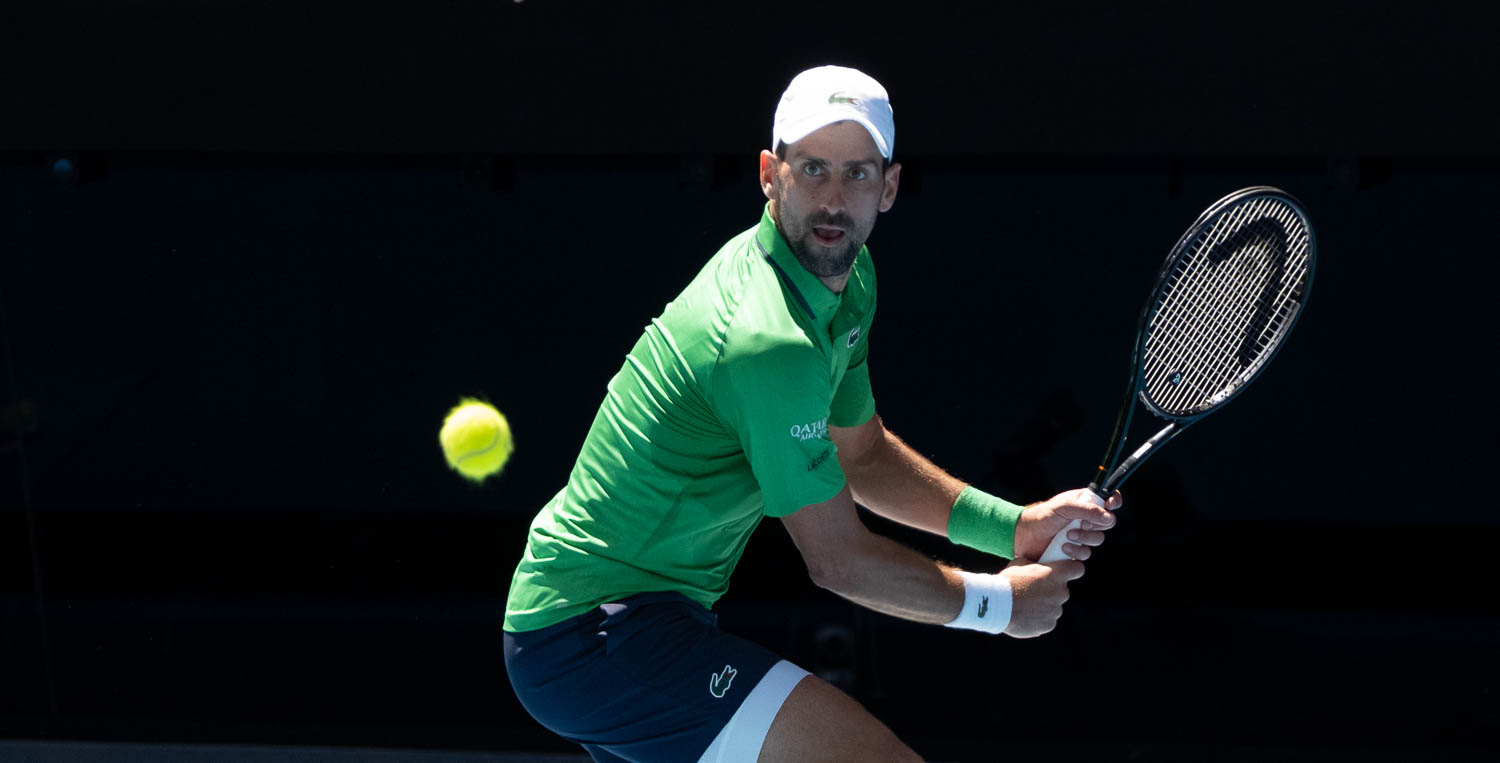
Novak Djokovic won the Australian Open ten times between 2008 and 2023 — the most Australian Open singles titles by any player in the Open Era. His ten titles, accumulated across fifteen years of competitive history at Rod Laver Arena, represent one of the most extreme concentrations of excellence at a single major championship in professional tennis.
This is the story of how a Serbian-born player who arrived at Melbourne Park as a talented contender turned the tournament into his defining achievement — and what his record means for the modern history of the sport.
The Ten Titles
Djokovic’s ten Australian Open titles came across a fifteen-year span between 2008 and 2023. The complete list:
- 2008 — defeated Jo-Wilfried Tsonga 4–6, 6–4, 6–3, 7–6(2)
- 2011 — defeated Andy Murray 6–4, 6–2, 6–3
- 2012 — defeated Rafael Nadal 5–7, 6–4, 6–2, 6–7(5), 7–5
- 2013 — defeated Andy Murray 6–7(2), 7–6(3), 6–3, 6–2
- 2015 — defeated Andy Murray 7–6(5), 6–7(4), 6–3, 6–0
- 2016 — defeated Andy Murray 6–1, 7–5, 7–6(3)
- 2019 — defeated Rafael Nadal 6–3, 6–2, 6–3
- 2020 — defeated Dominic Thiem 6–4, 4–6, 2–6, 6–3, 6–4
- 2021 — defeated Daniil Medvedev 7–5, 6–2, 6–2
- 2023 — defeated Stefanos Tsitsipas 6–3, 7–6(4), 7–6(5)
Each title was won at Rod Laver Arena, and each was achieved across seven matches in the fortnight. Each established its own narrative in the modern history of the Australian Open — but the cumulative weight of all ten is what transformed the tournament’s identity.
The Pre-Title Years — Before the Breakthrough
What is sometimes forgotten about Djokovic’s relationship with the Australian Open is how much competitive frustration preceded his breakthrough. In 2007 he reached three of the sport’s deepest stages — the French Open and Wimbledon semifinals, and the US Open final, where he lost in straight sets to Roger Federer — without converting his obvious talent into a Grand Slam title. That made his run to the 2008 Australian Open title, his first major, the moment that established him as a champion rather than a contender.
The 2008 Australian Open title was significant beyond the trophy itself. It made Djokovic the first Serbian player to win a Grand Slam singles title and interrupted the Federer–Nadal duopoly that had dominated men’s tennis since 2003. The match against Tsonga, ending in a fourth-set tiebreak, was the first of ten titles Djokovic would win at Melbourne Park.
Ten Titles From Eleven Finals
Djokovic appeared in eleven Australian Open finals across his career — the most of any man. He won his first ten, a perfect run that stood until Carlos Alcaraz beat him in the 2026 final. Those ten titles from eleven finals are the most successful finals record in Australian Open history, and among the most dominant any player has produced at a single major in the Open Era.
For context: Roger Federer made seven Australian Open finals, winning six and losing one (the 2009 final to Nadal). Rafael Nadal made five AO finals, winning two (2009 and 2022) and losing three. Stefan Edberg made six AO finals, winning two. Andy Murray famously made five AO finals — losing all five — in what remains the unhappiest finals record at the tournament.
What distinguishes Djokovic’s record is not simply how many finals he won, but the quality of opposition he beat to do it. His ten title wins came against six different opponents — Murray (four times), Nadal (twice), Tsonga, Thiem, Daniil Medvedev, and Stefanos Tsitsipas — a list that represents most of the highest-ranked players of the modern era.
The Murray Finals Series
Four of Djokovic’s ten Australian Open final wins came against Andy Murray — in 2011, 2013, 2015, and 2016. This is the most lopsided single-Slam finals series between any two players in Open Era Grand Slam history, and it produced one of the most distinctive competitive narratives of the 2010s — a story of recurring near-misses that ultimately defined Murray’s complicated relationship with the Australian Open.
Murray’s five Australian Open final appearances (he also lost the 2010 final to Federer) make him the most successful Australian Open finalist never to win the tournament. The combined narrative of his five losses — to Federer once and to Djokovic four times — turned Murray’s relationship with Melbourne Park into one of the most poignant individual storylines in modern tennis.
Murray himself addressed this narrative in subsequent interviews, acknowledging that the Australian Open had been the tournament where he came closest to multiple breakthroughs but where facing a peak-form Djokovic across the deciding match consistently proved insurmountable. His ability to push Djokovic into competitive finals — the four-set finals of 2011, 2013, and 2015, and the three close sets of 2016 — established Murray as the defining runner-up at Melbourne Park during the peak of Djokovic’s dominance.
The 2012 Final — Longest Grand Slam Final Ever
The 2012 men’s singles final between Djokovic and Rafael Nadal lasted five hours and fifty-three minutes — the longest Grand Slam final by playing time in tennis history. Djokovic won 5–7, 6–4, 6–2, 6–7(5), 7–5 in a match that remains, by widespread consensus, one of the greatest ever played in any tennis era.
The physical demands were extraordinary. Both players visibly struggled with cramps and exhaustion in the final games. The match had begun at 7:30pm Melbourne time and concluded at 1:37am the following morning. The trophy ceremony, conducted with both players visibly depleted, included the unusual decision to bring out chairs so both could sit during the speeches and presentation.
The 2012 final has been cited repeatedly since as the gold standard of competitive endurance and tactical depth in the modern men’s game — a match whose duration is unlikely to be surpassed given the introduction of final-set tiebreaks at all four Grand Slams since 2022. For Djokovic, the win established the physical durability that would define his career, and it was the first of his AO final wins over Nadal, a 2–0 Melbourne finals record over the Spaniard that he extended in 2019.
The 2019 Final — The Most Dominant AO Final
The 2019 Australian Open final was the opposite extreme from the 2012 epic. Djokovic defeated Nadal in straight sets — 6–3, 6–2, 6–3 — in two hours and four minutes, facing no break points across the entire match in what he and observers described as one of the most complete performances of his career. It was the most one-sided AO men’s final between two top-five competitors in the Open Era.
The 2019 final tied together Djokovic’s 2018 Wimbledon and US Open titles into a sequence of three consecutive Grand Slam championships, establishing the second great multi-Slam run of his career. And the dismantling of Nadal — a player whose endurance and clay-court excellence had defined their rivalry for over a decade — underscored how completely Djokovic’s game translated to hard-court conditions.
The 2021 Drama and the 2022 Deportation
The 2021 Australian Open — Djokovic’s ninth title — was contested under unusual circumstances, with Tennis Australia operating strict pandemic quarantine protocols. Djokovic’s tournament was further complicated by an oblique abdominal injury sustained in his third-round match, one that visibly affected his movement. He continued through the draw, defeating Daniil Medvedev in straight sets in the final for his ninth AO title.
The 2022 Australian Open never saw Djokovic compete. His attempt to enter Australia in January 2022 became one of the most prominent international incidents in the sport’s history. Unvaccinated against the virus that had caused the pandemic, Djokovic had been granted a medical exemption by tournament organisers, but the Australian federal government cancelled his visa on arrival. After a legal challenge that initially restored it, a second cancellation was upheld by the Federal Court, and Djokovic was deported days before the tournament began. In his absence, Rafael Nadal won the 2022 title, securing a then-record 21st Grand Slam.
The 2023 Return — The Tenth Title
Djokovic returned in 2023, after Australia relaxed its vaccination requirements, and won his tenth title in one of the most distinctive performances of his career. He competed throughout with a torn hamstring, requiring visible strapping across multiple matches. His path included a fourth-round win over Alex de Minaur, a quarterfinal over Andrey Rublev, and a semifinal over Tommy Paul. The final against Stefanos Tsitsipas — 6–3, 7–6(4), 7–6(5) — completed the most physically compromised Grand Slam title of his career.
The tenth title carried significance beyond the trophy. It moved Djokovic level with Rafael Nadal at 22 Grand Slam titles overall at the time, and it produced the most extreme concentration of titles at a single Slam by any Open Era man.
The 33-Match Winning Streak
Between his fourth-round loss to Hyeon Chung in the 2018 Australian Open and his semifinal loss to Jannik Sinner in the 2024 Australian Open, Djokovic won thirty-three consecutive matches at Melbourne Park. The streak — spanning five tournaments and four titles — matched the previous Australian Open record set by Monica Seles in the early 1990s.
The streak ended in the 2024 semifinal, where Djokovic lost to Sinner 6–1, 6–2, 6–7(6), 6–3 — making Sinner the player who finally broke Djokovic’s dominance at the tournament. Sinner went on to win the 2024 title and defend it in 2025, establishing himself as the next-generation AO champion after the close of Djokovic’s defining period.
For a fuller treatment of the records Djokovic established at Melbourne Park, see Australian Open Records — Titles, Matches and Statistics.
The Statistical Profile
Djokovic’s Australian Open career, from his first appearance in 2005 through the 2026 tournament, produces a statistical profile with no equal at any single Grand Slam in the Open Era:
- Ten singles titles (Open Era record at a single Slam)
- 104 career match wins at the AO through 2026 — an Australian Open record, surpassing Roger Federer’s 102
- Ten titles from eleven finals (his only final loss came to Carlos Alcaraz in 2026)
- Title-match wins over six different opponents
- A 33-match winning streak (matching Monica Seles)
- Four titles via the three-peat pattern (2011–13 and 2019–21)
- Career match wins across all four Grand Slams of 400+ (Djokovic became the first player to reach 400 during the 2024 Australian Open)
The Melbourne Park-specific concentration of these achievements is what distinguishes Djokovic from other Open Era greats. Roger Federer won eight Wimbledon titles, but his Grand Slam dominance was spread more evenly across the majors. Rafael Nadal won fourteen Roland Garros titles — more than Djokovic’s ten — but his AO final record was 2–3. Djokovic’s combination of multi-Slam excellence across all four majors plus extreme single-Slam dominance at Melbourne Park is structurally different from what any other player has produced.
Why Rod Laver Arena Suited Djokovic’s Game
The qualities that made Djokovic the defining champion of the Australian Open’s modern era reflect a fit between his game and the Melbourne Park conditions that no other tournament matched as precisely.
His signature strengths — extraordinary court coverage, the best return of serve in the men’s game across his career, baseline patience combined with the ability to attack from defence, and the durability to compete at peak intensity across five sets in extreme heat — found their most complete expression on the AO’s medium-fast hard court. The GreenSet surface (and the Plexicushion before it) produced the bounce height and ball speed that rewarded his return game more completely than clay’s higher bounce or grass’s lower, faster skid.
The Melbourne summer heat amplified the importance of conditioning in ways the other majors did not consistently replicate, and Djokovic’s off-season training and year-round fitness produced a January-readiness few top players matched. The closed-roof night sessions at Rod Laver Arena — slightly faster and lower-bouncing — further favoured his aggressive return play, and many of his defining AO performances came under lights.
The Modern Era’s Defining Champion
What does it mean to be the defining champion of a Grand Slam’s modern era? It means the player whose performance most completely shaped the tournament’s identity across a historical period — whose game and results changed how the event is understood by players, fans, and the wider sporting culture.
For Wimbledon, that player is Roger Federer; for Roland Garros, Rafael Nadal; for the US Open, the role is shared across champions from Serena Williams to Pete Sampras. For the Australian Open, it is unambiguously Novak Djokovic. The ten titles, the ten-from-eleven finals record, the 33-match streak, and the multi-generational dominance from Tsonga in 2008 through Tsitsipas in 2023 combine to make him the player whose competitive performance most completely shaped what the modern Australian Open means.
The tournament’s future will produce its own narratives. Carlos Alcaraz won the 2026 title at age twenty-two, beating Djokovic in the final to complete his career Grand Slam, and Jannik Sinner’s back-to-back 2024 and 2025 titles established him as the immediate successor to Djokovic’s era. Djokovic’s own perfect finals record ended with that 2026 defeat. But for the period from 2008 to 2023, his relationship with Melbourne Park remains the single most extreme concentration of titles at a Grand Slam in the Open Era — and the tournament will continue to be understood, for years to come, through the lens of his ten titles.
Related reading
- Australian Open Records — Titles, Matches and Statistics
- Grand Slams Explained
- The History and Meaning of Rod Laver Arena at Melbourne Park
- The Australian Open Guide