

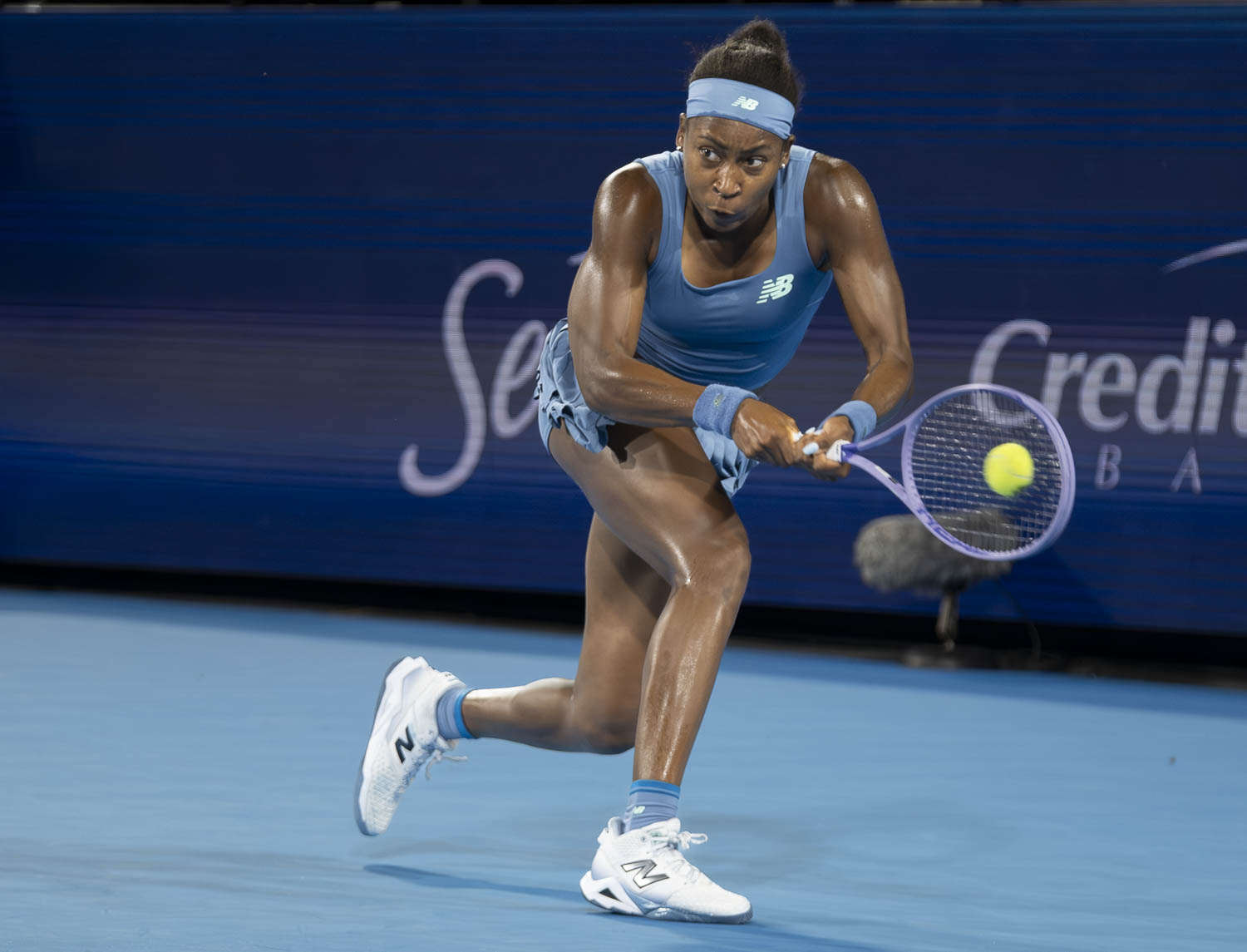
Coco Gauff spent ten months as the highest-ranked woman in tennis without a title, and asked in Cincinnati whether ending that run still mattered with the season three months from finished, she did not deflect. She said it did, and then described the problem in the plainest words available, calling it “just trying to get to that final step.” Six days later she took it.
The record underneath the drought never read like a player in decline. Gauff reached the final in Miami and lost it to Aryna Sabalenka. She reached the final in Rome and lost that one to Elina Svitolina. She went deep at Wimbledon and deep again in Toronto. Her previous trophy had come at Wuhan in October, and the ten months since produced a repeating shape: a strong week, a live chance, an exit somewhere short of Sunday. She was consistently excellent and almost never decisive, which is a harder thing to correct than a slump, because there is nothing obvious to repair.
Wimbledon was the clearest version of it. Gauff reached her first quarterfinal at the tournament, then a semifinal, and the fortnight was read at the time as a breakthrough on the surface that had given her the most trouble. It was. It also ended without a trophy, which is the sentence that followed nearly every good week she had this year. Toronto ran the same course. She landed in the heavier half of the draw, played her way through it, and went out before the final weekend.
None of that was failure by any ordinary standard, and Gauff was careful throughout not to describe it as one. Her framing in Cincinnati was about proximity rather than crisis — the sense of a player who believed the gap between where she was and where she wanted to be was small and closing. That turned out to be the accurate read. It was also the read that gets harder to sustain the longer the gap stays open, and a top-five player who goes a full season without lifting a trophy invites a different set of questions than one who is simply losing early.
Cincinnati was a fitting place for it to end. This is where Gauff won her first WTA 1000 title in 2023, beating Karolina Muchova in the final in what remains one of the defining weeks of her career. She returned seeded fourth, with a first-round bye, in a field that lost Jasmine Paolini and Muchova to injury before it started and Naomi Osaka to fatigue after the draw was made. Iga Swiatek was defending the title and went out in the semifinals to Jessica Pegula. Sabalenka, the top seed, was beaten in the fourth round by Sara Bejlek, whom Gauff then beat in the last four.
What she had not done in 2026 was finish. Two finals, both lost. Semifinals at Wimbledon and in Toronto. Quarterfinals scattered through the rest of it. The pattern was consistent enough that it had stopped looking like variance and started looking like something structural, though whether it was a matter of serving, of tactical decisions in tight sets, or simply of running into the two or three players converting better than she was had remained genuinely open.
The answer, when it came, was that there was less wrong than the record suggested. Gauff beat Pegula in the first all-American Cincinnati final in 56 years, took a 5-0 lead inside the opening set, and closed it out in 75 minutes for the 12th title of her career and her second in Ohio. The final step she had described as the difficult one turned out, on the day, not to require anything she had not already been doing all season.
The timing is what gives it weight. The US Open main draw begins Aug. 30, and Gauff arrives as a former champion at a tournament she won in 2023, on the surface and in the country where she has always drawn the loudest support. The rankings published the morning after the final kept her at No. 4 and cut the gap to Pegula in third to 561 points. A drought that had lasted since last October ended with seven days left before the year’s final major, which is either the best possible timing or the most demanding, depending on what she does with it.