

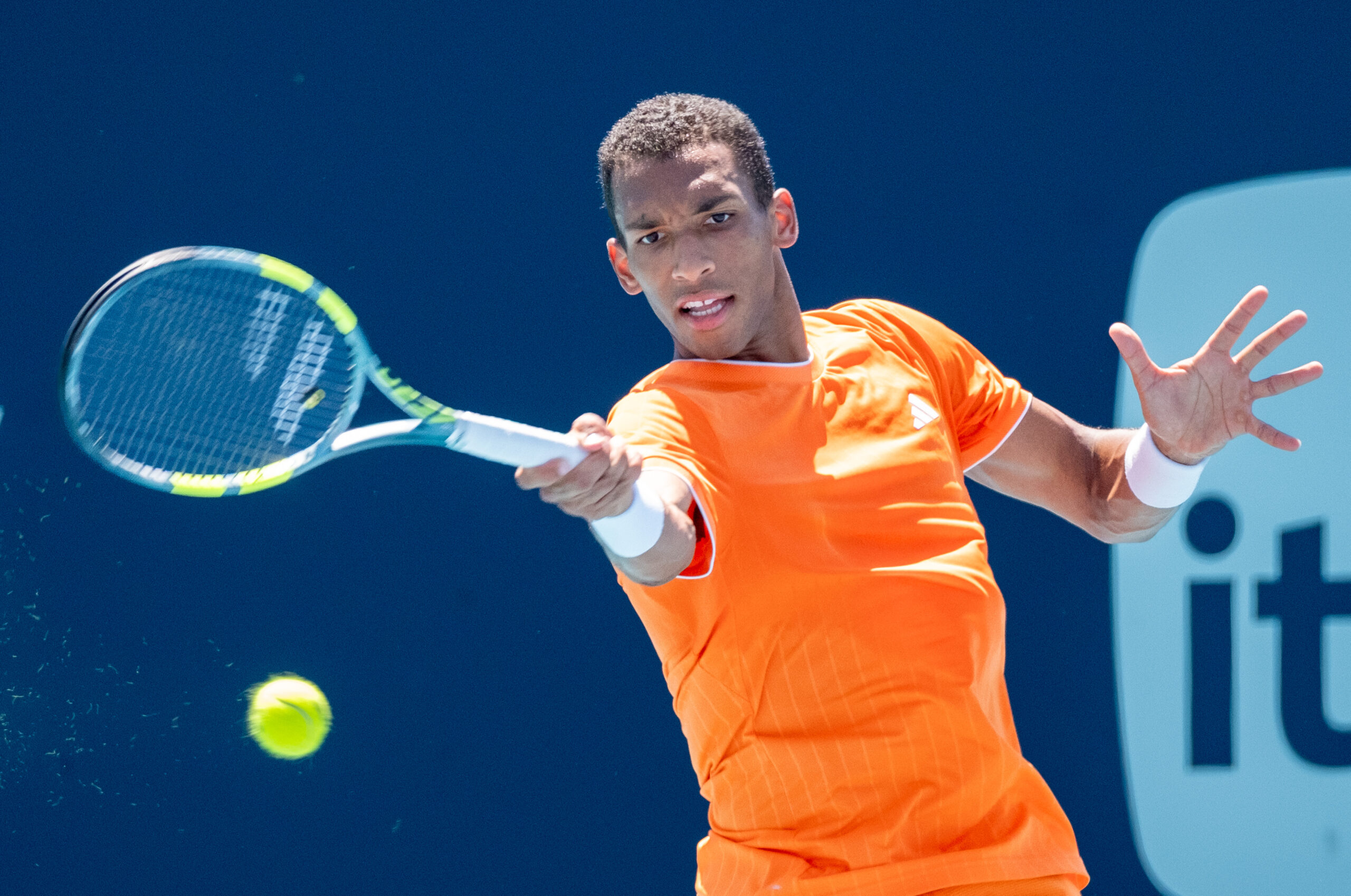
Updated Thursday, Aug. 6: Auger-Aliassime withdrew from Montreal on Wednesday with a back injury sustained in training, without having played a match. He said the pain began suddenly on Monday and that he could not serve when he tried to warm up on the day of his opening match. The coaching question set out below therefore goes untested at his home Masters, and the first real answer now comes in Cincinnati or New York. Full details are in our report on the withdrawal and the collapse at the top of the Montreal draw, and on the Canadian Open withdrawals tracker.
Felix Auger-Aliassime arrived at his hometown Masters 1000 ranked a career-high No. 4, seeded second, and without a full-time coach. The 25-year-old Montrealer told reporters at IGA Stadium on Thursday that he expects to name a successor to Frederic Fontang after the US Open, three weeks on from ending a partnership that began when he was 16. In the meantime he is working with his father, Sam Aliassime, who he said will not soften what needs saying.
Auger-Aliassime announced the split on July 10, three days after a five-set quarterfinal loss to Novak Djokovic at Wimbledon. The timing invited a simple reading, but the decision predated the grass. He had settled on it after losing to Flavio Cobolli in the Roland Garros quarterfinals, and Wimbledon was always going to be the last tournament of the arrangement.
“It was time to move on after 10 years, and for me to respect the curiosity I have into learning from different people that might look at my game from a different angle, and just to learn a bit more about the highest level and about the highest standards of tennis,” he said.
That curiosity is aimed at a specific gap. Auger-Aliassime has nine ATP titles, more than any Canadian man in the Open era, and he closed last season ranked fifth after reaching the semifinals at the ATP Finals. He has made the quarterfinals at all four majors and two Grand Slam semifinals. What he does not have is a Masters 1000 trophy or a major final. Runner-up finishes in Madrid in 2024 and Paris in 2025 are as close as he has come, and his best result at his home event remains a quarterfinal in 2022.
The circumstances this fortnight are unusually favorable. Jannik Sinner, Carlos Alcaraz and Djokovic are all absent from Montreal, leaving Alexander Zverev as the top seed and Auger-Aliassime as the highest-ranked player in his half of a 96-man draw. Alex de Minaur, Daniil Medvedev and defending champion Ben Shelton complete the top five.
Tournament director Valerie Tetreault framed the seeding as a marker of a decade of Canadian progress. The draw is made Friday at 11 a.m. ET, qualifying is Saturday, and main-draw play begins Sunday, with the top 32 seeds receiving first-round byes.
Fontang has neither stayed idle nor stayed quiet. He joined Jiri Lehecka’s team in late July, less than three weeks after the split, and gave his account of the ending to L’Equipe. In his telling the first conversation about the partnership’s future came at the Canadian Masters a year ago, when player and coach weighed either adding a voice for 2026 or closing the collaboration at the end of 2025 if the results did not arrive.
They arrived — a top-five finish — so the work continued. The Roland Garros defeat, he indicated, accelerated a decision already under consideration. Lehecka is the No. 9 seed in Montreal, which leaves open the possibility of a reunion neither man scheduled. Auger-Aliassime is not the only one recalibrating. Daniil Medvedev parted with Thomas Johansson after Wimbledon, and the men’s coaching market has rarely been busier heading into a hard-court swing.
The framing matters here, because it is being got wrong elsewhere. Auger-Aliassime is not adrift. He has his father in the box, a stated timeline, and no shortage of candidates likely to be interested in a top-five player entering his prime. What he is doing is contesting a Masters 1000 and, in all likelihood, a Grand Slam without the technical voice that shaped every significant result of his career.
New York is where the experiment gets its real verdict. He reached the semifinals at the US Open last year, his second at the tournament after 2021, and returns to Flushing Meadows with a substantial points defense and a ranking to protect. He is also entered in the revamped mixed doubles championship alongside Alexandra Eala, a first-time pairing that was, by her account, arranged largely by chance.
Whether the empty chair proves liberating or costly is the question of his summer. Montreal, with the three men who normally stand in his way all somewhere else, was meant to be where he started answering it.