

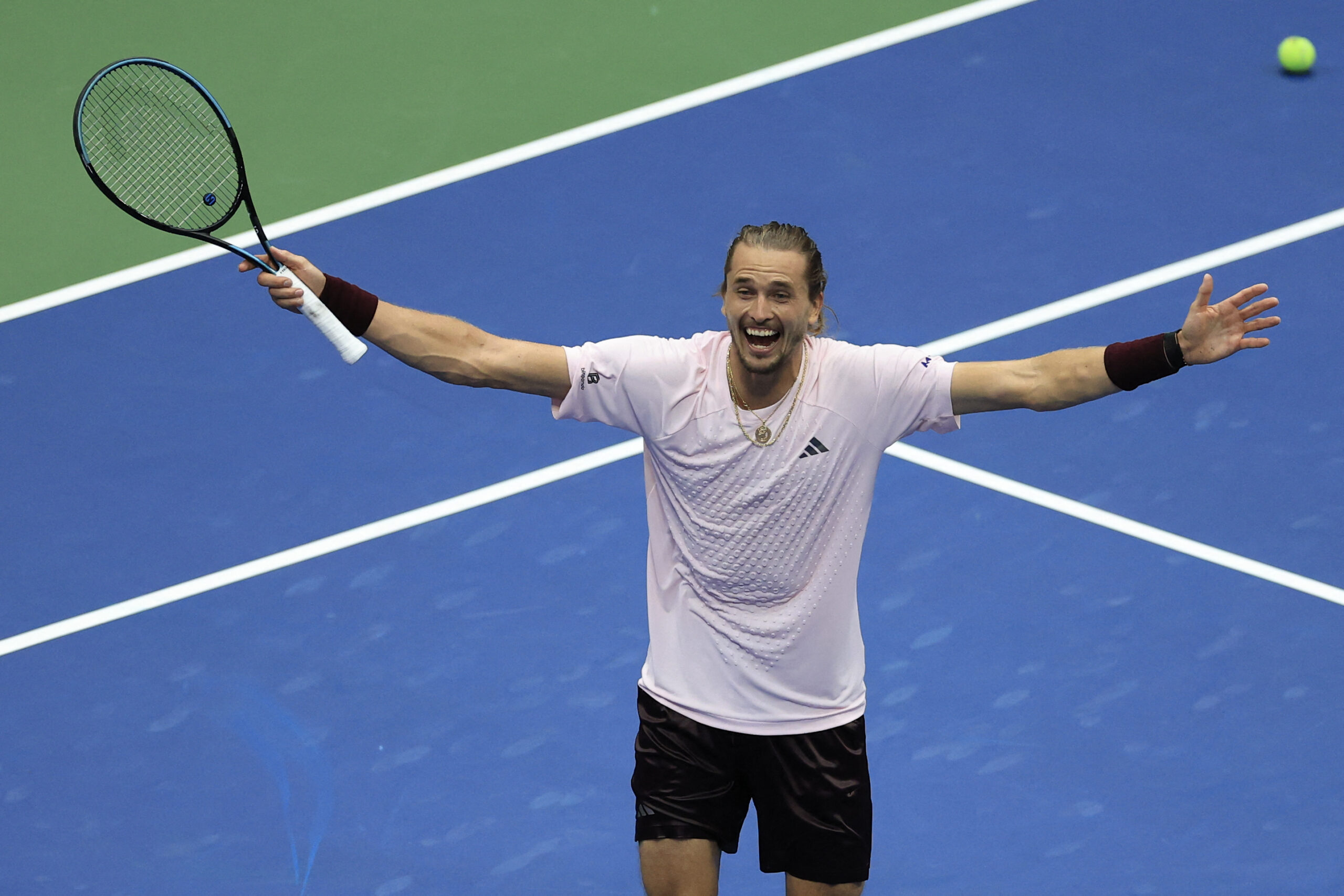
Ben Shelton served the opening game of the US Open final and lost it, and the shape of the afternoon was set before the crowd on Arthur Ashe Stadium had settled. Alexander Zverev broke him there, held from the front for the next two sets, and won 6-3, 7-6(2), 5-7, 6-2 for his second Grand Slam title of 2026.
Shelton was rushed early. He made 11 unforced errors in the first set to Zverev’s three, and twice double-faulted on break point, the second time handing over the set. His first serve, the shot that had carried him past Carlos Alcaraz in five sets and Frances Tiafoe in four, produced 10 aces across the whole final. He had hit 20 against Tiafoe in one match fewer sets.
Zverev, meanwhile, was barely playable behind his own delivery. He dropped three points behind his first serve across the opening two sets and did not face a break point until the third. Shelton did get to 5-5 in the second with a sprinting approach and a fist pump, the loudest passage of the day for him, but Zverev held and then took the tiebreak 7-2.
The third set was the one place the match turned. Serving at 5-6, Zverev played his worst game of the final, conceded three break points, and lost the set when a forehand volley went long. It was the first time Shelton had broken him in this match and only the second break Shelton has ever managed against him, ending a run of consecutive holds in the head-to-head that ran back to Cincinnati in 2024. Shelton hit 14 winners against seven unforced errors in that set, his cleanest tennis of the tournament.
It bought him nothing as Zverev broke back in the first game of the fourth set, took the insurance break in the seventh for 5-2, and lost four points on serve in the entire set. He won 12 of the final 14 points. When Shelton’s forehand return landed long on match point, Zverev walked back toward the baseline as though the match were continuing, then looked at the scoreboard.
Zverev was asked afterward what had changed in his opponent since their first meeting. He said it was the backhand wing, the side he used to attack without consequence: “I think this was the best backhand he’s hit ever against me”, adding that the errors he used to draw there no longer came.
What it settles. The result extends the wait for an American men’s Grand Slam champion past 23 years and 91 majors, back to Andy Roddick at this tournament in 2003. Zverev becomes the fourth man in the Open era to win his first two major titles in the same season, joining Jannik Sinner, Guillermo Vilas and Jimmy Connors, and the second German US Open men’s champion after Boris Becker in 1989. He was the No. 1 seed in New York only because Sinner withdrew with a knee injury, and Monday’s rankings leave him second.
The allegations. Zverev’s career has been shadowed throughout by domestic abuse allegations from two former partners, both of which he has consistently denied. Olga Sharypova, a former player, went public in October 2020 and again in August 2021. The ATP opened an investigation that October and closed it in January 2023, saying that a lack of reliable evidence, along with conflicting statements from those it interviewed, meant the allegations could not be substantiated. No sanction followed. Separately, a Berlin district court issued a penalty order in October 2023 fining him 450,000 euros over an alleged assault on Brenda Patea, his former partner and the mother of his daughter, during an argument in Berlin in May 2020. Zverev objected to the order, the case went to trial in Berlin in 2024, and that June it was discontinued under a settlement that carried no finding and no admission of guilt. His lawyers said a forensic medical report had refuted the allegations. He has not been convicted of any offence and has called the accusations baseless. The subject travels with him to the biggest matches: at the 2025 Australian Open, a spectator interrupted his runner-up speech to shout support for both women.
Shelton. He was the first Black American man in a US Open final since Arthur Ashe in 1972, and Ashe’s widow, Jeanne Moutoussamy-Ashe, watched from the stands. His route was the hardest of anyone’s: Tallon Griekspoor, Hubert Hurkacz, Denis Shapovalov, a resurgent Stefanos Tsitsipas, then Alcaraz and Tiafoe. In his press conference he called the loss a sting and declined the idea that the final had been a missed peak. “I’m a late bloomer. That’s just the way that it’s always been.”
The other argument. Shelton also used the press conference to raise Zverev’s second-serve routine, which has drawn comment from opponents all fortnight. The 25-second serve clock governs the first serve; the rules say only that the second must follow without delay. Zverev bounces the ball repeatedly before starting his second motion, sometimes around 20 times, and by one count bounced it roughly 12,000 times over the tournament. Karen Khachanov raised it after losing the semifinal. Shelton said chair umpire Marijana Veljovic had told him during the final to get to the line sooner, and that he had not seen why the obligation ran only one way: “He can start his routine whenever he wants.” He said a limit should exist. Zverev has said he does not do it deliberately and is not counting.