

The world number one ranking is not simply an individual achievement — it is a position that exists in relationship to other players who are simultaneously trying to claim it.
The most compelling chapters in the history of the ATP and WTA ranking systems are not stories of uncontested dominance but of sustained competition between players of comparable excellence who pushed each other back and forth across the top of the rankings over extended periods, neither able to establish permanent supremacy.
These ranking rivalries — the competitive battles for the top position that played out week by week, tournament by tournament, across entire seasons and in some cases entire eras — are among the most revealing stories in professional tennis.
They show which players defined specific competitive periods, how closely matched the sport’s best players were in different eras, and what sustained excellence at the very top of professional tennis actually looks like when it is genuinely contested rather than dominated by a single player.
What Makes a Ranking Rivalry
A ranking rivalry is different from a head-to-head rivalry in an important way. Head-to-head records measure what happens when two specific players compete against each other directly.
Ranking rivalries measure something broader — the sustained competition for the top position in the rankings that plays out across a full calendar, in which both players are simultaneously accumulating points at different events and the ranking position changes based on results that may not even involve direct competition between the rivals.
Two players can be intense ranking rivals without frequently meeting on court — if their results across the full calendar consistently produce similar point totals, the number one position changes hands between them repeatedly based on who won which event in which week, creating a ranking narrative that may be more compelling than their direct head-to-head record suggests.
The greatest ranking rivalries in tennis history combine both elements — players who competed intensely at the ranking level and whose direct encounters were frequent enough to give the ranking competition a specific competitive face. These are the rivalries where watching the rankings become almost as compelling as watching the matches.
Federer vs. Djokovic vs. Nadal — The Big Three Ranking Battle
The most complex and most sustained ranking rivalry in men’s tennis history is not a bilateral competition between two players but a trilateral battle among three simultaneously exceptional players — Roger Federer, Rafael Nadal, and Novak Djokovic — whose competition for the number one ranking defined men’s professional tennis for nearly two decades.
The Big Three ranking narrative has several distinct phases that each produced their own specific ranking dynamics.
The Federer-Nadal phase (2004–2011) was defined primarily by Federer’s extended consecutive reign at number one — 237 weeks without interruption — punctuated by Nadal’s challenge that eventually displaced him. Federer held number one for the vast majority of this period, but Nadal’s consistent Roland Garros dominance and eventual Wimbledon breakthrough in 2008 gave the ranking narrative its most dramatic moments. The 2008 season — in which Nadal finally displaced Federer after the 2008 Wimbledon final — was the most significant single ranking transition of the phase.
The Djokovic emergence (2011–2013) transformed the bilateral Federer-Nadal competition into a trilateral rivalry. Djokovic’s extraordinary 2011 season — three Grand Slams, five consecutive wins over Nadal in finals — announced the arrival of a third all-time great who could not simply be absorbed into the existing competitive hierarchy. His displacement of Nadal from number one in 2011 created a new ranking dynamic in which Djokovic, Nadal, and Federer were all capable of holding the top position depending on the specific competitive context of each period.
The full Big Three competition (2013–2022) produced the most complex ranking rivalry in men’s tennis history — three players each accumulating weeks at number one in different phases of the same extended period, with Andy Murray briefly joining the competition for the top position in 2016. The specific weeks at number one distribution across this period — Djokovic accumulating the most, with Federer and Nadal sharing the remainder plus Murray’s single year — reflected a competitive balance that no previous era of men’s tennis had produced.
The Big Three ranking battle is ultimately not a rivalry that any of the three players won — it is a competition that all three of them defined, collectively producing the most extraordinary accumulation of weeks at number one, year-end number ones, and Grand Slam titles in the history of either professional tour.
Connors vs. Borg — The First Great Men’s Ranking Battle
The first truly compelling bilateral ranking rivalry in the history of the ATP computerized system was the competition between Jimmy Connors and Bjorn Borg in the late 1970s — a rivalry that defined the transition between the early Open Era and the more commercially developed professional tennis of the 1980s.
Connors held the number one ranking for 160 consecutive weeks between 1974 and 1977 — the dominant force in men’s tennis during the early years of the computerized ranking system. His aggressive baseline game and extraordinary competitive intensity made him the most reliable performer in men’s tennis through the mid-1970s and the first player to demonstrate what sustained number one dominance looked like in the new ranking era.
Borg’s emergence as the primary challenger to Connors’s dominance through the mid-to-late 1970s created the ranking rivalry’s most compelling phase. Borg displaced Connors from number one in 1977 and held the position intermittently through his remaining competitive years — his five consecutive Wimbledon titles and six Roland Garros titles reflecting a clay and grass court dominance that Connors’s hard court-oriented game could not consistently match across the full calendar.
The specific competitive dynamic of the Connors-Borg rivalry — Connors’s aggression and baseline power against Borg’s topspin and physical endurance — was the defining tactical conversation of men’s tennis in the late 1970s and produced a ranking competition that mirrored the tactical contrast between the two players.
Connors dominated when the calendar favored hard courts and indoor surfaces. Borg dominated when the calendar moved to clay and grass. The ranking position reflected which surface cycle the season was in as much as either player’s absolute competitive superiority.
McEnroe vs. Lendl — The 1980s Defining Rivalry
The ranking rivalry that defined men’s tennis through the first half of the 1980s was the competition between John McEnroe and Ivan Lendl — two players of fundamentally contrasting styles whose competition for the number one position reflected a broader tactical evolution in men’s tennis.
McEnroe held number one for four separate periods between 1981 and 1985 — his serve-and-volley game and extraordinary hand skills making him the most technically complete player in men’s tennis during his peak years. His year-end number one finishes in 1981, 1982, 1983, and 1984 represented a level of sustained dominance that made him the defining player of the early 1980s.
Lendl’s competition for the top ranking began in earnest in 1982 and accelerated through 1984 and 1985 as his baseline power game — more physically demanding but ultimately more sustainable across the full calendar — began to challenge McEnroe’s serve-and-volley approach.
The transition of the number one ranking from McEnroe to Lendl — which occurred gradually rather than in a single dramatic moment — reflected a broader shift in men’s tennis from the serve-and-volley game that had dominated the early Open Era toward the baseline power game that would define the sport through the late 1980s and 1990s.
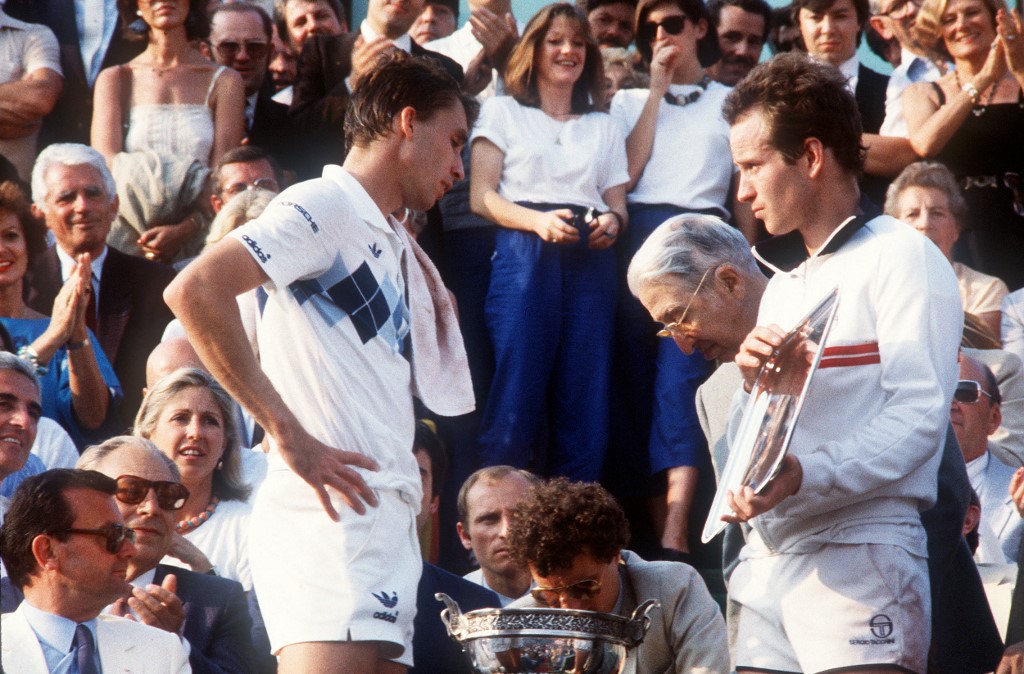
The most symbolically significant moment in the McEnroe-Lendl ranking rivalry was the 1984 Roland Garros final — in which Lendl came back from two sets down to beat McEnroe and deny him the French Open title that would have completed his Career Grand Slam.
McEnroe held number one going into that final. His loss — and his subsequent psychological difficulty in recovering from the defeat — was the turning point that marked the beginning of Lendl’s sustained dominance of the ranking through the mid-to-late 1980s.
Lendl held number one for 157 consecutive weeks between 1985 and 1988 — the second longest consecutive reign in men’s tennis history — and his dominance of this period effectively ended the McEnroe era and established baseline power tennis as the competitive standard of men’s professional tennis.
Sampras vs. Agassi — The 1990s American Rivalry
The ranking rivalry that defined men’s tennis through the 1990s was the competition between Pete Sampras and Andre Agassi — two American players of contrasting styles whose periodic exchanges of the number one position were the central competitive narrative of a decade in men’s tennis.
Sampras held number one for six consecutive year-end finishes between 1993 and 1998 — the longest consecutive year-end number one streak in men’s tennis history — and his total of 286 weeks at number one was the men’s record until Federer surpassed it in 2012. His dominance was built on Wimbledon and hard court excellence — seven Wimbledon titles and five US Opens giving him a Grand Slam title accumulation that no contemporary could match across those surfaces.
Agassi’s competition with Sampras for the top ranking was less about sustained possession of the number one position — Agassi held it for shorter periods and less consistently than Sampras — and more about the specific competitive moments when he challenged and occasionally displaced Sampras at the most important events.
His 1994 and 1995 periods at number one, his 1999 return to number one following his career renaissance after a ranking drop outside the top 100, and his late-career competitiveness into the early 2000s gave the Sampras-Agassi ranking rivalry a longevity that their direct head-to-head record reflected.
The specific tactical dynamic of the Sampras-Agassi rivalry — Sampras’s serve-dominated, net-approaching game against Agassi’s inside-the-baseline returning and flat groundstroke power — was the most analytically rich bilateral matchup in men’s tennis between the McEnroe-Lendl era and the Big Three.
Their competition for the number one ranking was the ranking expression of a tactical argument between two different visions of how professional tennis should be played.
Navratilova vs. Evert — The Greatest Women’s Ranking Rivalry
The most celebrated ranking rivalry in women’s tennis history is the competition between Martina Navratilova and Chris Evert — a bilateral competition for the top position that played out across a decade of women’s professional tennis and produced the most sustained competitive symmetry in the history of either professional tour.
Evert held the number one ranking for five year-end finishes between 1975 and 1981 — the dominant player in women’s tennis through the second half of the 1970s and the competitive standard that Navratilova needed to displace before establishing her own era of dominance. Her baseline consistency and mental resilience made her the most reliable performer in women’s tennis across a decade of competition, and her ranking position reflected a competitive quality that no contemporary could consistently overcome.
Navratilova’s competition with Evert for the top ranking began in earnest in the late 1970s and intensified through the early 1980s as her physical preparation and serve-and-volley game gave her competitive advantages that Evert’s baseline game could not consistently neutralize. Her seven year-end number one finishes between 1978 and 1986 — including four consecutive from 1982 to 1985 — reflected a period of sustained dominance that made her the most complete player in women’s tennis during her peak years.
The Navratilova-Evert ranking rivalry is unique in the history of either professional tour because of the specific symmetry of their competition. Their head-to-head record — Navratilova winning 43 of 80 meetings — reflects genuine competitive balance rather than the one-sided dominance that most ranking rivalries eventually produce.
Their decade of competition for the number one position produced more frequent ranking transitions than any other bilateral rivalry in tennis history, with the specific position changing multiple times within single seasons based on Grand Slam and major tournament results.
The ranking rivalry ended not with either player being displaced by the other but with the emergence of Steffi Graf — whose arrival at number one in 1987 rendered the Navratilova-Evert competition for the top position a historical artifact rather than the defining competitive narrative of the women’s tour.
Graf vs. Seles — The Interrupted Rivalry
The women’s ranking rivalry that should have defined the early 1990s — and that was building toward being one of the most compelling in the sport’s history — was the competition between Steffi Graf and Monica Seles that was violently interrupted in April 1993 and never resumed on the terms that it had established.
Graf had held the world number one ranking almost continuously since August 1987 — her 186-week consecutive reign the longest in women’s tennis history — when Seles finally displaced her in March 1991 after winning eight Grand Slams before the age of twenty.
Seles’s 109-week consecutive reign from March 1991 to April 1993 represented the most convincing competitive challenge to Graf’s dominance that anyone had mounted since Navratilova’s era, and the specific trajectory of the ranking competition suggested that Seles’s displacement of Graf was the beginning of a sustained era of shared dominance rather than a temporary interruption.
The stabbing attack in Hamburg in April 1993 ended the rivalry before it could fully develop. Graf held the number one ranking throughout Seles’s absence — her dominance during this period never fully contested in the way that Seles’s form before the attack had suggested it would be — and Seles’s return to competition in 1995 did not restore the competitive symmetry that the rivalry had been building toward.
The Graf-Seles ranking rivalry is therefore the most significant what-might-have-been story in women’s tennis history — a competition whose potential was more compelling than its actual record, interrupted at the precise moment when it was becoming the most interesting competitive narrative in the sport.
Williams vs. Everyone — The Serena Era’s Competitive Context
Serena Williams’s competitive dominance of women’s tennis across the 2000s and 2010s was so complete that the most interesting ranking rivalry of her era was not a specific bilateral competition with a single opponent but the rotating competition between various challengers for the second position in the rankings — the position from which any challenge to Williams’s number one status could theoretically be mounted.
The players who most consistently challenged Williams for the top ranking — Maria Sharapova, Victoria Azarenka, Simona Halep, Petra Kvitova, and others — each held the number one position for brief periods when Williams’s health issues or competitive absences created openings, but none was able to sustain a genuine bilateral ranking competition with her across an extended period.
The specific ranking dynamic of the Williams era was therefore defined more by the question of who held number one during Williams’s absences than by any sustained competition for the position while she was fully active.
Her 319 total weeks at number one and her 186-week consecutive reign reflect a dominance that rendered bilateral ranking rivalry essentially impossible — no single contemporary was competitive enough across the full calendar to create the sustained competition for the top position that the greatest ranking rivalries require.
Djokovic vs. Murray — The Final Big Three Era Competition
The most recent significant bilateral ranking rivalry in men’s tennis was the competition between Novak Djokovic and Andy Murray for the number one position in 2016 — a rivalry whose most dramatic moment came at the ATP Finals in November 2016, when Murray’s victory gave him the year-end number one position in the final competitive week of the season.
Murray’s competition with Djokovic for the top ranking through the autumn of 2016 was one of the most mathematically complex ranking battles in the history of the ATP system — requiring specific results across multiple events simultaneously to determine which player would hold the position at year-end.
Murray’s victories at Shanghai, Vienna, and Paris in consecutive weeks created the mathematical possibility of overtaking Djokovic, and his ATP Finals victory completed the process.
The specific significance of the Murray-Djokovic ranking rivalry is partly that it produced the most dramatic year-end number one conclusion in the history of the ATP ranking system, and partly that it represented the only period in over a decade when a player outside the Big Three held the ATP number one ranking.
Murray’s 41 weeks at number one — accumulated almost entirely in 2016 — were the product of a specific competitive window created by Djokovic’s relative vulnerability in the second half of that season, but they were genuine and hard-earned in a way that the specific competitive context of the Big Three era makes more rather than less impressive.
What Ranking Rivalries Reveal About Eras
The greatest ranking rivalries in tennis history collectively illuminate something important about how competitive eras in professional tennis are defined and remembered.
Eras are not defined by single players dominating alone — they are defined by the specific competitive relationships between the best players of each period and the sustained competition for the top position that those relationships produce. The Navratilova-Evert era is remembered as such because both players were simultaneously excellent across the same extended period.
The Big Three era is the most compelling in men’s tennis history precisely because three simultaneously exceptional players created a more complex and more sustained competition for the top position than any previous era had produced.
The ranking rivalry is ultimately the most sensitive measure of competitive eras in professional tennis — more sensitive than Grand Slam title counts alone, more revealing than head-to-head records alone, because it captures the sustained week-by-week competition for the sport’s most continuously updated distinction.
Following who holds the ranking and why is, in many ways, following the deepest competitive narrative the sport produces.
Part of the Rankings series. Related: Who Has Spent the Most Weeks at World Number One in Tennis History · The Greatest Year-End Number One Seasons in Tennis History · The Longest Reigns at World Number One in Tennis History