

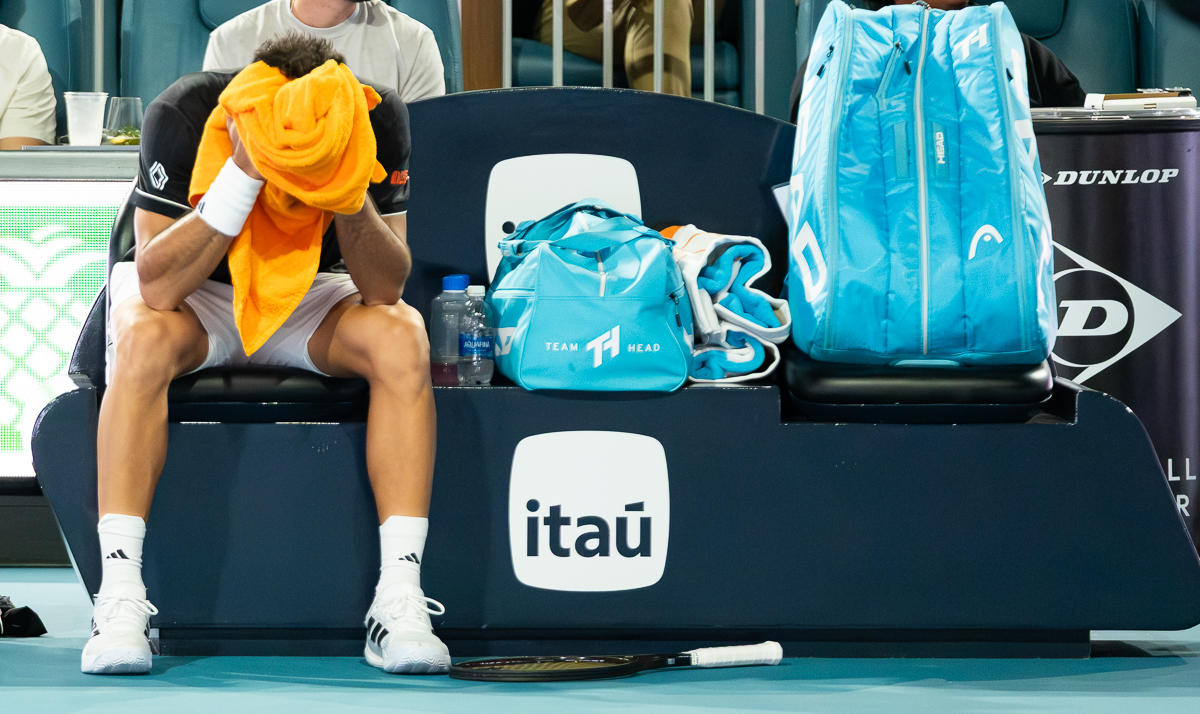
Professional tennis has a problem it has been slow to name clearly. Players are breaking down more frequently, retiring from tournaments mid-season at higher rates, withdrawing from events they are entered in, and speaking openly about mental and physical exhaustion in ways that would have been professionally unusual a generation ago.
The vocabulary has changed — burnout, mental health, player welfare — and so has the willingness of players at the top of the sport to use it publicly. What has not changed nearly enough is the structure that produces those conditions.
Burnout in professional tennis is not a new phenomenon. Players have always faced the accumulated toll of a long season, the psychological demands of individual competition, and the physical punishment of competing on hard courts across eleven months of the year.
What is new is the scale, visibility, and professional legitimacy of the conversation around it — and the growing recognition that the sport’s calendar, competitive structure, and cultural expectations around participation are contributing to a problem that threatens both individual careers and the long-term health of the professional game.
What Burnout Means in a Tennis Context
Burnout is not simply tiredness. It is not the normal fatigue that follows a long tournament or a difficult week of matches. Burnout is a sustained state of physical, mental, and emotional depletion that accumulates over time and does not resolve with normal recovery — a condition where the usual mechanisms for restoration no longer work because the demands being placed on the individual consistently exceed the body and mind’s capacity to regenerate.
In a professional tennis context, burnout manifests in several distinct but related ways. Physical burnout appears as injury accumulation, reduced physical resilience, and the inability to maintain the movement quality and endurance that professional competition requires.
Mental burnout appears as difficulty concentrating, reduced competitive motivation, emotional volatility on court, and the progressive erosion of the psychological resources that competitive tennis demands in greater quantities than almost any other individual sport.
Emotional burnout appears as a growing disconnection from the sport itself — a loss of the intrinsic motivation that drove a player to invest the years of effort required to reach the professional level.
These three dimensions interact and amplify each other in ways that make burnout genuinely difficult to treat once it has set in. A player who is physically exhausted makes worse decisions under pressure, which leads to competitive frustration, which depletes the emotional resources needed to maintain motivation through difficult periods, which makes recovery harder.
The cycle is self-reinforcing, and breaking it typically requires more extended rest than the professional calendar easily accommodates.
The Calendar Problem
The most structurally significant contributor to player burnout in professional tennis is the length and density of the professional calendar — a problem examined in detail in the previous article in this series but worth addressing specifically in the context of burnout.
An eleven-month professional season with no mandatory rest periods, an offseason of approximately six weeks, and a schedule of mandatory events that requires the highest-ranked players to compete across all three surfaces on multiple continents is simply incompatible with the physical and psychological recovery requirements of sustained elite competition.
This is not a controversial claim — it is a straightforward observation that sports scientists, player representatives, and increasingly the players themselves have made repeatedly and publicly.
The ATP and WTA have both responded to this critique with incremental calendar adjustments over the years — small reductions in the number of mandatory events, minor extensions to the offseason, adjustments to specific tournament windows.
None of these changes have addressed the fundamental issue: a calendar designed around commercial and competitive interests rather than player welfare creates structural conditions where burnout is not an occasional individual problem but a predictable systemic outcome.
The mandatory tournament structure compounds this problem specifically for the highest-ranked players, who face the greatest calendar demands at precisely the stage of their careers when commercial obligations — promotional work, sponsor appearances, media commitments — are also at their peak.
A player ranked inside the top ten is simultaneously required to compete at the greatest number of mandatory events, attend the greatest number of commercial obligations, and manage the greatest level of public scrutiny. The cumulative demand of all three — competitive, commercial, and public — creates a total burden that the calendar’s limited recovery windows cannot adequately address.
The Physical Toll of Hard Courts
Professional tennis is played predominantly on hard courts — a surface that, as noted throughout this series, transmits impact forces through the body at a rate that clay and grass do not.
The physical consequences of spending seven or eight months of the year competing and training on asphalt or concrete surfaces accumulate in ways that are not always immediately visible but that shape injury patterns and career longevity in significant ways.
Stress fractures, particularly in the feet and legs. Chronic knee problems. Hip flexor issues. Lower back pain that becomes a permanent management challenge rather than an acute injury that heals.
These are the physical signatures of long careers played primarily on hard courts, and they appear across the professional tour with a frequency that suggests the surface demands are not being adequately managed within the current calendar structure.
The relationship between hard court playing time and injury rate is not incidental. Sports scientists who have studied professional tennis injury patterns consistently find higher injury rates during and after extended hard court periods than during clay or grass seasons.
The Australian Open hard court swing — arriving at the start of the year when players are least physically conditioned — and the US Open series — arriving at the end of a long season when cumulative fatigue is at its peak — are the periods when hard court physical demands are most problematic and when injury rates are typically highest.
What makes this particularly challenging to address is that the hard courts at both ends of the calendar are Grand Slam periods — the most commercially important events in the sport, where player participation is least negotiable.
A player who is accumulating physical damage from hard court demands faces the choice of managing that damage while continuing to compete at the events where their presence is most expected and most commercially significant, or withdrawing from those events and accepting the ranking and commercial consequences.
Neither option is satisfactory, and the tension between them is a structural feature of the burnout problem rather than an individual failure of management or judgment.
Mental Health and the Individual Sport Problem
Tennis is uniquely demanding psychologically among major professional sports, and understanding why helps explain why mental burnout is such a particular challenge in this sport.
In team sports, the psychological burden of competition is distributed across a roster. A player who has a bad game is supported by teammates, shares the responsibility for the result, and is embedded in a social structure that provides continuity and collective purpose even through difficult periods.
Coaches, teammates, and organizational support systems provide a buffer between individual psychological vulnerability and competitive consequences.
In professional tennis, there is no such buffer. Every match is won or lost by a single player. Every bad performance is theirs alone. Every decision under pressure — tactical, technical, emotional — is made without the shared responsibility that team competition provides.
The psychological load of individual competition at the professional level is simply higher than in team sports, and the mechanisms for distributing that load are correspondingly fewer.
This fundamental psychological solitude of professional tennis is amplified by the sport’s competitive structure. A professional tennis player who is struggling psychologically cannot be rested without competitive consequence — a team sport player can be managed out of a lineup without their absence being immediately visible or statistically consequential.
A tennis player who withdraws from events or loses in early rounds while managing psychological difficulty is immediately exposed in the public record of results and rankings.
The visibility of psychological struggle in tennis — the inability to hide poor form, the immediate public recording of every loss, the absence of teammates who can carry the competitive load during difficult periods — creates a self-reinforcing pressure that makes psychological burnout both more likely and harder to acknowledge.
A player who is psychologically exhausted faces the additional pressure of knowing that acknowledging that exhaustion has immediate, visible, and measurable competitive and commercial consequences.
High-Profile Cases That Changed the Conversation
The burnout conversation in professional tennis has been shaped significantly by high-profile players speaking openly about their experiences in ways that would have been professionally unusual in earlier generations of the sport.
Naomi Osaka’s withdrawal from the 2021 French Open press obligations — and her subsequent withdrawal from Wimbledon and her disclosure of the anxiety and depression she had been managing — was a defining moment in the public conversation about mental health in professional tennis.
Osaka’s willingness to prioritize her psychological wellbeing over the commercial and competitive expectations of the sport, and the response it generated from tennis’s governing bodies and fellow players, made visible a conversation that had been conducted privately within the sport for years.
The response to Osaka’s withdrawal illustrated the tension at the heart of the burnout problem. Institutional reactions — from the Grand Slams who initially threatened her with fines and suspension for skipping press obligations — reflected a sport that still prioritized commercial and competitive obligations over individual player welfare.
The overwhelming public and peer support Osaka received illustrated a growing recognition that those priorities needed reexamination.
Other players — Andy Murray speaking openly about the psychological toll of long injury absences and career uncertainty, Simona Halep discussing anxiety management as a competitive challenge, and numerous others who have addressed mental health in tennis with increasing candor — have collectively shifted the cultural norms around these conversations in ways that matter for how the sport addresses burnout going forward.
The Role of Ranking Pressure
One of the most specifically tennis-structural contributors to burnout is the ranking system — specifically the way the 52-week rolling points structure creates relentless scheduling pressure that has no equivalent in most other major professional sports.
Defending points — the requirement to match or exceed last year’s results at every tournament to avoid ranking decline — means that a player can never genuinely rest from the competitive pressure of the calendar. A good result last year becomes next year’s obligation.
A strong clay season creates a body of points that must be defended across the following year’s clay season regardless of physical condition or competitive form. The rolling nature of the system means there is no off-season from ranking pressure even during the actual offseason.
This structural pressure interacts with burnout in a specific way: it makes rational recovery decisions — deciding to skip tournaments for rest and physical management — carry ranking and competitive consequences that create a powerful incentive to continue competing through fatigue and early-stage burnout rather than addressing it proactively.
A player who knows that withdrawing from a mandatory event will cost them hundreds of ranking points is rationally incentivized to compete even when doing so may be accelerating their physical and psychological deterioration.
The ranking system, in this sense, is not neutral with respect to burnout. It actively creates pressure to compete through conditions that would otherwise warrant rest, and it does so systematically across the entire player field rather than only for individuals making poor decisions.
The Commercial Dimension
Sponsorship deals, appearance obligations, media commitments, and the commercial infrastructure of a top professional tennis player’s career add a layer of demand to the competitive and physical calendar that is rarely included in discussions of burnout but that contributes to it meaningfully.
A player ranked inside the top twenty carries commercial obligations that extend well beyond tournament competition. Sponsor appearances, promotional events, media days, social media commitments, and the general management of a public profile at global scale all require time, energy, and psychological resources that are not replenished by rest from competition alone.
A player who takes a week off from competition but spends that week fulfilling commercial obligations has not genuinely recovered — they have simply shifted the domain of their exhaustion.
The commercial dimension of modern professional tennis careers is larger and more demanding than it was for previous generations of players, and it has grown precisely during the period when the tennis calendar has also been most densely packed.
The combination of more demanding competition calendars and more demanding commercial obligations — both expanding simultaneously — has created total demand levels that no previous generation of professional players navigated in quite the same way.
What the Sport Has Done — and What It Hasn’t
The ATP and WTA have both acknowledged player welfare concerns and made incremental adjustments to the competitive structure in response. The introduction of player councils with genuine representation in governance decisions, some reductions in mandatory event counts, adjustments to prize money at lower tour levels, and more structured engagement with player welfare organizations have all been steps in the right direction.
What has not happened is a fundamental restructuring of the calendar to reflect the physical and psychological demands of sustained elite competition. The commercial interests that drive the calendar’s length and density — the broadcast deals, the sponsor relationships, the ticket revenues, and the tournament licensing fees that depend on sustained player participation across a full season — are simply too large and too entrenched to be displaced by player welfare considerations alone.
This is not unique to tennis. Every professional sport manages a tension between commercial interests and athlete welfare, and in most cases commercial interests have historically prevailed in the short term.
What is distinctive about tennis is the combination of an unusually long season, an unusually demanding physical surface mix, an unusually isolated individual competitive structure, and an unusually transparent ranking system that punishes rest — a combination that makes the burnout problem more acute than in most comparable professional sports.
What Players Are Doing to Manage It
In the absence of structural calendar reform, professional players have developed a range of individual strategies for managing the burnout risk that the sport’s demands create.
Schedule management — selectively skipping lower-tier events to preserve energy for mandatory and high-value tournaments — is the most common and most visible approach. Players who can afford the ranking cost of skipping 250-level events regularly do so, concentrating their competitive energy on the events that matter most and accepting the ranking implications of a leaner schedule.
Physical preparation sophistication has improved significantly, with players investing in sports science, nutrition, sleep management, and recovery technology in ways that were not available to previous generations.
Cryotherapy, altitude training, advanced physiotherapy, and data-driven training load management all contribute to extending the physical window within which professional competition is sustainable.
Mental performance support — sports psychologists, mindfulness practices, and the broader infrastructure of psychological support that is now standard at the elite level — has become a more openly acknowledged part of player preparation.
The cultural shift that Osaka and others have contributed to has made it more acceptable to invest visibly in psychological support rather than treating it as a private weakness to be managed discretely.
And increasing player openness about the limits of sustainable competition — the willingness to speak publicly about needing rest, about managing anxiety, about the toll of the calendar — has itself become a form of collective pressure on the sport’s governing bodies to take the structural issues more seriously than commercial interests alone would require.
Why This Matters Beyond Individual Players
Player burnout in professional tennis is not just a welfare issue for the individuals affected — it is a commercial and competitive problem for the sport itself that the governing bodies would be wise to take more seriously on purely self-interested grounds.
A sport that burns through its most compelling performers before they reach their peak, or that loses players to extended injury and psychological difficulty at the most commercially valuable stages of their careers, is damaging its own product.
Fans come to tennis to watch the best players compete at full intensity. A calendar and competitive structure that systematically undermines the ability of the best players to maintain full intensity across a full season is ultimately a threat to the commercial vitality that the same calendar is designed to maximize.
The best version of professional tennis — the one that generates the most compelling competition, the richest narratives, and the greatest commercial value — is one in which the sport’s best players are healthy, motivated, and competing at full capacity at its most important events.
Building a calendar and competitive structure that makes that outcome more likely rather than less is not just a player welfare imperative. It is the most straightforward commercial investment the sport’s governing bodies could make.
The burnout problem is solvable. It requires structural changes that carry short-term commercial costs. Whether the sport’s governing bodies will accept those costs — or whether they will continue to optimize for short-term commercial extraction at the expense of long-term competitive health — is the most important organizational question in professional tennis today.
Related: How the Tennis Calendar Is Built and Why It Matters · What It Actually Costs to Be a Professional Tennis Player · How Tennis Players Make Money Beyond Prize Money