

The Australian Open has produced some of the most memorable finals in Grand Slam history. The combination of Melbourne summer heat, the medium-fast GreenSet hard court surface, the season-opening calendar position, and the specific atmosphere at Rod Laver Arena has created a venue where the biggest matches of the modern era have repeatedly produced extraordinary drama.
This is the story of the greatest Australian Open finals ever played — the matches whose competitive quality, historical significance, and lasting impact have made them defining moments in the tournament’s modern history.
2012 Men’s Singles Final: Djokovic def. Nadal 5–7, 6–4, 6–2, 6–7(5), 7–5
The 2012 men’s singles final between Novak Djokovic and Rafael Nadal is the longest Grand Slam final by playing time in tennis history — five hours and fifty-three minutes of competitive tennis that remains, by widespread consensus, one of the greatest matches ever played in any era of the sport.
The match began at 7:30pm Melbourne time and concluded at 1:37am the following morning. Both players visibly struggled with cramps and exhaustion in the final games. The physical demands were extraordinary even by Grand Slam standards — both Djokovic and Nadal were operating at the edges of physical sustainability through the deciding fifth set, each still serving and returning at near-peak intensity despite the match’s accumulating length.
Djokovic’s eventual victory in the deciding set — 7–5 in the fifth — completed his third Australian Open title and established a 2–0 finals record against Nadal at Melbourne Park. The trophy ceremony, conducted with both players visibly depleted, included the unusual decision to bring out chairs so both could sit during the speeches and presentation.
The 2012 final has been cited repeatedly since as the gold standard of competitive endurance and tactical depth in the modern men’s game. Its 5h53m duration is unlikely to be surpassed given the introduction of final-set tiebreaks at all four Grand Slams since 2022.
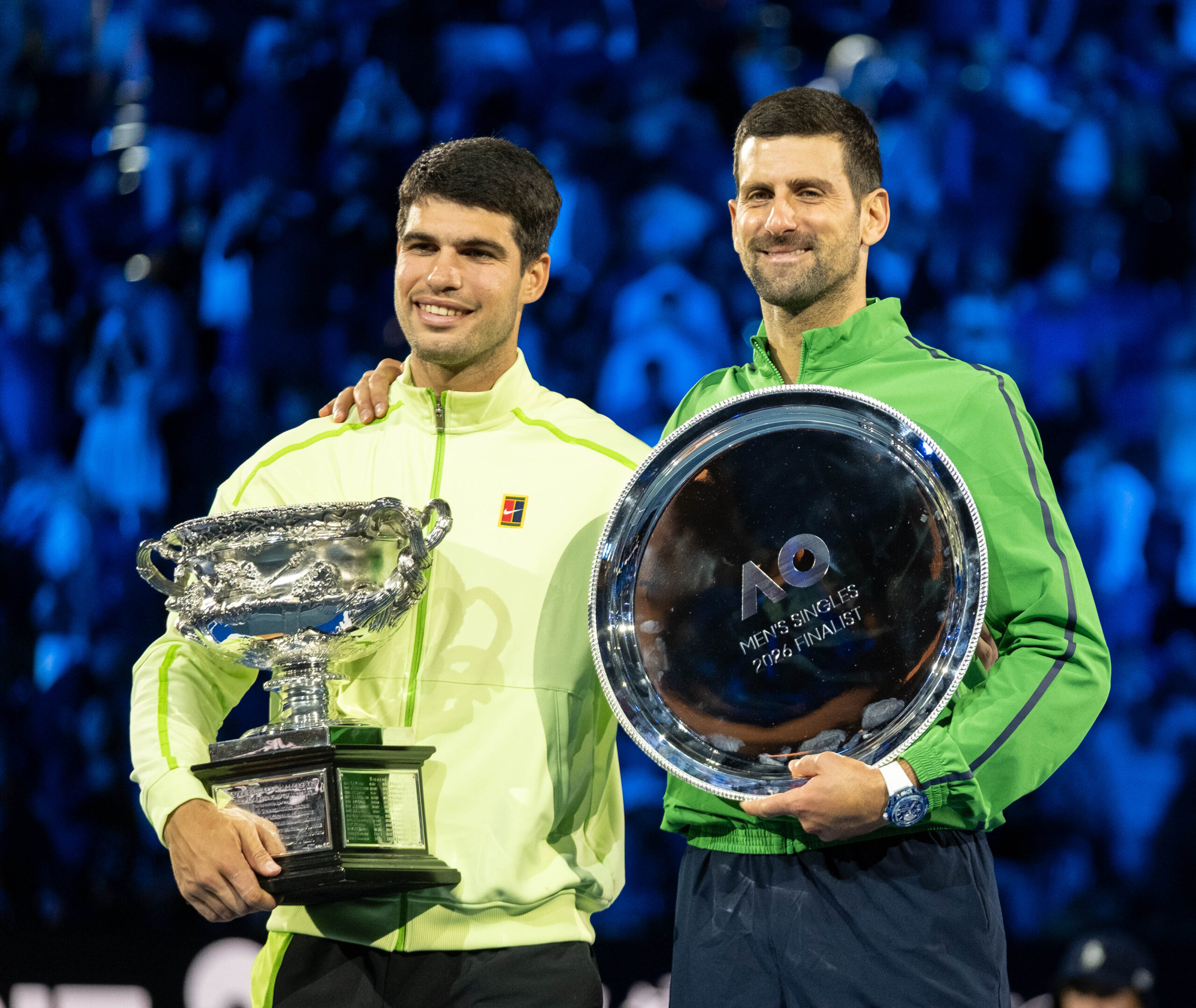
2026 Men’s Singles Final: Alcaraz def. Djokovic 2–6, 6–2, 6–3, 7–5
The 2026 Australian Open men’s singles final was the most historically significant final Melbourne Park had produced in years — the match that ended Novak Djokovic’s perfect record at the tournament and gave Carlos Alcaraz the career Grand Slam at just twenty-two, making him the youngest man ever to complete the set.
Djokovic, thirty-eight and chasing a record-extending eleventh AO title and twenty-fifth major, produced a near-perfect opening set to take it 6–2 and looked, briefly, as though experience might carry him to history. But Alcaraz reset completely, seizing control of the baseline exchanges and winning the next three sets 6–2, 6–3, 7–5 in a tense, physical contest featuring some of the finest rally sequences of the fortnight.
The win made Alcaraz the sixth man in the Open Era to complete the career Grand Slam, and the youngest. For Djokovic, the defeat was his first in eleven Australian Open finals, ending the most successful finals record the tournament has produced. It was the clearest passing of the torch yet at Melbourne Park — the venue Djokovic had defined for fifteen years, lost in a final for the first time, to the player leading the sport’s next era.
2017 Men’s Singles Final: Federer def. Nadal 6–4, 3–6, 6–1, 3–6, 6–3
The 2017 men’s singles final between Roger Federer and Rafael Nadal produced one of the most celebrated late-career performances in tennis history. Federer was thirty-five, returning from a six-month layoff for knee surgery, and had not won a Grand Slam title in nearly five years. Most observers had concluded that his major-championship career was effectively over.
The match was Federer’s first Slam final against Nadal since the 2011 French Open. Their previous Grand Slam final encounter — the 2009 Australian Open final, also at Rod Laver Arena — had been won by Nadal. The Spaniard held a 23–11 career head-to-head advantage, and Federer had not beaten Nadal in any tournament since 2015.
The match swung back and forth through five competitive sets, each player taking turns to control momentum. Federer’s victory came when he broke Nadal in the fifth set and served out the match 6–3 in the decider.
The win produced one of the most emotional trophy ceremonies in modern tennis — Federer’s visible tears during the speech and his acknowledgment that he had not expected to compete at this level again. The 2017 title was the first of several additional Grand Slam championships Federer won across 2017 and 2018, one of the most successful late-career resurgences any player has produced.
2009 Men’s Singles Final: Nadal def. Federer 7–5, 3–6, 7–6(3), 3–6, 6–2
The 2009 Australian Open men’s singles final was Nadal’s first hard court Grand Slam title and one of the most emotionally significant moments of the Federer–Nadal rivalry. Nadal had won the 2008 Wimbledon final — the famous five-set epic on grass — and the 2009 Australian Open established that his game could translate to hard courts as completely as it had to clay and grass.
The match was a five-set physical battle. Nadal had played a six-hour semifinal against Fernando Verdasco the day before — at the time the longest match in Australian Open history — and his ability to return for another demanding five-setter two days later reflected the extraordinary conditioning that defined his peak years.
Federer led into the fifth set after taking the fourth, but Nadal produced one of the most dominant deciding sets in modern Grand Slam history, winning 6–2 to claim his sixth major.
The trophy ceremony became one of the most discussed moments in modern tennis. Federer, holding the runner-up trophy, broke down in tears during his speech, repeating “God, it’s killing me” as the loss overwhelmed him. Nadal, recognising the moment, approached Federer with a comforting gesture that became one of the most reproduced images of the modern game’s mutual respect.
2022 Men’s Singles Final: Nadal def. Medvedev 2–6, 6–7(5), 6–4, 6–4, 7–5
The 2022 Australian Open men’s singles final produced one of the most remarkable comebacks in Grand Slam history. Daniil Medvedev led Rafael Nadal by two sets to love and was serving at 3–2 in the third when the match’s direction reversed.
Nadal had been physically compromised throughout the tournament, recovering from a foot injury that had nearly forced his retirement months earlier. He was thirty-five and had not won the Australian Open since 2009. His recovery from two sets down required five hours and twenty-four minutes — the second-longest Grand Slam final in history, after the 2012 epic. Nadal broke Medvedev twice in the third set, controlled the fourth, and won the decider 7–5.
The win moved Nadal to twenty-one Grand Slam titles, then the all-time men’s record. Djokovic had been deported from Australia days before the tournament over a vaccination dispute, opening the draw Nadal exploited fully. Medvedev’s performance — dominating Nadal across two sets and staying competitive into the decider — confirmed him as one of the best hard court players of his era, even in defeat.
2024 Men’s Singles Final: Sinner def. Medvedev 3–6, 3–6, 6–4, 6–4, 6–3
The 2024 Australian Open men’s singles final was Jannik Sinner‘s first Grand Slam championship and one of the most dramatic comeback victories in modern AO history. The Italian, twenty-two at the time, had been the breakthrough player of the previous twelve months and had ended Djokovic’s 33-match Australian Open winning streak in the semifinal.
Medvedev started in dominant form, winning the first two sets 6–3, 6–3 and appearing headed for his first AO title. Sinner’s transformation mid-match was one of the most striking competitive responses in modern Grand Slam tennis. He shifted his tactical approach, found greater depth on his groundstrokes, and constructed points more effectively from the baseline, taking the third and fourth sets 6–4 and closing out the decider 6–3.
The win mattered for Sinner personally — his first major after several deep runs that had ended in defeat — and for the broader post-Big Three transition. With Djokovic’s semifinal defeat and Sinner’s emergence, the 2024 Australian Open marked the most visible moment yet of the men’s tour’s generational shift. Sinner defended the title in 2025, the first player to win consecutive AO titles since Djokovic’s 2019–2021 three-peat.
2003 Women’s Singles Final: S Williams def. V Williams 7–6(4), 3–6, 6–4
The 2003 Australian Open women’s singles final between Serena Williams and Venus Williams completed the “Serena Slam” — Serena holding all four Grand Slam singles titles simultaneously, achieved from June 2002 through January 2003.
The match was the sisters’ fourth consecutive Grand Slam final against each other — they had also met in the 2002 Roland Garros, Wimbledon, and US Open finals, with Serena winning all four. The Australian Open final extended Serena’s perfect record against her older sister in Grand Slam finals, and was the closest of the four — Venus taking the second set after Serena had won the first in a tiebreak, before Serena took the decider 6–4.
Serena’s first Australian Open title would be the first of seven AO championships across her career — the Open Era women’s record at the tournament.
2017 Women’s Singles Final: S Williams def. V Williams 6–4, 6–4
The 2017 Australian Open women’s singles final between Serena and Venus Williams was the sisters’ ninth and final Grand Slam final encounter, and it produced one of the most extraordinary individual narratives in tennis history.
Serena was thirty-five and in the early stages of pregnancy with her first child — a fact she announced publicly months later but that was unknown at the time. The final represented one of the most physically and competitively demanding situations any pregnant athlete has produced at the highest level of sport. She won in straight sets, 6–4, 6–4, in a controlled tactical performance against Venus, who at thirty-six had reached her first AO final in fourteen years.
Serena’s seventh Australian Open title established the Open Era women’s record at the tournament. It was also her twenty-third Grand Slam singles title, surpassing Steffi Graf’s Open Era record of twenty-two — and it proved to be the last Grand Slam title of her career.
2022 Women’s Singles Final: Barty def. Collins 6–3, 7–6(2)
The 2022 Australian Open women’s singles final produced one of the most celebrated moments in modern Australian sporting history. Ash Barty’s straight-sets win over Danielle Collins was the first Australian women’s Grand Slam title at the Australian Open in forty-four years — since Chris O’Neil’s 1978 victory at the Kooyong Lawn Tennis Club.
Barty entered as world number one and the home crowd’s clear favourite, and the atmosphere at Rod Laver Arena was one of the most distinctive home-crowd settings in modern Grand Slam tennis. She won the first set 6–3 with a serve-and-volley approach that exploited the medium-fast surface, and after Collins forced a second-set tiebreak, Barty controlled it comprehensively to win 7–2 in the breaker.
Barty announced her retirement from professional tennis in March 2022, just six weeks after the title — making the win the final Grand Slam championship of her career.
2005 Women’s Singles Final: S Williams def. Davenport 2–6, 6–3, 6–0
The 2005 Australian Open women’s singles final between Serena Williams and Lindsay Davenport produced one of the most extraordinary comeback victories in women’s Grand Slam history. Davenport, the world number one and a three-time Grand Slam champion, served for the match in the second set and held three championship points across the match.
Serena saved each through aggressive return play and tactical adjustments that prevented Davenport from closing out the match. The contest shifted dramatically in the third set, where Serena produced a 6–0 dismissal that contrasted sharply with the tight back-and-forth of the first two sets.
The win was Serena’s second Australian Open title and established the match-point-comeback pattern that would become one of her signature competitive identities.
2023 Women’s Singles Final: Sabalenka def. Rybakina 4–6, 6–3, 6–4
The 2023 Australian Open women’s singles final between Aryna Sabalenka and Elena Rybakina was Sabalenka’s first Grand Slam championship and the start of one of the most consistent women’s careers of the modern era.
Rybakina, the reigning Wimbledon champion, took the first set 6–4 in dominant fashion, using her serve and powerful baseline play to control the early structure. Sabalenka’s recovery required tactical adjustments and a more aggressive return position that allowed her to break back and level the match. The third set produced one of the highest-quality sequences in modern AO finals — both players exchanging holds at the highest level before Sabalenka broke in the closing stages to win 6–4.
The win established Sabalenka as a Grand Slam champion at twenty-four and began her sustained excellence at the AO — she defended the title in 2024 by defeating Zheng Qinwen in the final, becoming the first woman to win consecutive AO titles since Victoria Azarenka in 2012–2013.
Why the Australian Open Produces Great Finals
The Australian Open’s specific competitive environment has produced a disproportionate number of all-time great Grand Slam finals across the modern era. Several factors contribute to this concentration of competitive excellence.
The season-opening calendar position means players arrive either at peak off-season conditioning or recovering from late-season injuries — a polarisation that produces unusual competitive dynamics. Players whose off-season preparation has been exceptional often peak at the AO; players returning from injury sometimes produce comeback narratives the other Grand Slams cannot replicate.
The Melbourne summer heat amplifies physical demands in ways that test the limits of even peak-form professionals. The 2012 Djokovic–Nadal final, the 2022 Nadal–Medvedev final, the 2024 Sinner–Medvedev final, and the 2026 Alcaraz–Djokovic final all featured comeback victories — several from positions of physical compromise — a pattern made possible by the AO’s specific challenges and the closed-roof conditions at Rod Laver Arena.
The medium-fast hard court surface rewards both aggressive baseline play and tactical adaptation in ways that produce shifting momentum across long matches. Faster than the US Open’s surface, slower than modern grass at Wimbledon, it creates conditions where mid-match tactical adjustments can produce dramatic momentum swings.
The Rod Laver Arena atmosphere — particularly during closed-roof night sessions — produces a competitive setting that experienced players consistently describe as one of the most distinctive in the sport. The packed crowd, the acoustic environment, and the awareness of the matches played here across nearly four decades produce a psychological context that elevates the intensity of major finals.
And the position of the Australian Open as the first major of the season gives its finals specific narrative weight. A breakthrough title can define an entire season; a comeback win can establish a player’s credentials for the year that follows; a defining championship can shift the trajectory of a career. The combination of these factors has produced an AO finals archive that, across the modern era, includes more all-time-great Grand Slam finals per capita than any other major.
Related reading
- Australian Open Records — Titles, Matches and Statistics
- Novak Djokovic at the Australian Open — The Defining Champion of the Modern Era
- Grand Slams Explained
- The Australian Open Guide