

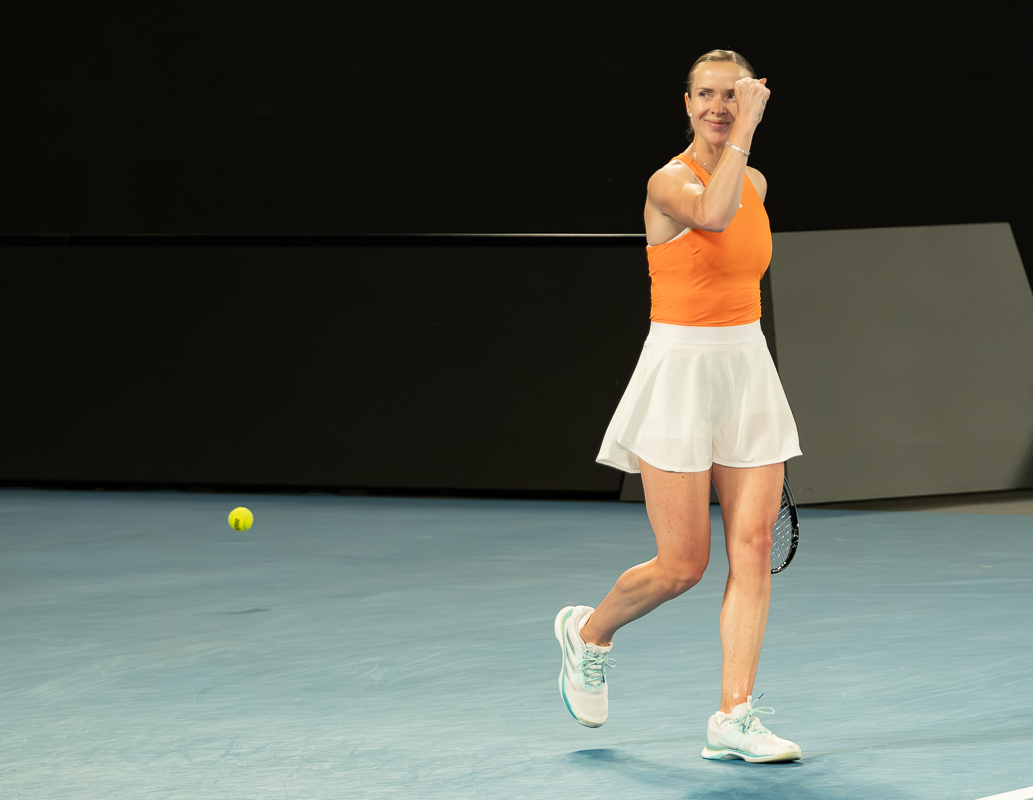
Elina Svitolina withdrew from the Cincinnati Open on Tuesday before her third-round match, and the ankle that forced her out had been troubling her for nearly three weeks.
The world No. 9 was scheduled to face Xiyu Wang, a qualifier who has come through from the first round of the qualifying draw. Wang advanced instead on a walkover and will play Madison Keys in the fourth round. Svitolina said the injury dated to Toronto, that her second-round win here had aggravated it, and that she had been advised by doctors to rest. “Very sad to pull out this round,” she said in a statement released through the tournament.
The sequence matters more than the withdrawal itself. Svitolina reached the semifinals at the National Bank Open in Toronto this month, where she lost to Iga Swiatek, who went on to win the title. She arrived in Ohio carrying the problem and played anyway. On Sunday night she met Tereza Valentova in the second round, lost the opening set, took a medical timeout early in the second, saved seven match points, won that set on a tiebreak and then took the third 6-0. The 3-6, 7-6(5), 6-0 result was one of the more remarkable escapes of the fortnight. Two days later it is the reason she is not on court.
That is the arithmetic of the North American hard-court swing, and it has been running against the women’s field all month. The US Open main draw begins Aug. 30, which leaves Svitolina 12 days to resolve an ankle that has not resolved in three weeks of trying. She has not withdrawn from anything in New York, and nothing in her statement suggests she intends to. But the runway is short, and the evidence of the past week is that the ankle does not respond well to being asked to hold up over three sets.
Her 2026 has been the strongest stretch of her post-maternity career. She won a third Italian Open title in May, beating Coco Gauff in the final and Elena Rybakina on the way, and the Toronto semifinal was a further sign that the level travels onto quicker surfaces. New York has been the exception. She lost in the first round at last year’s US Open, and her Cincinnati week a year ago ended in the second round. A fourth-round place here, even one surrendered without a swing, is a step forward on both.
Wang’s side of this is worth noting too. The walkover carries her into a second WTA 1000 fourth round, her first having come at the Italian Open in 2023, and she has reached it from qualifying. Her wins in Ohio were also her first on a hard court since the tour left the grass, a run that had looked increasingly out of step with a season that has otherwise gone well — a fourth round at Roland Garros, a WTA 125 final in Brescia, and several titles at the ITF level.
Keys reached the last 16 by beating Katerina Siniakova 6-1, 6-3 earlier Tuesday and will meet Wang for the second time. Keys has been among the steadier Americans in a draw that has otherwise been unkind to the seeds, and a quarterfinal here would be useful preparation for a home Slam where the expectations attached to her have not eased.
The attrition is the larger story of this tournament. Cincinnati lost its top two men before a ball was struck, with Jannik Sinner and Carlos Alcaraz both out injured, and the women’s field arrived without Jasmine Paolini and Emma Raducanu. Naomi Osaka withdrew after the draw was made. The event has since lost a top-10 woman mid-tournament and, on the men’s side, Joao Fonseca. None of these are connected to one another. All of them point the same way, which is that the calendar between Wimbledon and Flushing Meadows is asking more of players than a meaningful number of them can currently give.
For Svitolina, the decision to stop was the conservative one and probably the correct one. She has spent the season proving she can still beat the players ranked above her. What she has not had, and what the next 12 days will decide, is a body that lets her do it seven times in a row.