

Elena Rybakina put 27 percent of her first serves in the court in the opening set of the US Open final and won it anyway. Aryna Sabalenka, handed a second serve to attack in most of Rybakina’s service games, did not earn a single break point in those ten games.
The break came at 2-2. Rybakina had let one chance go earlier in the set and took the next one, and Sabalenka handed it over with a double fault. What happened next told more than the scoreline did: Sabalenka launched a ball high into the stands and picked up a code violation for ball abuse at the changeover. Rybakina held twice at love in the set. Through the first five games she had six winners and no unforced errors. Sabalenka finished the set with 15 unforced errors.
The second set was Sabalenka’s, and it took her twelve games to get it. Serving at 4-5, Rybakina faced two set points at 15-40 and erased both, the second when Sabalenka pushed a routine forehand into the net and held for 5-5. Two games later, with Rybakina serving at 5-6, Sabalenka broke for the first time in the match and took the set 7-5.
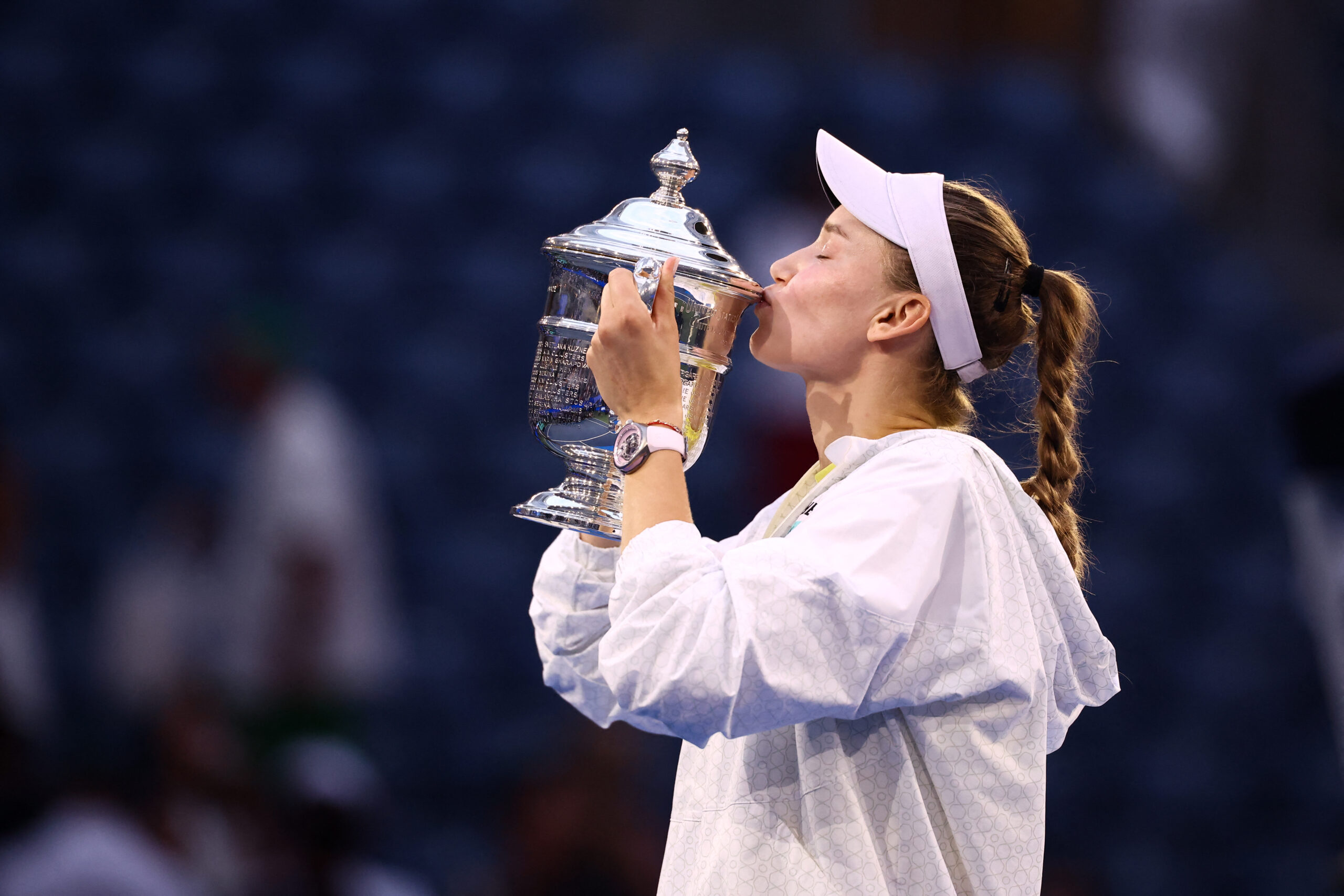
Whatever that set had done to Rybakina did not survive the changeover. She broke for 3-1 in the decider, held at love for 4-2 and broke again for 5-2. She did not lose a point behind her first serve in the set and did not face a break point in it, striking 15 winners against six unforced errors. Serving for the title she double-faulted twice, held to 30 anyway and finished on her second match point with her 12th ace: 6-4, 5-7, 6-2, two hours and 21 minutes on Arthur Ashe Stadium.
It is Rybakina’s third major, after Wimbledon in 2022 and the Australian Open in January, and it comes at the tournament where she had never previously been past the fourth round. She arrived in New York having retired from her Cincinnati quarterfinal against Iga Swiatek with a foot injury, and spent the build-up off the practice court and in the treatment room. Asked about it afterwards, she said that somehow everything had aligned on her side.
The result completed a handover that was already settled. Rybakina had clinched the world No. 1 ranking earlier in the fortnight, in her quarterfinal win over Zheng Qinwen, ending Sabalenka’s run of 99 consecutive weeks at the top. Sabalenka has spent 107 weeks at No. 1 across two stints. Rybakina takes the ranking formally on Monday.
For Sabalenka it is a fifth defeat in nine major finals and the first calendar year since 2022 in which she has not won one. She lost before the semifinals at Roland Garros and Wimbledon and lost both of her major finals this season to the same opponent. She was trying to become the third woman in the Open era to win three consecutive US Opens, after Chris Evert and Serena Williams, and had not lost at Flushing Meadows since the 2023 final.
She smashed her racquet after the handshake and was asked about it in her press conference. “I just wanted to let all of that aggression and disappointment go outside,” she said, explaining that holding it in would have left her unable to speak. She also made a joke of being overtaken, saying 99 weeks was an achievement and inviting Rybakina to try to beat it.
The rivalry now runs to 18 meetings. Sabalenka leads 10-8 overall, but Rybakina holds an 8-7 edge on hard courts and has won five of their seven finals. This was their third meeting in a Grand Slam final and the third to go to three sets. Rybakina is the third player since 2000 to win the Australian Open and the US Open in the same season, joining Angelique Kerber in 2016 and Sabalenka in 2024. It is her third title of the year and the 14th of her career, and it leaves her a Roland Garros trophy short of the career Grand Slam.
She heads into the closing weeks with a 1,007-point lead in the Race to the WTA Finals, though she defends a heavy load from last autumn, when she won Ningbo and the WTA Finals. The year-end No. 1 ranking is not settled. The men’s final follows on Sunday, with Alexander Zverev meeting Ben Shelton.