

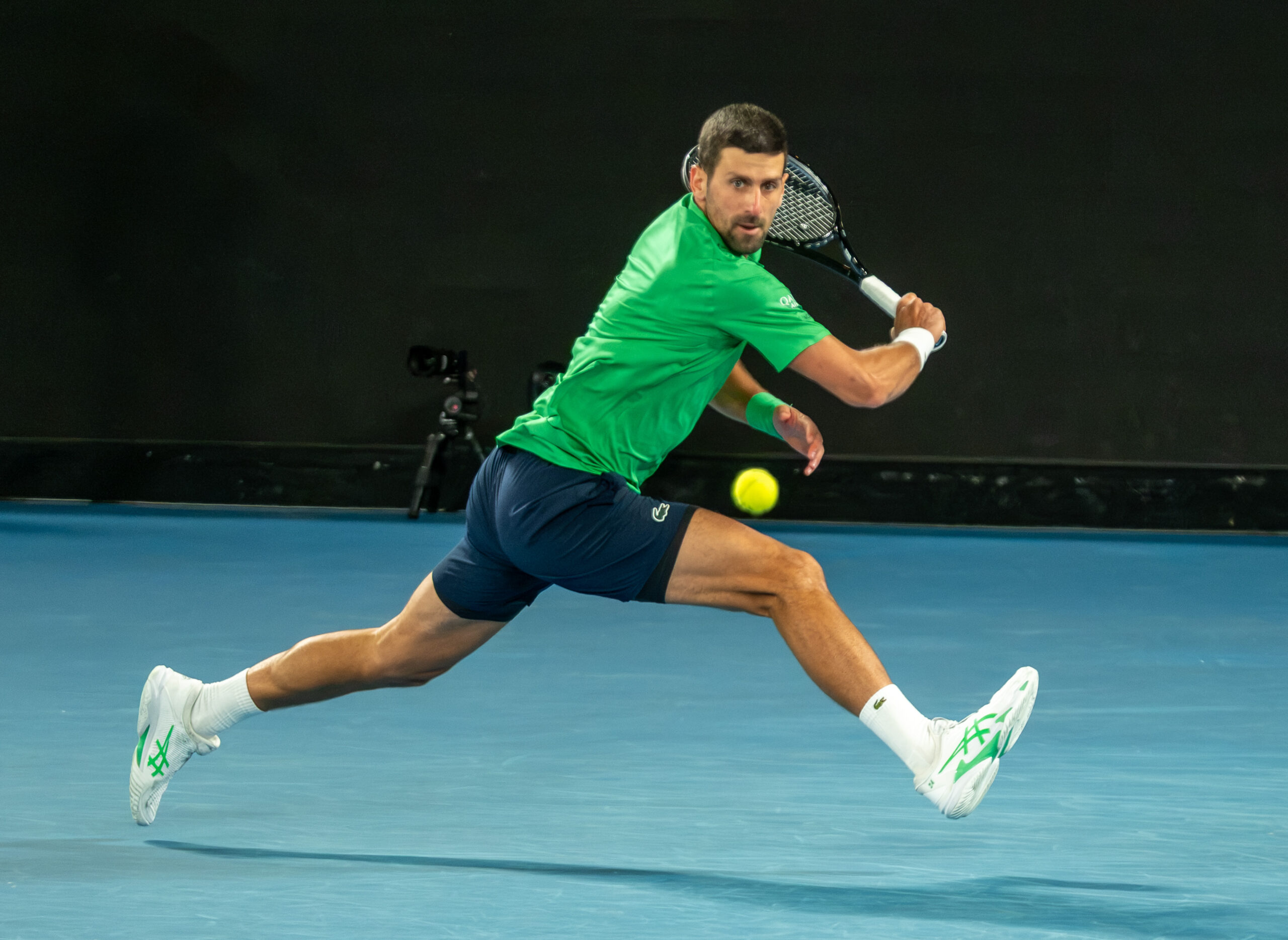
Novak Djokovic wants tennis to tear up its scoreboard. The 24-time Grand Slam champion has called for sets to be cut from six games to four, for advantage scoring to be scrapped, and for matches to be held inside a two-hour window — a package that would rewrite the sport’s basic arithmetic and, at the majors, strip away the single biggest obstacle standing between a 39-year-old and a record 25th title.
Asked in a video interview to name the tennis opinion he would defend no matter how much criticism it drew, Djokovic did not hesitate. The scoring format should change, he said, with sets played to four games rather than six and no-ad scoring replacing the traditional deuce sequence. He would keep best-of-five sets, he added, while working to keep matches within a two-hour window. He described the combination as better for everyone.
The first half of that answer is a familiar modernization pitch. The second half is where it becomes something more. Djokovic has spent two decades winning the endurance war, and best-of-five is the format that rewarded it. Now it is the format that punishes him. Capping matches at roughly two hours while preserving five sets would keep the prestige of major tennis and remove the physical tax that comes with it — the exact tax that has decided his last several deep runs.
The math is severe. In a no-ad game, deuce becomes a single deciding point, and a break of serve can arrive without the long war of attrition that usually precedes it. A set played to four games instead of six cuts roughly a third of the games needed to close it. Together the two changes compress a five-set match toward the length of a routine straight-sets win, and they hand disproportionate value to a single early break. Djokovic did not say how a four-game set would be resolved at 3-3, or whether a tiebreak would still apply.
His 2026 explains the appeal. He reached the Australian Open final in February and lost to Carlos Alcaraz in four sets after taking the opener. He reached the Wimbledon semifinals in July and lost to Jannik Sinner, the eventual champion. Both defeats followed the same shape: a competitive start, then a gap that widened as the match lengthened.
He has played five tournaments in the first seven months of the year, a schedule stripped down to protect a body that no longer recovers the way it did. That calculus is visible in his August. He withdrew from the National Bank Open in Montreal, choosing rest over match play, and will instead open his hard-court season at the Cincinnati Open, his first tune-up before a major all season. The US Open main draw begins Aug. 30.
The reaction to his proposal was immediate and largely unfriendly. A significant share of the response online accused Djokovic of advocating for rules that would suit the player he is now rather than the sport, and pointed out that the marathon matches he built his legend on — the five-hour finals, the fifth-set escapes — are exactly what his plan would eliminate.
Others argued the opposite: that a predictable match length is what broadcasters, tournaments and younger viewers have wanted for years, and that tennis has been losing casual attention to faster, simpler racket sports. Shorter formats are not hypothetical. No-ad scoring is already standard across tour-level doubles, and the revamped US Open mixed doubles event that Djokovic himself has entered runs on abbreviated scoring rather than the traditional format.
Exhibition circuits have gone further, replacing sets with timed quarters. The men’s tour has also shown a willingness to test structural fixes elsewhere, agreeing to trial more frequent ball changes after years of player complaints about arm injuries. What Djokovic has not done is put a proposal in front of anyone with the power to enact it.
The rules of tennis sit with the International Tennis Federation, and the majors answer to their own board, which has shown no appetite for touching scoring at the Grand Slams. No such change is on the table. The irony is not lost on the man who suggested it. Any reform of this scale would take years of trials, negotiation and broadcaster buy-in — long enough that Djokovic would almost certainly never play a match under it.