

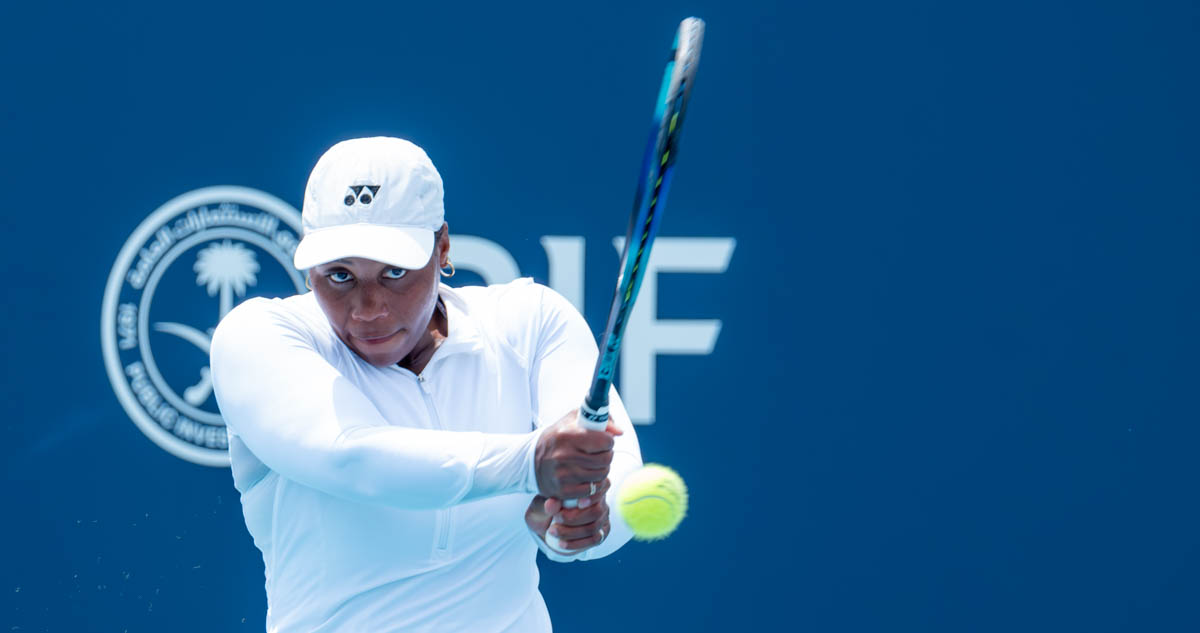
Any Taylor Townsend profile runs into the same contradiction early. She is one of the most successful doubles players of her generation, a three-time Grand Slam champion in the discipline, and she has never won a singles title on the WTA Tour. Both things are true. Neither one explains the other, and the attempt to make them explain each other has followed her for a decade.
The junior who was told to get fitter
Townsend was born in Chicago on 16 April 1996, the daughter of two school administrators, and moved through the American development system early — first to Atlanta, then to the USTA’s training base in Boca Raton as a teenager. In 2012 she won the Australian Open junior singles and doubles titles and finished the season as the world’s No. 1 junior, the first American girl to hold that year-end ranking since Gretchen Rush in 1982.
That same year the USTA withheld funding and coaching support for her competition schedule, citing concerns about her fitness and conditioning. She was 16. The decision drew public criticism from senior figures in the sport, and Townsend has spoken about it repeatedly in the years since, framing it as something done to a teenager rather than something she needed. She turned professional at the end of 2012 and moved on to other coaching.
A left-hander who goes forward
Townsend played right-handed for her first two years before switching, and the left-handed serve has been the spine of her game ever since. The slice serve out wide in the deuce court drags a right-handed returner off the doubles alley and opens the whole court behind it — the same geometry that made left-handers valuable long before power became the sport’s default setting.
What makes her unusual is what she does after the serve. Townsend approaches. She uses a heavy backhand slice to change the height and pace of a rally, then takes the net behind it. In an era where the overwhelming majority of points on both tours are decided from behind the baseline, she has built a professional career on the opposite instinct. Her stated childhood idol was Martina Navratilova, which reads less like trivia than like an explanation.
The serve is the part she is least modest about. The WTA quoted her after a US Open win saying she knows she has “one of the best serves in the world” — and adding that being a lefty helps.
The second career
Townsend gave birth to her son, Adyn Aubrey, in March 2021, and returned to competition in April 2022 through the ITF circuit rather than straight back onto the tour. Almost everything she is now known for came after that return.
Before motherhood she had been a solid but unspectacular singles professional: a third round at Roland Garros in 2014 at 18, a first appearance inside the top 100 in January 2015, a best year-end finish of No. 74 in 2018. After it, she reached the doubles summit of the sport.
The partnership with Siniakova
Townsend began playing with Katerina Siniakova in 2024, and the pairing has won a Grand Slam title in every season since it formed: Wimbledon in 2024, the Australian Open in 2025, Roland Garros in 2026. Siniakova brings the returning and the baseline consistency; Townsend brings the serve and the volleys. Siniakova has described the contrast between their games as the thing that makes the team difficult to read.
In 2026 they won Indian Wells and Miami back to back, becoming the sixth women’s doubles team to complete the Sunshine Double, then added Madrid and Roland Garros. Townsend reached No. 1 in the doubles rankings on 28 July 2025 and spent eight weeks there.
Until September 2026, one gap remained. The pair had won three of the four majors together, and Townsend’s individual career Grand Slam in doubles was missing the same title: the US Open. She had lost US Open finals before — in 2022 alongside Caty McNally, beaten by Siniakova and Barbora Krejcikova, and again in 2025 with Siniakova herself.
Singles, and the US Open exception
Townsend’s singles record is the part that resists a tidy summary. She has never won a WTA singles title and reached her first tour-level final only in 2026, in Austin. Her career-high singles ranking, as listed by the WTA, is No. 46.
And yet at Flushing Meadows she is a different player. In 2019 she came through qualifying, saved a match point to beat the fourth seed Simona Halep in the second round, and reached the fourth round. In 2025 she did it again, beating the fifth seed Mirra Andreeva on the way. Those two runs remain her best results at a major, and both came in New York.
The explanation most often offered is the surface and the crowd, and both are probably part of it. A flat, low slice and a willingness to volley are worth more on a medium-paced hard court than on clay, and Townsend plays visibly better in front of a loud gallery than in front of a quiet one.
Season Snapshot — September 27, 2026
The figures in this section are current as of the date above and will change during the season.
- Doubles ranking: No. 2
- Singles ranking: No. 96
- Career WTA doubles titles: 16
- Grand Slam doubles titles: 3 (Wimbledon 2024, Australian Open 2025, Roland Garros 2026, all with Siniakova)
- 2026 doubles titles: Indian Wells, Miami, Madrid and Roland Garros with Siniakova; Austin with Hunter
- Qualified with Siniakova for a third consecutive WTA Finals
- Coached by Roger Tyzzer
At the 2026 US Open she beat Maja Chwalinska 6-2, 6-3 in the first round and Taylah Preston 6-1, 6-1 in the second, winning all 23 of her first-serve points in that match. She then beat the 15th seed Diana Shnaider to reach the fourth round, where Aryna Sabalenka ended her singles run.
What is still open
She carried it. After Aryna Sabalenka ended her singles run, Townsend and Siniakova, the top seeds, lost the first set of the doubles final to wild cards Ashlyn Krueger and Robin Montgomery and then won 5-7, 6-0, 6-2 on Arthur Ashe Stadium. The title completed Townsend’s career Grand Slam in doubles and the partnership’s, and gave Siniakova a second career Grand Slam, according to the WTA. “If flipping the script had a face,” Townsend said, “you’d see my face.”
The singles question is less answerable. A player ranked outside the top 50 who reaches the second week of a major roughly once every six years is not on an upward curve, but she is also not the sort of player whose results predict the next ones. New York has been the exception often enough that it is no longer obviously an exception.
More player pages are collected in the GTN tennis player profiles index.