

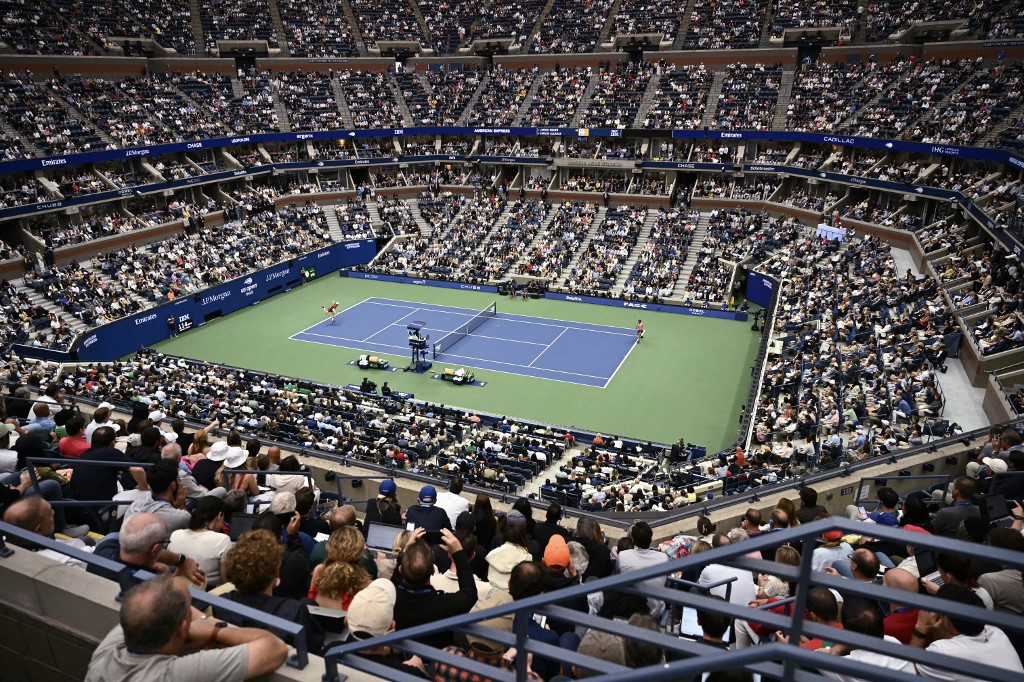
Among the four Grand Slams, the US Open presents a set of challenges that no other major imposes on its competitors in the same combination. The heat and humidity of late-summer New York can be physically punishing. The tournament arrives at the end of a long calendar season in which players have already played sixty matches or more. The North American hard-court swing leading into it is one of the most demanding three-week stretches on tour. The night sessions on Arthur Ashe Stadium routinely run past midnight, with the latest finish in tournament history concluding at 2:50 a.m. And the noise of the largest tennis venue in the world is, by widespread player agreement, more disruptive than the atmosphere at any other Grand Slam.
Players who have won all four Grand Slams routinely identify the US Open as one of the most physically and mentally demanding of the four to win — not because the field is deeper than at the other majors, but because the cumulative pressure of competing in late-August New York is qualitatively different from competing anywhere else. Here is a complete examination of why the US Open is the hardest Grand Slam to win, broken down across the specific factors that make it so.
It Arrives at the End of the Calendar Year
The US Open is the fourth and final Grand Slam of the calendar year. By the time players arrive at Flushing Meadows in late August, they have already competed at the Australian Open in January, the European clay-court season culminating at Roland Garros in late May, and the grass-court season culminating at Wimbledon in early July. Players have played, on average, between 50 and 70 matches over the previous eight months — across three different surfaces — before the US Open’s first ball is struck.
The cumulative physical demand of this schedule has no equivalent at the other three Grand Slams. The Australian Open arrives at the start of the year, when players are fresh from the off-season. Roland Garros and Wimbledon come in the middle of the year, when fatigue is rising but recovery windows are still substantial. The US Open is contested when bodies have already been pushed for eight straight months and the physical reserves of even the most elite players are at their season-low ebb.
This timing favours players who have managed their workload skillfully across the season. It punishes players who have over-committed to the early-year tour calendar, who have played heavy doubles schedules, who have battled injuries through the spring and summer. The player who arrives at Flushing Meadows in the best physical condition has frequently sacrificed depth of competitive results earlier in the year to be ready specifically for this moment. The trade-off between season-long ranking points and US Open readiness is one of the most consequential strategic decisions in modern professional tennis.
The North American Hard-Court Swing Is the Cruelest Lead-In in Tennis
The three weeks immediately before the US Open are dominated by two of the most physically demanding tournaments on the calendar: the Canadian Open (in Toronto or Montreal) and the Cincinnati Open — both Masters 1000 / WTA 1000 events held in conditions that closely resemble what awaits at Flushing Meadows.
The schedule is brutal. Players who reach the final at the Canadian Open the second Sunday of August can be playing their first US Open match approximately 14 days later. Those who reach the final at Cincinnati the third Sunday of August have approximately seven days before their first US Open match. Players competing deep into both events are doing so in roughly the same heat, humidity, and surface conditions that will define the US Open itself — a structural simulation of the demands they will then face on a Grand Slam scale.
The Cincinnati Open in particular has produced some of the most physically punishing matches in tennis. Players regularly cite the combination of heat, humidity, and hard-court demands as among the hardest physical conditions they encounter all year — and they arrive at Cincinnati already exhausted from Toronto/Montreal, with no real opportunity to recover before the US Open begins.
This compressed three-week lead-in is what makes the US Open’s first week so unpredictable. The seedings reflect ranking-based form across the season. The actual physical condition of the field reflects what each player has just been through. A player who has skipped Cincinnati to be fresh for the US Open arrives in better condition than the player who reached the Cincinnati final but loses ranking points. The strategic calculations are intricate, and the physical consequences play out across two weeks at Flushing Meadows.
The Heat and Humidity Are a Genuine Adversary
Late August and early September in New York produce some of the most punishing tennis weather in the Grand Slam calendar. Temperatures regularly exceed 32°C (90°F), humidity routinely passes 70 percent, and the conditions at Flushing Meadows — sitting at low elevation in an open park environment — can produce heat-index readings of 38°C (100°F) or higher on the worst afternoons.
The US Open has had heat rules in place for years, with rest breaks introduced under specified threshold conditions for both men’s and women’s matches. But even with these mitigations, the heat at the US Open remains a structural factor. Matches that begin in the early afternoon under direct sun on Arthur Ashe Stadium — particularly with the roof open — produce conditions in which players visibly struggle to maintain hydration and core body temperature.
Compare this to the other Grand Slams. The Australian Open contends with extreme heat in January, but the venue’s extreme-heat policy now suspends play above specific thresholds. Roland Garros’s late-May climate is variable but rarely produces the sustained, oppressive heat-and-humidity combination of New York in late summer.
Wimbledon’s English summer is among the mildest climates in the four Slams. The US Open’s environmental conditions sit at the end of the spectrum that asks the most of player physiology — and players who have not specifically prepared for these conditions, through training in similar climates or careful pre-tournament conditioning, often find them genuinely punitive.
Arthur Ashe Stadium Is the Loudest Tennis Venue in the World
Arthur Ashe Stadium holds 23,771 spectators — more than the next-largest Grand Slam main court (Court Philippe-Chatrier at around 15,225) by some 8,500 seats. The acoustic effect of a roof closed over an arena of nearly 24,000 reacting fans creates a sound environment that, by widespread player agreement, has no equivalent at any other tennis venue.
The crowd is also distinctively New York. American audiences — particularly New York audiences — bring the habits of basketball, baseball, and football crowds to tennis. They cheer during points. They react audibly to errors. They drink heavily through long afternoons. They are not bound, in the way Wimbledon crowds are, by an inherited expectation of silence between rallies. The combination of size, acoustic conditions, and cultural permission to express themselves produces a venue where the sonic backdrop is genuinely different from the other Grand Slams.
For players, this can be disorienting in ways that go beyond simple distraction. Martina Navratilova has observed that in tennis, you hear the ball before you see it — and that crowd noise at Arthur Ashe Stadium can drown out the auditory cue that elite players use to track the ball. The serve, the impact of strings on ball, the slight scrape of shoes on the court: these auditory signals are part of how players read what is happening on the court at the highest level. The US Open’s crowd noise can mask all of them.
Some players thrive on this. Frances Tiafoe at his 2022 semi-final run, Serena Williams across her career, and Novak Djokovic in his late-career US Open titles have all demonstrated the ability to feed off Arthur Ashe Stadium’s energy. Others have visibly struggled with it. The list of top-ranked players who have underperformed at the US Open is longer than the equivalent list for any other Grand Slam.
The Night Sessions Disrupt Everything About Normal Tennis
The US Open’s night session structure is, in scheduling terms, the most disruptive feature of any Grand Slam calendar. Night sessions begin at 7:00 p.m. local time on Arthur Ashe Stadium (and during the early rounds on Louis Armstrong Stadium as well). Matches that begin at 7:00 p.m. and run to four or five sets can — and frequently do — finish past midnight.
The latest finish in US Open history was the Alcaraz vs. Sinner quarter-final at the 2022 tournament, which ended at 2:50 a.m. local time after 5 hours and 15 minutes of play. Alcaraz won and would go on to claim his first Grand Slam title days later. The 2022 finish broke the previous late-finish record (2:26 a.m., reached three times before) and prompted significant discussion about whether US Open scheduling needed reform.
Tournament director Stacey Allaster has publicly defended the format, explaining that starting the evening session earlier than 7:00 p.m. would make it impossible for New Yorkers to attend on weeknights. Reducing the night session to a single match was considered but rejected as unfair to ticket holders. The result is a scheduling structure in which any night session match can, in principle, run until the early hours of the morning — and players have to plan for that possibility every time they take the court for a 7:00 p.m. start.
The cumulative effect on body clocks, recovery cycles, and pre-match preparation is real. A player whose first match goes to a 2:00 a.m. finish must then return for their next match potentially within 36 hours, in a state of disrupted sleep and incomplete recovery. The night-session structure introduces a level of physical and mental volatility to the US Open that the other Grand Slams — with their generally earlier finishes — do not produce in the same way.
The Surface Rewards a Specific Kind of Player
Hard courts are the dominant surface on the professional tour, and the US Open’s Laykold surface — a medium-fast acrylic compound — sits in the middle of the hard-court spectrum. This means that more players are competitively viable at the US Open than at Roland Garros (where clay-court specialists have a structural advantage) or Wimbledon (where grass-court tennis suits a narrower range of styles).
The breadth of viable contenders is itself a challenge. A player attempting to win the US Open faces seven consecutive matches in which any opponent — including unseeded qualifiers and lower-ranked direct acceptances — can credibly compete at a high level. The Roland Garros draw rewards the player whose game is built for clay, who can rely on the surface to disadvantage flat-hitting opponents.
The Wimbledon draw rewards the grass-court specialist, of which there are now relatively few. The US Open draw rewards the all-court hard-court player who can handle every kind of opposition style — which is to say, a smaller subset of players, with no surface-specific advantage to lean on.
This is what makes upsets at the US Open — particularly in the early rounds — happen with such regularity. A big-server having a hot week, an aggressive baseliner playing above their ranking, a young rising player on a confidence run: any of these can credibly defeat a top-five player at the US Open in a way that would be unlikely at Roland Garros or Wimbledon.
The 2024 US Open’s eventual champion, Jannik Sinner, faced a series of testing four- and five-set matches en route to the title. The 2025 women’s champion, Aryna Sabalenka, dropped sets to lower-ranked opponents through the draw before triumphing in the final.
The Best-of-Five Format Compounds Everything
Like the other three Grand Slams, the US Open men’s singles is contested over best-of-five sets. But the specific demands of the US Open — heat, humidity, late-night finishes, the deep field of hard-court-capable competitors — make a best-of-five match at Flushing Meadows uniquely punishing.
A five-set match in 90°F heat with 70 percent humidity, ending at 1:00 a.m., against a hard-court specialist who has been preparing for these conditions for months, is fundamentally a different physical and mental experience than a five-set match at the Australian Open (where the heat is offset by a closed roof when needed), at Roland Garros (where slower clay produces longer points but cooler conditions), or at Wimbledon (where the climate is forgiving and matches are limited to the 11pm curfew).
The cumulative demand of multiple best-of-five matches across two weeks, in conditions that combine the worst heat-and-humidity in the Grand Slam calendar with the worst late-finish risk, produces a tournament format in which physical fitness becomes the single most reliable predictor of who reaches the second week — and who reaches the trophy.
The 15-Day Format Extends the Demand
In 2025, the US Open expanded to a 15-day format for the first time, adding a Sunday start to the schedule. The additional day extends the tournament’s physical demand by one day for players who reach the second week. For players who must come through qualifying — which begins the week before the main draw — the cumulative physical demand can include up to 10 matches across 18 days.
The 15-day expansion was, in tournament-director terms, a commercial move: more days of play meant more revenue from broadcasts, ticketing, and on-site concessions. In competitive terms, it added an additional layer of physical demand to a tournament that was already at the demanding end of the four-Grand-Slam spectrum.
The Statistical Evidence
The numbers support the intuition. Across the past decade of US Open men’s and women’s singles, first-round seedings have been upset at a rate broadly comparable to Wimbledon — significantly higher than at the Australian Open or Roland Garros. The 2023 US Open saw the first unseeded American man to reach the semifinal in 17 years (Ben Shelton).
The 2025 US Open produced a women’s final between Aryna Sabalenka and Amanda Anisimova — neither of whom would have been considered a top-three favourite by some assessments at the start of the tournament.
Career Grand Slam analyses also support the pattern. Roger Federer won eight Wimbledons and five US Opens. Rafael Nadal won 14 Roland Garros titles and four US Opens. Novak Djokovic won ten Australian Opens and four US Opens. The pattern is consistent: even the very best players in tennis history have found the US Open one of the harder Grand Slams to win in proportion to their dominance at other majors. The combination of conditions, scheduling, surface, and atmospheric pressures makes it the most variable Grand Slam to predict — and the hardest to repeatedly win.
The Bottom Line
The US Open is the hardest Grand Slam to win not because the field is deeper than at the other three majors — though hard-court tennis does produce broader fields than grass or clay — but because the cumulative effect of all the specific challenges the tournament imposes creates a competitive environment that the other Grand Slams do not require players to navigate in combination.
The season fatigue. The North American hard-court swing lead-in. The heat and humidity. The acoustic intensity of Arthur Ashe Stadium. The unpredictability of the night sessions. The 15-day format. The breadth of viable competitors that the surface allows. Each is, individually, manageable. Combined, they produce a tournament in which the gap between excellence and victory is wider than at any other Grand Slam in late summer.
The players who win the US Open — particularly those who win it multiple times — earn a different kind of recognition than the players who dominate any other major. The tournament asks more, in more ways, at more inconvenient moments of the season, than any other event in tennis. That is what makes the US Open, in the assessment of the players who compete there year after year, one of the hardest Grand Slams to win.