

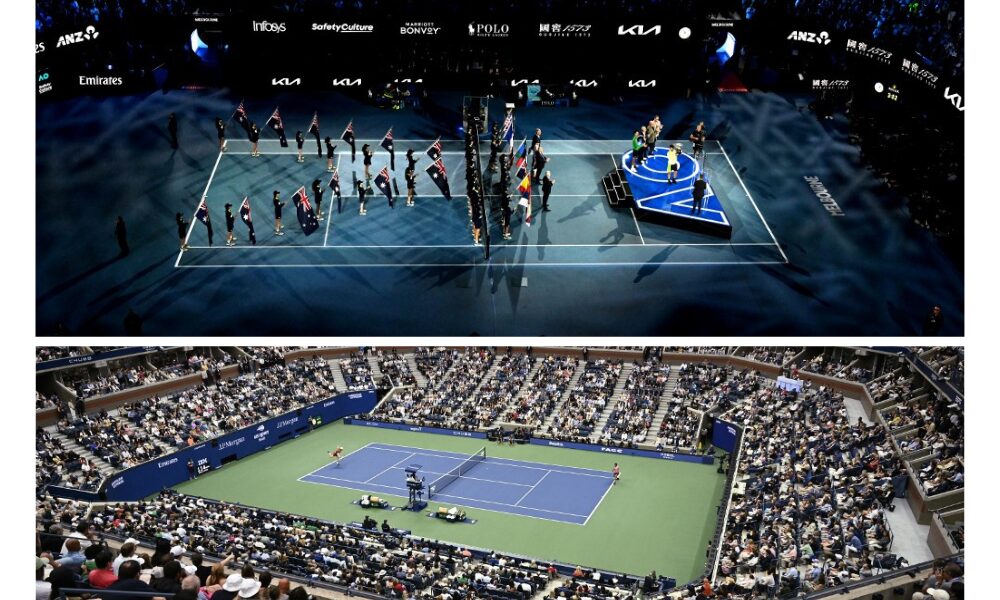
Both the Australian Open and the US Open are played on hard courts, so you’d be forgiven for thinking they play pretty much the same. They don’t. From the surface under players’ feet to the air temperature, the balls, the crowd, and the scheduling, the two tournaments offer very different experiences — on and off the court.
The Same Surface, But Not Really
The most common misconception about these two Grand Slams is that because both are played on hard courts, they must play the same way. In reality, the surfaces at Melbourne Park and Flushing Meadows are quite different products that behave very differently in play.
The Australian Open is played on GreenSet (which replaced Plexicushion when the AO switched suppliers in 2020), classified by the ITF as a Category 4 (Medium Fast) surface. The US Open uses Laykold (introduced in 2020, replacing the long-running DecoTurf that had been the New York surface since 1978), tuned each year for the tournament to a specific Court Pace Rating.
The ITF Court Pace Classification rates surfaces on a 1-to-5 scale — 1 (Slow), 2 (Medium Slow), 3 (Medium), 4 (Medium Fast), 5 (Fast) — but the rating only gives a broad bracket. Within those brackets, tournaments can dial in specific Court Pace Rating numbers year-to-year, and both the Australian Open and US Open adjust their surface formulations between editions. The popular conventional wisdom that the AO plays faster than the US Open has held over most of the past decade, although the US Open has been incrementally speeding up its surface in recent years.
In practical terms, the ball travels faster and stays lower at the Australian Open, while the US Open surface tends to generate slightly more bounce and gives heavy topspin players marginally more time to work with. Serve-and-volley players and big hitters tend to enjoy Melbourne, while grinders who rely on high-bouncing topspin can sometimes exploit the New York surface more effectively. It’s part of why certain players consistently perform better at one tournament than the other, even though both are nominally “hard court” events.
Heat vs. Humidity
Both tournaments have a weather problem, but they’re completely different problems.
The Australian Open contends with extreme dry heat. January in Melbourne can push temperatures above 40°C (104°F), and the tournament operates a formal Extreme Heat Policy — a 1-to-5 Heat Stress Scale — that can suspend play on outside courts when conditions become dangerous.
The heat affects not only how players feel physically, but also how the ball behaves: hot air causes the gas inside the ball to expand, making it bounce higher and travel faster.
The US Open, held in late August and early September, deals with a different beast: humidity. New York’s late-summer air is thick and oppressive, and while temperatures rarely match Melbourne’s extremes, the humidity makes matches feel brutally exhausting in a different way.
The US Open also has its own heat rule — a 10-minute break between the second and third sets in women’s matches and between the third and fourth sets in men’s matches — but it operates without anything as systematic or technologically advanced as the AO’s Heat Stress Scale.
And as temperatures drop during New York’s evening sessions, the ball behaves differently too: cooler air causes the gas inside the ball to contract, producing a lower, flatter bounce than the same ball on the same court would produce in the afternoon heat.
The Ball Itself
Both tournaments use Wilson balls, but the specific ball types used at each event are calibrated differently to suit the surface and conditions. Ball choice has a meaningful effect on pace and spin, and players who’ve competed at both tournaments have noted how differently each ball plays — even when they look almost identical in the hand.
The Australian Open has long had issues with balls “fluffing up” over the course of a match in the Melbourne heat, which further slows the ball and can change the feel of a match as it progresses.
Scheduling and Night Sessions
Both tournaments run day and night sessions, but they have distinct characters.
The US Open night session is one of tennis’s most iconic settings. Matches under the lights of Arthur Ashe Stadium — the biggest tennis stadium in the world, with over 23,700 seats — attract some of the loudest, most energetic crowds in the sport. Night sessions in New York often stretch deep into the night, and the atmosphere is electric in a way that’s unique to New York City.
The Australian Open has wrestled with its own scheduling issues around night sessions. The combination of evening matches that run late and the Melbourne time zone — which puts it in prime daytime viewing slots across Asia and Europe — has sometimes resulted in matches finishing in the early hours of the morning.
A notorious 2023 match between Andy Murray and Thanasi Kokkinakis ended at 4:05am local time. From 2024, the AO restructured its scheduling to reduce this problem, cutting the number of day-session matches on the main courts to avoid pushing night matches so late. For a deeper read on how the AO night session works and its evolving scheduling debate, see Australian Open Night Sessions Explained.
Venue Size and Crowd Culture
The venues are strikingly different in scale and atmosphere. Arthur Ashe Stadium, the US Open’s main court, holds over 23,700 spectators — making it the largest tennis stadium in the world.
Rod Laver Arena at Melbourne Park holds around 15,000. The energy at Arthur Ashe is notoriously intense and vocal; the New York crowd is famous for its noise, opinionated reactions, and willingness to get involved in the match.
Melbourne crowds tend to be more relaxed — in keeping with Australia’s reputation for laid-back sporting culture — but that doesn’t mean they’re quiet. The Australian Open has consistently broken Grand Slam attendance records in recent years, drawing over 1.2 million visitors across the 2025 tournament.
The grounds-pass culture at Melbourne Park means large, festive crowds fill the precinct all day, creating an atmosphere that’s more festival-like than the stadium-centric experience of Flushing Meadows. Three retractable roofs at Melbourne Park (vs. one at the US Open’s Arthur Ashe Stadium) also give the AO more flexibility to manage weather and lighting conditions across multiple courts simultaneously.
Position in the Season
The timing of each tournament shapes how it plays out in ways that go beyond the calendar.
The Australian Open is the first Grand Slam of the year, held in January. Players arrive after an off-season break, which means some are in peak physical condition while others are still finding their rhythm.
For players who’ve spent the off-season training hard, the Australian Open can be the tournament where they make a big statement. For those still getting match-sharp, early exits are common.
The US Open is the final Grand Slam of the year, held in late August and early September. By this point, players have been on tour for months.
Fatigue, injuries, and accumulated wear can be factors — but so can peak form, as the hard court swing preceding the US Open (including major events in Cincinnati and Montreal) gives players extensive match practice.
The title also carries a season-closing significance that the Australian Open, as the opener, simply cannot replicate.
Prize Money
Both tournaments offer some of the largest prize pools in sport, with equal pay for men and women in singles. The US Open set a record in 2024 with a $75 million total prize pool, the largest in tennis history at the time.
The Australian Open’s 2026 prize pool stands at A$111.5 million — equivalent to roughly US$75 million — reflecting the tournament’s rapid growth in financial stature over the past decade. The 2026 figure represents more than a tripling of the prize money offered just ten years earlier, and was the first time the AO crossed the nine-figure threshold in Australian dollars.
Frequently Asked Questions
Is the Australian Open or US Open faster? The Australian Open’s GreenSet surface is generally rated faster than the US Open’s Laykold — historically classified by the ITF as Medium Fast (Category 4) compared to the US Open’s Medium Slow (Category 2). However, both tournaments tune their surfaces each year, and the US Open has been incrementally speeding up its court in recent editions, so the gap can vary tournament to tournament.
What surface does the Australian Open use? GreenSet, a cushioned acrylic hard court applied by GreenSet Worldwide since 2020. It replaced Plexicushion Prestige (used 2008–2019), which itself replaced Rebound Ace (used 1988–2007).
What surface does the US Open use? Laykold Cushion Plus, a cushioned acrylic hard court applied by Advanced Polymer Technology since 2020. It replaced DecoTurf, which had been the US Open surface from 1978 onward.
Do both tournaments use the same balls? Both use Wilson tennis balls, but the specific ball models are calibrated differently to suit each tournament’s surface, climate, and conditions. Players regularly comment on how differently the two balls play, even when they look identical.
Which tournament has the bigger stadium? The US Open’s Arthur Ashe Stadium is the largest tennis stadium in the world, with over 23,700 seats. The Australian Open’s Rod Laver Arena holds around 15,000 — but Melbourne Park as a whole accommodates more than 40,000 spectators across its 35 outdoor courts and three roofed arenas.
Which Slam has more attendees? The Australian Open consistently leads on total attendance, drawing over 1.2 million visitors in 2025 — the highest of any Grand Slam. The US Open also draws large crowds, but Melbourne Park’s grounds-pass culture and larger precinct footprint allow it to host more fans across the tournament fortnight.
Why does the heat affect each tournament differently? Melbourne’s January summer is characterised by extreme dry heat, sometimes exceeding 40°C (104°F) in radiant sun. New York’s late summer features humidity rather than peak temperatures — usually milder in absolute terms but oppressive in feel, with thick air that affects player stamina. The two climates produce different tactical and medical responses on court.
Is the Australian Open or US Open older? The US Open is significantly older. It was first played as the US National Championships in 1881, more than two decades before the first Australian Championships in 1905. The US Open also has older history in its current form, dating to 1968 (Open Era) at Flushing Meadows. The Australian Open didn’t move to its modern home at Melbourne Park until 1988.
The Bottom Line
Calling the Australian Open and US Open “the same kind of tournament” because both are played on hard courts is a bit like saying two restaurants serve the same food because both have kitchens.
The surface speed, the weather, the ball behaviour, the crowds, the scheduling, and the position in the season all combine to make each tournament a genuinely distinct test. Players know it, and so do the tacticians who prepare them.
The hard court Slams may share a surface category, but they demand very different things from the people who want to win them.