

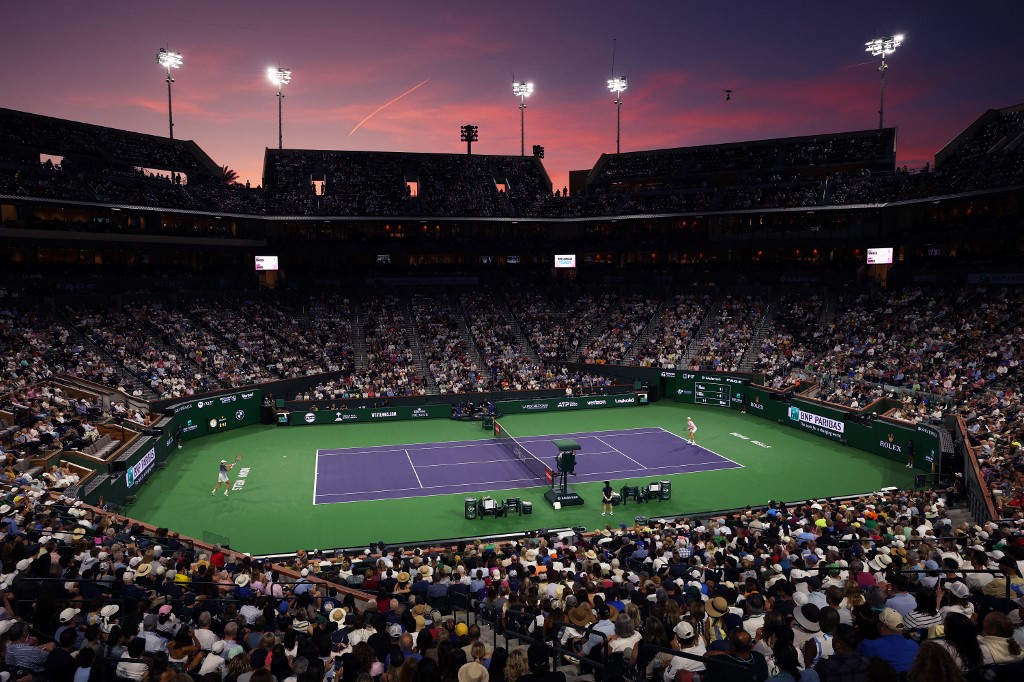
The BNP Paribas Open — better known as Indian Wells — is the first ATP Masters 1000 and WTA 1000 event of the 2026 season, played at the Indian Wells Tennis Garden in the California desert. Often called the “fifth Grand Slam” for its prestige and atmosphere, it opens the hard-court swing that leads directly into Miami.
The basics
Location: Indian Wells, California
Venue: Indian Wells Tennis Garden
Surface: Outdoor hard
Level: ATP Masters 1000; WTA 1000
Dates: March 4–15, 2026
Draw size: Singles 96, Doubles 32
Top seeds
ATP seedings: Carlos Alcaraz (1), Jannik Sinner (2), Novak Djokovic (3), Alexander Zverev (4), Lorenzo Musetti (5), Alex de Minaur (6), Taylor Fritz (7), Ben Shelton (8)
WTA seedings: Aryna Sabalenka (1), Iga Swiatek (2), Elena Rybakina (3), Coco Gauff (4), Jessica Pegula (5), Amanda Anisimova (6), Jasmine Paolini (7), Mirra Andreeva (8)
Five storylines to watch
1) The Sunshine Double opener
Indian Wells is the first half of the Indian Wells–Miami swing, and how players perform here sets the tone for the entire hard-court stretch. A deep run in the California desert means less recovery time heading into Miami, but it also means arriving with match rhythm and momentum. Managing both is one of the defining challenges of the early season.
2) A 96-player draw means early danger matches
With a 96-player singles draw, seeded players receive byes into the second round, but the first match can still be a trap.
Qualifiers arrive with match rhythm, and unseeded main-draw players can be top-30 quality. The desert conditions reward players who are already sharp, and the first week separates those who came in ready from those still finding their legs.
3) Defending champions with everything to protect
Jack Draper won the 2025 men’s title with a 6-2, 6-2 victory against Holger to claim his first Masters 1000 crown. Mirra Andreeva claimed the women’s title by defeating Sabalenka in the final.
Both arrive this year as seeded players protecting a full 1,000-point haul in their first tournament defense at this level. How they handle that pressure is one of the most interesting psychological subplots of the week.
4) The Alcaraz-Djokovic half
The draw placed Alcaraz and Djokovic in the same half of the bracket, setting up a potential blockbuster semifinal between the world No. 1 and the five-time Indian Wells champion. If both navigate the first week cleanly, that match would be the defining contest of the tournament before a ball is struck in the final.
5) WTA rhythm after a quiet February
Sabalenka and Swiatek arrive at Indian Wells having skipped the Middle East tournaments, meaning they come into the California desert without recent competitive matches.
Their opponents in the first week will carry more match sharpness, which in a 96-player draw can be enough to cause a first-week upset. How quickly the top seeds find their footing will shape the entire women’s draw.
Potential quarterfinal collisions
The ATP draw’s most anticipated collision is a potential Alcaraz–Djokovic semifinal, with the two heavyweights landing in the same half of the bracket. Alcaraz cannot face Sinner until a potential final, which means the top two seeds are guaranteed to be kept apart until the championship match — but the same protection does not apply to Alcaraz and Djokovic, who could meet as early as the semifinals.
On the WTA side, Sabalenka and Swiatek are also kept apart until a potential final, but both face difficult quarters with dangerous opponents lurking in the third and fourth rounds.
Floaters who can upset seeds early
Former top-tier contenders Qinwen Zheng, Maria Sakkari, and Paula Badosa arrive with enough big-match experience and shot-making power to turn any seed’s tournament into a nightmare. On the men’s side, Cameron Norrie — the 2021 champion — knows this desert well and remains a dangerous floater against seeds who aren’t yet match-sharp.
Casper Ruud’s heavy topspin game typically translates to Indian Wells, though his recent form coming in is a question mark.
Wild cards and qualifiers to watch
Venus Williams received a wild card for Indian Wells, returning to a tournament she knows well. On the men’s side, home favorites Taylor Fritz, Ben Shelton, Frances Tiafoe and Tommy Paul lead the American charge — all of whom carry crowd support and genuine game to cause early damage to seeded opponents. Watch the qualifier section closely: Indian Wells qualifying regularly produces players with match rhythm who can exploit seeded opponents still finding their footing.
The section of the draw that looks “open”
Identify this once the bracket is published. On the ATP side, the Zverev quarter is considered the most open of the four, with Zverev holding a 13-9 career record at Indian Wells and never advancing past the quarterfinal.
On the WTA side, the Gauff quarter looks the most winnable on paper, with her top threats including Diana Shnaider, Alexandra Eala and Linda Noskova — all capable players who lack the consistency to be reliably backed.
Conditions and how the court plays
Indian Wells is outdoor hard-court tennis in the California desert. The conditions are typically dry and fast, rewarding big servers and clean ball-strikers. Day sessions can play differently from night sessions as temperatures drop, and wind is a genuine factor — Zverev has openly called himself “the worst wind player” on tour, a notable admission at a venue where gusts routinely disturb rhythm and ball tosses.
In a draw this large, players who adjust quickly to shifting conditions tend to separate from the field in the first week.
Players most likely to win
Carlos Alcaraz
Is the overwhelming favorite and the man everyone else is trying to avoid. He arrives in California in strong early-season form, having won both the Australian Open and the Qatar Open.
He is a two-time Indian Wells champion, having won in 2023 and 2024, and is chasing a third title that would place him alongside Federer, Djokovic and Nadal as the only three-time men’s champions this century. His combination of explosive offense and elite defensive range makes him dangerous from any position on the court.
Jannik Sinner
Arrives with unfinished business. He has yet to win a title in 2026, following a semifinal exit at the Australian Open and a quarterfinal defeat in Doha, and Indian Wells represents a chance to find top gear on a surface that suits his baseline control and first-strike patterns. He has reached the Indian Wells semifinals twice before without winning the title, making this week a significant opportunity.
Novak Djokovic
Arrives with history on his side. He holds a joint-record five titles at Indian Wells and is returning after reaching the Australian Open final, where he fell to Alcaraz. His experience, return depth, and ability to manage big-match moments over two weeks make him one of the most dangerous players in the field, even if the question of his motivation in a week without a ranking milestone at stake remains open.
Alexander Zverev
Enters Indian Wells with a record that flatters to deceive — two quarterfinals is his best result in the desert — but his game is in good shape after an Australian Open semifinal that lasted five hours and 27 minutes against Alcaraz. His serve platform and backhand stability hold up well in these conditions, and if he can neutralise the wind factor, he has the tools to go deeper than he has before.
Taylor Fritz
Is the American home favorite with a genuine chance to go deep on familiar hard courts. Fritz is the last American to win the men’s title, having done so in 2022 and the crowd support at the Tennis Garden gives him a meaningful edge in tight matches. His serve-plus-one efficiency plays up in Indian Wells conditions where breaks are scarce and tiebreaks are frequent.
Aryna Sabalenka
is the clear WTA favorite despite arriving without competitive matches since the Australian Open. She is looking to reach her third Indian Wells final in the last four years, and her first-strike power and serve can shorten matches before opponents settle into their rhythm. The key question is how quickly she finds match sharpness in the early rounds.
Iga Swiatek
She is chasing history in Indian Wells. A third title here would make her the first woman to win the Indian Wells singles crown three times. She arrives similarly short on match practice after skipping the Middle East, but her return pressure and baseline consistency are well-suited to hard-court conditions and she has shown repeatedly that she can peak quickly at big events.
Elena Rybakina
Enters Indian Wells as the 2026 Australian Open champion and one of the most dangerous servers in the women’s game. Her flat, clean ball-striking rewards the faster conditions at Indian Wells, and she arrives with far more match rhythm than Sabalenka or Swiatek after a busy start to the season.
Coco Gauff
Is one of the most dangerous players in the women’s draw on home soil. Her elite athletic defense and improving first-strike patterns make her a threat to go deep, and playing in front of American crowds consistently brings out her best tennis in big moments.
Jessica Pegula
Is another American with a genuine shot at making a deep run on home hard courts. Her early-contact game and steady decision-making are well-suited to a 96-player draw, and she has the consistency to grind through awkward matchups in the first week when conditions and opponents are unpredictable.
One sleeper pick
Victoria Mboko is the name to watch on the WTA side. The Canadian teenager enters Indian Wells at the No. 10 seed, and her tennis since winning a WTA 1000 event last year has been consistently impressive.
She has the game and the temperament to make a deep run — and she lands in Sabalenka’s quarter, which means a potential quarterfinal against the world No. 1 if she gets there.
At her current level, that matchup is not as one-sided as it might look on paper. On the men’s side, Sebastian Korda is worth watching after his title run at Delray Beach, arriving with match rhythm and a game built for these conditions.
What it means for rankings
Indian Wells is a Masters 1000 and WTA 1000 week, so the points leverage is large. A deep run can swing seeding and momentum heading into Miami and the clay season, while a poor week creates immediate pressure because of how the rolling 52-week system drops points from the same window a year earlier.
For Draper and Andreeva as defending champions, protecting a full 1,000-point haul while navigating a loaded field is the defining challenge of their week.
Related reading
Tennis Rankings Explained | Masters 1000 Guide | WTA 1000 Guide | How Tennis Seeding Works | How Wild Cards Work in Tennis | How Tennis Qualifying Works | What Is a Lucky Loser in Tennis