

The surface a tennis court is made of changes almost everything about how the game is played. Ball speed, bounce height, slide distance, the viability of different shot trajectories — all of it shifts when the surface changes, and the players who have built their games around one set of conditions do not always transfer that quality to another.
The split between clay court specialists and hard court specialists is one of the oldest storylines in men’s tennis, and the current tour offers a vivid cross-section of both types.
Why Clay Suits Certain Games
The physical properties of clay reward a specific style of play. The slower surface and higher bounce give defenders more time to retrieve, which neutralises powerful flat hitting and extends rallies. Players who thrive on clay tend to generate heavy topspin, move fluidly from side to side along the baseline, and have the physical endurance to sustain long exchanges without their level dropping.
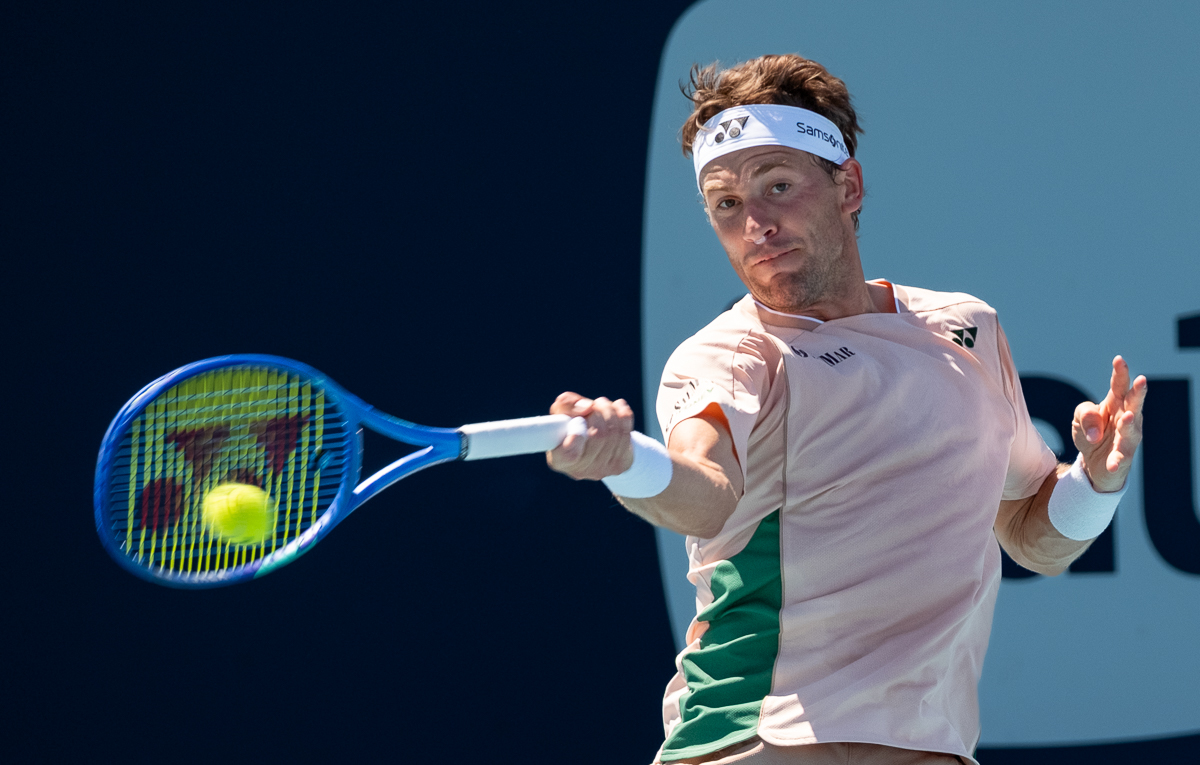
Casper Ruud is the clearest current example of a player shaped almost entirely by the surface. Ruud is primarily an offensive baseliner who hits with heavy topspin, and has won 12 of his 14 career titles on clay.
His footwork is optimised for the slide — the technique clay court players use to glide into the ball and maintain balance without stopping abruptly — and his forehand in particular becomes a weapon of a different order when the surface slows the ball enough to let him load up.
On hard courts, where the ball arrives faster and lower, those same patterns are harder to execute. Ruud himself acknowledged the structural problem at the 2024 ATP Finals, saying: “In my eyes, it’s too late to change what kind of player I am at this point. I’m 25. The structure of my game is already there. I’m not going to start playing super flat or different style of tennis now.”
Carlos Alcaraz is a different case — a player whose clay court dominance is built not just on topspin but on athleticism and the ability to dictate physically. He lost just once on clay in 2025, winning Monte-Carlo, Rome and Roland Garros, and has 11 of his career titles on the surface.
But Alcaraz also wins on hard courts, which places him in a separate category from Ruud. The reason he tilts toward clay is more subtle: the extra time the surface provides suits his tendency to construct points at high intensity, dragging opponents wide and then finishing at the net. On faster surfaces those constructions get compressed, and errors creep in.
Why Hard Courts Suit Different Games
At the other end of the spectrum sit players whose games are built for pace and precision on hard courts. The flat trajectories, the serve-driven point structures, the premium on clean ball-striking over extended rallies — all of this rewards a different physical profile.
The change is most exposed during the North American swing, when players move from European clay to the hard courts of Toronto, the Cincinnati Open and New York inside a few weeks, with little time to adapt.
Taylor Fritz exemplifies the hard court archetype. Fritz has yet to win a title on clay, and the surface is by some distance his weakest. The reason is structural: his game is built around a powerful flat serve and a forehand that functions best when he can end points early.
On clay those short points are harder to construct, errors accumulate when balls kick up unpredictably, and the sliding footwork required is not native to a player developed primarily on hard courts.
Fritz’s clay record in 2025 was 3-4, including a first-round exit at Roland Garros. The surface does not suit the way he generates power or moves through the court, and the honest assessment from his own camp is that the clay season is the most expendable part of his calendar.
Jannik Sinner represents a fascinating counterpoint — a player widely identified as a hard court specialist who has proven more adaptable on clay than his profile suggests. Sinner has a clay win rate of 73 percent and has regularly reached the business end of big clay events, but has just one title on the surface — an ATP 250 in Umag — and came within a point of winning Roland Garros in 2025.
The reason Sinner functions on clay despite being fundamentally a hard court player is his return game and defensive positioning. He does not need to construct clay-specific patterns because his ability to redirect pace and build pressure from the back of the court translates across surfaces. He is harder to break down than most hard court players, which is a quality the slow surface rewards.
The Footwork Question
Underpinning most surface-specific strengths and weaknesses is footwork. Clay requires a sliding technique that takes years to develop instinctively — players raised on clay from junior level acquire it naturally, while those who grew up on hard courts must actively learn it and integrate it under match pressure.
This is one reason American men have historically underperformed on clay. Fritz is described as the only American in his generation who genuinely embraced the clay challenge from early in his career, and his commitment has gradually influenced others on the US tour. But even that commitment operates within limits set by the physical memory of how a player learned the game.
The players who transcend surface splits — Alcaraz, Djokovic in his prime, and increasingly Sinner — are those who have combined technical adaptability with the physical attributes to compete regardless of conditions. For everyone else, the surface switch twice a year remains one of the most revealing tests in the sport.