

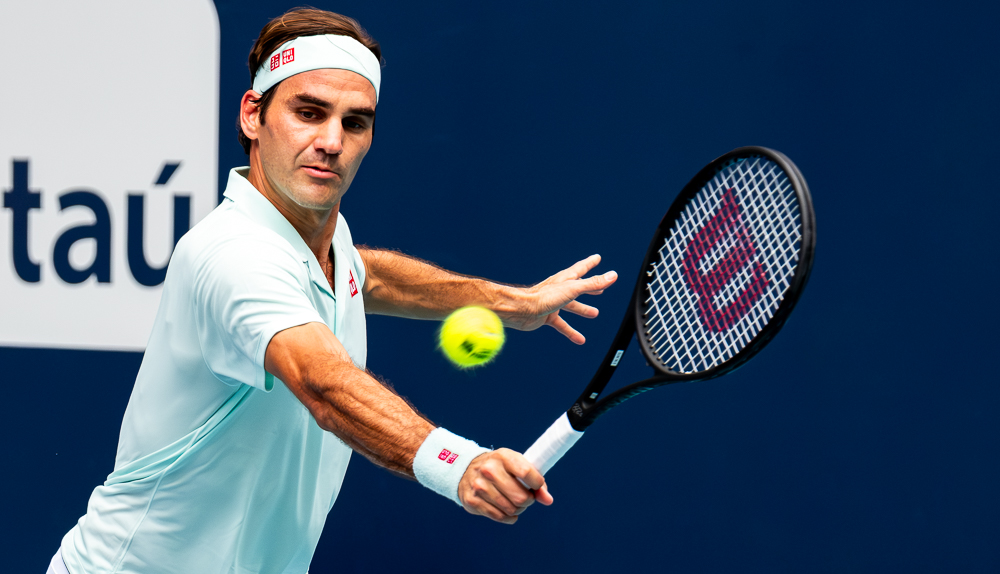
Update — Aug. 24, 2026: The exhibition is tomorrow night. Federer plays alongside Andy Roddick against Andre Agassi and John McEnroe at Arthur Ashe Stadium on Tuesday, Aug. 25 — his first appearance at Flushing Meadows since 2019, and his first on that court since he won the last of five consecutive US Open titles there. US Open qualifying began on the grounds today, so the exhibition lands inside a Fan Week already open to the public, though the Ashe session itself remains a separately ticketed event.
Update — Aug. 22, 2026: The exhibition is three days out. ESPN has confirmed live coverage from 8 to 10 p.m. ET on Tuesday, Aug. 25 across ESPN2, Disney+ and ESPN+, which gives fans priced out of Arthur Ashe a way to watch it without a resale ticket. The event still requires a separate paid ticket on site and is not covered by the free Fan Access Pass that now governs grounds entry during Fan Week — see our guide to what the pass does and does not include.
Roger Federer will walk back onto Arthur Ashe Stadium on the evening of Tuesday 25 August, four years after retiring, for a doubles exhibition alongside three men who also once owned the place. Billed by the USTA as Roger Federer: An Icon Returns to New York, the match pairs Federer with Andy Roddick against Andre Agassi and John McEnroe. It is, on paper, the feel-good booking of the American summer. In practice, it has become the most argued-about ticket in tennis.
Resale listings for the one-off USTA-organised event have climbed to levels that have startled even a sport accustomed to premium pricing. Tennis Temple reported this week that entry-level resale seats were trading from roughly $240, with the better positions comfortably into four figures and the most expensive listings reaching as high as $24,000. Secondary marketplaces tell a similar story: Vivid Seats has listed the cheapest available seats at around $243 against an average nearer $1,256.
The reaction has split along a predictable but revealing line. Federer’s return is, for a certain generation of fans, the closest thing tennis has to a reunion tour. It is also, at those prices, something most of them will watch on a screen.
A five-time champion, one night only
Federer won the US Open five times — consecutively, from 2004 to 2008, a run no other player of either sex has matched — and finished his career with 20 major titles and 103 tour-level trophies. Arthur Ashe was where he built a good deal of that legend, and where New York gave him the nickname “Darth Federer” for the all-black kit he wore in night sessions. He last competed at the tournament in 2019.
The exhibition headlines Fan Week, the run of events that precedes the main singles draw, rather than sitting inside the championship itself. It also lands four days before Federer is inducted into the International Tennis Hall of Fame in Newport, Rhode Island, on 29 August — selected in his first year of eligibility. The New York night is, in effect, the opening act of his enshrinement week.
He framed the return in warm, uncomplicated terms when it was announced. The US Open has always been one of the most special tournaments for me, he said, adding that the stadium means a great deal to him and that he had missed the energy the crowd brings each year.
The format is a doubles match under lights, scheduled for 7 p.m., with all four participants former champions at Flushing Meadows. Tickets went on general sale on 11 June through Ticketmaster and the tournament’s own site, and were absorbed quickly.
It follows a pattern Federer established earlier in the year. Having stepped away for good at the 2022 Laver Cup, he edged back into public view in 2026 with a practice session and an exhibition appearance in Melbourne — enough to reassure a fanbase that had spent four years reading meaning into his every gym video, and enough to make New York inevitable.
The sceptics
Not everyone is convinced the occasion will land. Jon Wertheim has publicly questioned whether the format can work, and he is not alone in wondering what an exhibition doubles match between four men aged between their mid-forties and late sixties actually delivers beyond the walk-on.
The argument is not really about whether Federer can still hit a backhand. It is about what these nights are becoming, and where they are being placed. Because the exhibition sits in Fan Week rather than the main draw, it displaces no competitive tennis — a point in the USTA’s favor.
But Fan Week is also the part of the fortnight built around access: the week when the grounds are at their most open and the barrier to seeing tennis at Flushing Meadows is at its lowest. Making its marquee evening the most expensive ticket of the entire tournament inverts that logic. When a nostalgia doubles match commands a resale ceiling beyond what a fan would pay to watch the world’s best compete for the actual title, it is fair to ask what is being sold, and to whom.
Others push back that this is simply supply and demand doing its work, and that the USTA can hardly be blamed for the resale market. Tickets were sold at face value through official channels; what happened afterwards is the same thing that happens to any scarce cultural event. The counter-counter-argument is that scarcity was a choice — one night, one match, one stadium.
The commercial logic is not subtle
Nor is it new. Tennis has spent the past several years discovering how much of its audience is attached to players rather than to the sport’s competitive structure — an insight that has produced exhibition circuits, legends nights and hybrid events across the calendar. Federer at Ashe is the purest expression of that discovery yet: an evening whose entire value proposition is memory.
That it works is not really in dispute. Whether it is good for the tournament that hosts it is a different question, and one the US Open will face again, because there is no version of this that happens only once. If a Federer night can command these numbers, so eventually can others.
What to watch
Three things will determine how this is remembered by September. Whether the match itself has any competitive texture, or plays as a scripted exhibition with a highlight reel attached. Whether the atmosphere inside Ashe justifies a premium that has already priced out much of the crowd that made Federer’s night sessions famous in the first place.
And whether the USTA reads the reaction as a mandate or a warning. Federer, for his part, has never been the difficult part of this equation. He said he missed the noise. On 25 August, he will get it.