

The world number one ranking and Grand Slam titles are professional tennis’s two most celebrated measures of excellence — and in most cases they go together. The players who spend the most weeks at the top of the rankings tend to be the players with the most Grand Slam titles.
The players who win the most Grand Slams tend to spend the most time at number one. The relationship between the two achievements is close enough that it is easy to assume they are inseparable — that reaching the top of the professional rankings requires winning at least one of the sport’s four most important events.
It does not. The ranking system measures accumulated performance across the full professional calendar — at Grand Slams, at Masters events, at 500 and 250 level tournaments, across the full breadth of the competitive year.
A player who is consistently excellent across the full calendar can reach the top of the rankings without winning any single Grand Slam, if their results across the full range of events are collectively superior to everyone else’s.
This article examines the players — men and women — who reached world number one without ever winning a Grand Slam singles title. Their stories illuminate something important about what the ranking system measures, how it differs from Grand Slam title counts as a measure of excellence, and what it means to be the best professional tennis player in the world by one measure while never achieving the most celebrated single result the sport offers.
Why Reaching Number One Without a Grand Slam Is Possible
Understanding how a player can reach world number one without winning a Grand Slam requires understanding the specific mechanics of the ranking system — particularly the relationship between Grand Slam points and the points available at other events.
A Grand Slam title is worth 2,000 ranking points — the highest single result available in professional tennis. But the ranking is calculated from a player’s best results across multiple tournaments, not from a single result.
A player who consistently reaches the semifinals and finals of Masters 1000 events — worth 400 and 650 points respectively — across eight or nine events in a season accumulates ranking points that can approach or exceed the total generated by a single Grand Slam title combined with mediocre results everywhere else.
The ranking system is therefore specifically designed to reward sustained consistency across the full calendar rather than peak performance at the four most important events alone.
A player who is reliably excellent at Masters events, who makes consistent deep runs at Grand Slams without winning them, and who accumulates points across the full range of tour events can reach the top of the rankings — and can hold it for extended periods — without the single defining Grand Slam victory that popular perception treats as the prerequisite for number one status.
This is not a flaw in the ranking system. It is a deliberate feature — the recognition that sustained excellence across the full professional calendar is a genuine and significant achievement that deserves recognition even when it is not accompanied by the concentrated peak performances that Grand Slam titles require.
Men Who Reached Number One Without a Grand Slam
Marcelo Rios — The Most Discussed Case
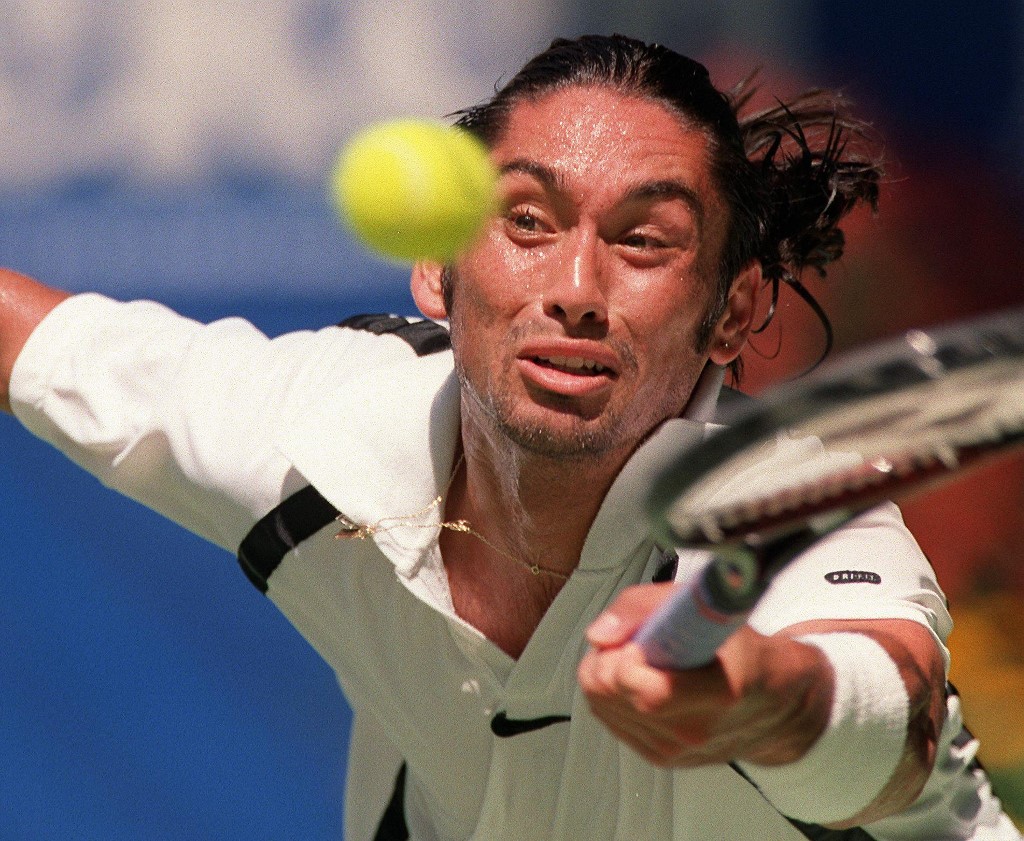
Marcelo Rios is the most discussed player in the history of men’s tennis to reach world number one without winning a Grand Slam — and his case has become the reference point for every subsequent discussion of the relationship between the ranking and Grand Slam titles.
Rios was born in Santiago, Chile in December 1975 and turned professional in 1994. He reached world number one on March 30, 1998, at the age of twenty-two — the first South American player to reach the top of the men’s rankings — following a period of sustained excellence that included multiple Masters titles and consistent deep runs at Grand Slam events without a title.
His closest approach to a Grand Slam title came at the 1998 Australian Open, where he reached the final before losing to Petr Korda. Had he won that match, the entire narrative of his career and the discussion around number one without a Grand Slam would have been different. Instead, his final loss meant that his subsequent ranking — which reached number one just weeks after the Australian Open — was built entirely on results below the Grand Slam title level.
Rios’s game was built around exceptional touch, variety, and tactical sophistication — a left-handed game that combined flat groundstrokes, heavy spin, and net approaches in ways that created problems for opponents who were more powerful but less varied. At his best, he was one of the most complete tacticians in men’s tennis and the player most capable of disrupting the rhythm of opponents who relied on power and pace.
His personal conduct — widely described as difficult, combative, and occasionally hostile to opponents, officials, and media — created a reputation that overshadowed his tennis and contributed to a narrative in which his failure to win a Grand Slam was treated as a moral verdict rather than simply a competitive result.
That framing is unfair to what he achieved. Reaching world number one in men’s professional tennis requires competitive excellence of the highest order, regardless of whether it is accompanied by a Grand Slam title.
Rios held the number one ranking for six weeks before relinquishing it and never returned to the top position. His total of six weeks at number one is the shortest extended reign at the top of the men’s rankings in the Open Era, which reflects both the specific circumstances of his arrival at number one and the career arc that followed it.
Lleyton Hewitt — Briefly at Number One Before His Grand Slam Wins
Lleyton Hewitt’s specific case is more nuanced than a simple number one without a Grand Slam categorization. Hewitt reached number one at the 2001 US Open — which he won — so his first number one was accompanied by a Grand Slam title.
But the record of his ranking trajectory shows that he held the number one ranking briefly before winning that title, making his case technically relevant to this discussion even though it is not the central example.
The more straightforward version of Hewitt’s case is less relevant here than Rios’s, and his inclusion is primarily for completeness in the historical record.
Dinara Safina — A Case Worth Noting on Both Tours
While primarily relevant to the women’s discussion below, it is worth noting here that the phenomenon of number one without Grand Slam is not gender-specific — it reflects the ranking system’s structure rather than any quality specific to men’s or women’s tennis.
Women Who Reached Number One Without a Grand Slam
The women’s tour has produced more prominent examples of players reaching number one without winning a Grand Slam — partly reflecting the greater competitive depth and more frequent ranking changes that have characterized the WTA tour in certain periods.
Dinara Safina — The Most Recent Major Case
Dinara Safina is the most recent prominent example of a player who held the world number one ranking without winning a Grand Slam singles title — and her case is the most discussed in women’s tennis since the WTA ranking system began.
Safina was born in Moscow, Russia in April 1986 — the younger sister of Marat Safin — and turned professional in 2000. She reached world number one in April 2009 following a period of sustained results that included three Grand Slam final appearances — the 2008 Roland Garros final, the 2008 US Open final, and the 2009 Australian Open final — without a title. Her record of reaching three consecutive Grand Slam finals without winning any of them is among the most dramatic near-miss sequences in women’s tennis history.
Her arrival at number one without a Grand Slam title generated significant media discussion and considerable criticism — some observers argued that reaching three Grand Slam finals and losing all three was evidence of a fundamental inability to win under maximum pressure rather than simply competitive misfortune. That framing is worth examining carefully.
Safina lost her three Grand Slam finals to Ana Ivanovic, Serena Williams, and Serena Williams respectively — opponents who were competitive peaks rather than accessible victories. Her losses were not evidence of a psychological inability to win Grand Slams so much as evidence of the specific difficulty of winning Grand Slams against opponents performing at their best.
The ranking she accumulated — genuinely earned through sustained consistency across the full calendar — was a legitimate measure of her competitive level even without a Grand Slam title to accompany it.
She held the world number one ranking for twenty-six weeks across 2009 before Serena Williams displaced her. The competitive relationship between the two players — Williams winning the Grand Slams that Safina could not — illustrates the specific gap between ranking-based excellence and Grand Slam title excellence that this article examines.
Jelena Jankovic — Number One Across 2008
Jelena Jankovic reached world number one in August 2008 and held the ranking for eighteen weeks across 2008 and 2009 — a reign that included the year-end number one distinction for 2008 without a Grand Slam singles title to accompany it.
Jankovic was born in Belgrade, Serbia in February 1985 and built her career around exceptional defensive retrieving, consistent baseline performance, and competitive depth across the full range of tour events.
She reached four Grand Slam finals without winning any — a pattern that paralleled Safina’s and reflected a similar competitive profile: excellent enough across the full calendar to reach the top of the rankings, not quite able to win the Grand Slams that would have made her ranking unambiguous.
Her closest approach to a Grand Slam title came at the 2008 US Open — where she reached the final before losing to Serena Williams — and at Roland Garros in 2007 and 2008, where she reached the semifinals and final respectively.
The specific competitive obstacle in her path to Grand Slam titles was frequently Serena Williams — a pattern that reflects the difficulty of winning Grand Slams in an era when Williams was the dominant force at the sport’s most important events.
Ana Ivanovic — Number One in 2008, Before and After Her Grand Slam
Ana Ivanovic’s case is different from Safina’s and Jankovic’s in an important way. She reached world number one in June 2008 following her Roland Garros title — her Grand Slam win accompanied her arrival at number one rather than being absent from it.
Her inclusion in this discussion requires clarification: she is not a player who reached number one without a Grand Slam, but she is part of the broader 2008 narrative that makes this section of women’s tennis history particularly rich.
The 2008 WTA ranking picture — in which Ivanovic, Jankovic, and Safina each held the number one ranking at different points in the same calendar year, with only Ivanovic having a Grand Slam title — illustrates the specific competitive fragmentation that can produce number one without Grand Slam in women’s tennis.
Amélie Mauresmo — Reached Number One Before Her Grand Slam Wins
Amélie Mauresmo’s case is technically similar to Hewitt’s on the men’s side — she held the world number one ranking before winning her first Grand Slam title, making her briefly a number one without a Grand Slam before her titles arrived to resolve the situation.
Mauresmo reached number one for the first time in September 2004 but did not win her first Grand Slam until the 2006 Australian Open — meaning she held the number one ranking for extended periods across 2004 and 2005 without a Grand Slam title.
Her eventual Grand Slam success confirmed that the ranking she had accumulated was an accurate reflection of her competitive level, and her case illustrates how the number one without Grand Slam situation can be temporary rather than permanent.
Caroline Wozniacki — Two Years at Number One Without a Grand Slam
Caroline Wozniacki is the most prominent recent example in women’s tennis of a player who spent an extended period at world number one without a Grand Slam singles title — holding the top ranking for 71 weeks across 2010 and 2011 without winning any of the four majors.
Wozniacki was born in Odense, Denmark in July 1990 and built her career around exceptional consistency, extraordinary defensive retrieving, and the ability to extend rallies and outlast opponents in a style that generated consistent results across the full range of tour events. Her consistency was genuine — she reached the US Open final in 2009 and 2014 without winning either — but her game in its peak years lacked the offensive weaponry that Grand Slam titles have generally required in the modern era.
Her extended period at number one without a Grand Slam generated more sustained media criticism than any other comparable case in women’s tennis history. The criticism often conflated two separate questions — whether her ranking was legitimate and whether her game was capable of winning Grand Slams — treating the absence of a Grand Slam as evidence that the ranking was somehow fraudulent rather than recognizing them as different measures of different qualities.
Wozniacki eventually won the Australian Open in 2018 — nine years after her first US Open final — completing a career that demonstrated both the legitimacy of her extended number one periods and the genuine difficulty of converting consistent excellence into Grand Slam titles. The 2018 Australian Open victory did not retroactively validate her earlier rankings — they were already valid — but it resolved the specific question of whether she could win at the Grand Slam level that her career had left open for nearly a decade.
Kim Clijsters — Multiple Number One Periods Including One Before Grand Slams
Kim Clijsters held the world number one ranking for extended periods before winning her first Grand Slam title — accumulating weeks at the top of the rankings from 2003 onward while her Grand Slam results included multiple final losses rather than titles. Her first Grand Slam win came at the 2005 US Open, by which point she had already spent considerable time as the top-ranked player in women’s tennis.
Clijsters’s case illustrates the specific pattern in which number one without Grand Slam is a transitional rather than permanent state — a period when consistent excellence across the calendar has produced the top ranking before the specific results at the most important events have followed. Her eventual four Grand Slam titles confirmed that the ranking was an accurate early assessment of her competitive level.
What These Cases Tell Us About the Ranking System
The players examined in this article collectively illuminate several important truths about what the world number one ranking measures and how it relates to Grand Slam titles.
The ranking measures breadth of excellence, Grand Slams measure peaks. A player can be the most consistent and reliable performer across the full professional calendar — at Masters events, at 500s, at the early rounds of Grand Slams — without producing the specific peak performances at the most important events that Grand Slam titles require. The ranking and the Grand Slam count are measuring related but genuinely different things.
Grand Slam titles require specific conditions that consistency does not guarantee. Winning a Grand Slam requires seven consecutive victories over two weeks against the full depth of the field. Even the most consistent player in the world can fail to win a Grand Slam if their peak performance across a specific fortnight does not exceed everyone else’s. Consistency across the calendar does not guarantee peak performance at any specific event.
The criticism directed at number one without Grand Slam reveals assumptions about what number one should mean. The media discussion around Safina, Jankovic, and Wozniacki was often framed as a challenge to the legitimacy of their rankings rather than simply an observation about the gap between two different measures of excellence. That framing reflects a cultural assumption that Grand Slam titles are the real measure of tennis greatness and that number one without Grand Slams is somehow less valid. The ranking system does not share that assumption — it measures what it measures and produces results accordingly.
Some cases resolve and some do not. Wozniacki, Clijsters, and Mauresmo eventually won Grand Slams, converting their number one status into a complete competitive record. Rios and Safina did not. The difference between these outcomes is not primarily a reflection of the legitimacy of their rankings but of the specific competitive circumstances and career trajectories that followed their arrivals at number one.
Key Cases at a Glance
Men who held number one without a Grand Slam:
- Marcelo Rios — 6 weeks at number one, 1998, career Grand Slam titles: 0
Women who held number one without a Grand Slam for extended periods:
- Caroline Wozniacki — 71 weeks at number one, 2010–2011, Grand Slam titles at the time: 0 (won Australian Open 2018)
- Dinara Safina — 26 weeks at number one, 2009, career Grand Slam titles: 0
- Jelena Jankovic — 18 weeks at number one, 2008–2009, career Grand Slam titles: 0
- Kim Clijsters — extended weeks at number one before first Grand Slam title in 2005
- Amélie Mauresmo — extended weeks at number one before first Grand Slam title in 2006
The Rarity on the Men’s Tour
One of the most striking features of this topic is how rare the men’s examples are. Marcelo Rios remains the only man in the full history of the ATP computerized rankings to have held the world number one ranking without ever winning a Grand Slam singles title. Every other man who has reached number one in the Open Era has won at least one Grand Slam.
This rarity reflects the specific structure of men’s tennis — the best-of-five sets format at Grand Slams, which gives the better player more time to assert superiority and reduces the role of single-match variance in determining outcomes, and the specific competitive depth of the men’s tour at the Grand Slam level, which means reaching number one on the men’s tour has historically been closely associated with the Grand Slam results that produce the most points.
The women’s examples are more numerous partly because the best-of-three format at women’s Grand Slams introduces more variance — a single poor set can end a Grand Slam campaign in a way that best-of-five is more resistant to — and partly because the WTA tour has historically produced more frequent changes in the competitive landscape that have created windows for consistent performers to reach number one through calendar depth rather than Grand Slam peaks.
Number One Is Still Number One
The players examined in this article reached the highest individual ranking in professional tennis — a position that requires outperforming every other professional player on the planet across the full breadth of the competitive calendar.
That achievement does not require a footnote about the absence of a Grand Slam title. It is what it is — the most comprehensive available measure of sustained professional excellence across the full range of competitive contexts that professional tennis provides.
The Grand Slam title is a different thing. It measures the ability to win seven consecutive matches at one of four specific events against the full depth of the professional field. It is a genuine measure of something important — peak excellence under maximum competitive pressure. It is not the same as the ranking, and conflating the two produces misreadings of what both achievements mean.
Number one is still number one. The absence of a Grand Slam does not change what it took to get there.
Part of the Rankings series. Related: Who Has Spent the Most Weeks at World Number One in Tennis History · The Most Grand Slam Singles Titles in Tennis History · The Youngest Players to Reach World Number One in Tennis History