

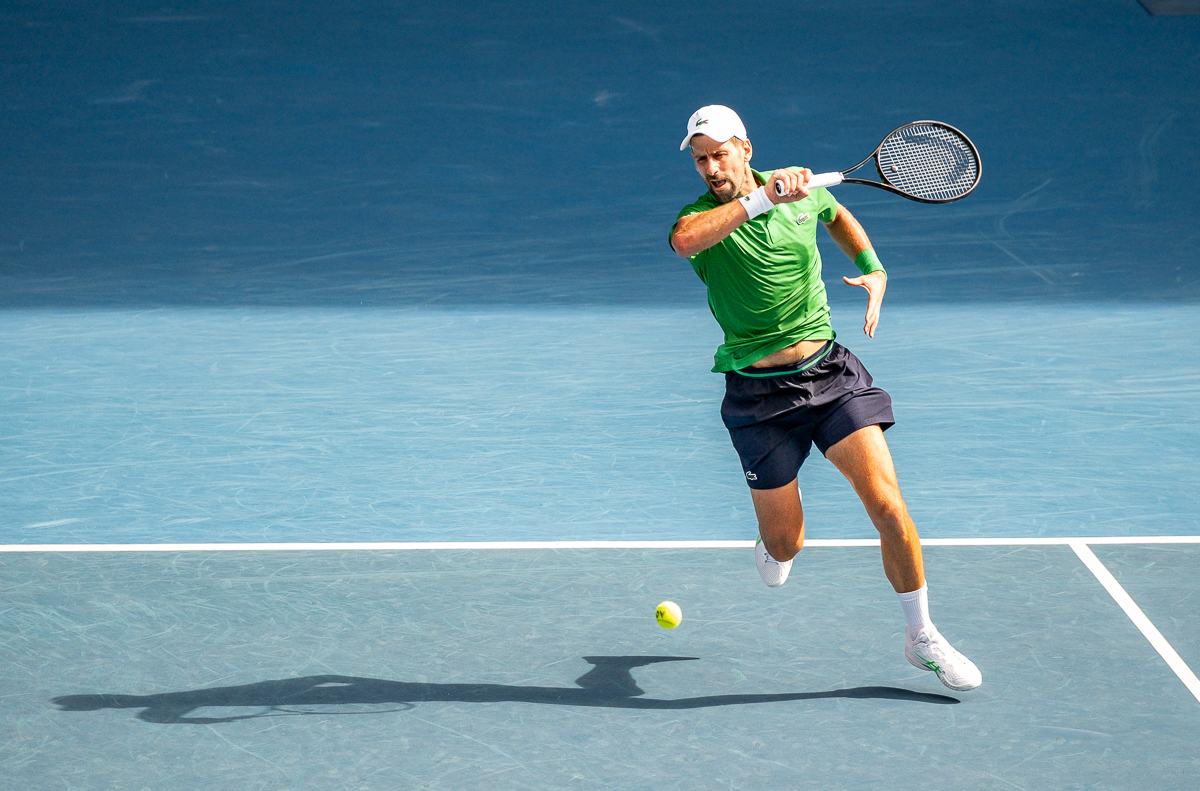
Watch a professional tennis match from the 1980s and then watch one from today. The difference is immediate and striking — not just in equipment, athleticism, or racket technology, but in where the players are standing.
Thirty or forty years ago, professional players competed from a variety of court positions. Serve-and-volley specialists lived at the net. Counterpunchers retreated far behind the baseline to absorb pace and redirect it. All-court players moved fluidly between the baseline, the service line, and the net depending on the situation.
Today, the vast majority of professional tennis is played from the baseline. And within that baseline dominance, a further shift has occurred that receives less attention but matters enormously: players are not just playing from the baseline — they are playing closer to it, inside it, and on top of it in ways that would have been tactically unusual or physically impossible for most professionals a generation ago.
Understanding how court position has changed the modern baseline game — what drove the shift, what it looks like in practice, and what it means for how the sport is played and watched — is one of the most revealing analytical lenses available for following professional tennis today.
What Court Position Actually Means
Before examining how court position has changed, it helps to be precise about what court position means in tennis and why it matters.
Court position refers to where a player is standing relative to the baseline when they strike the ball. There are three broad positions: inside the baseline, on the baseline, and behind the baseline. Each produces a fundamentally different competitive situation.
A player standing inside the baseline — between the service line and the baseline — is taking the ball early, before it reaches its peak height after the bounce. This position compresses time for the opponent, generates sharper angles, and allows the player to redirect pace rather than generate it from a standing start. It is an aggressive position that rewards clean ball-striking and imposes significant time pressure on the opponent.
A player standing on or just behind the baseline is in the standard competitive position for most professional tennis. They have time to set their feet, prepare their swing, and generate pace with a full backswing. The ball arrives at a comfortable height — typically between knee and shoulder — and the player can execute their full technical repertoire without being rushed.
A player standing significantly behind the baseline — sometimes several meters back — is in a defensive position. They have more time to reach wide balls, more margin for the ball to drop before they strike it, and more physical space to work with.
But they are also further from the net, which means their shots travel further to reach the opponent and have less angular potential. They are trading time for safety, accepting a passive position in the hope of recovering and counterattacking.
The evolution of professional tennis over the past three decades has been, in simplified terms, a story of the entire competitive baseline moving forward — with the players who have moved furthest forward gaining the greatest competitive advantage.
Where Players Stood Before: The Historical Baseline
To understand how dramatically court position has changed, it is worth establishing where professional players typically competed from in earlier eras of the sport.
Through the 1970s and into the 1980s, professional tennis featured genuine stylistic diversity in court positioning. Serve-and-volley players — those who served and immediately moved toward the net to play a volley — were a significant presence on all surfaces, not just grass. Players like John McEnroe, Stefan Edberg, and Pat Cash built their games around net approaches and were capable of spending long stretches of matches well forward of the baseline.
At the other end of the positioning spectrum, clay court specialists retreated well behind the baseline to neutralize pace, extend rallies, and rely on their superior movement and endurance to outlast opponents in long exchanges.
Bjorn Borg’s baseline game was conducted further back than most modern professionals would consider competitive, but the combination of his topspin, his movement, and the slower equipment of the era made it devastatingly effective.
What all of these positions shared was variety — within a single match, and certainly across a tournament, a fan watching professional tennis would see players at multiple different court positions, employing genuinely different tactical approaches. The net was a contested space. The area behind the baseline was a viable competitive zone. Court position was a variable, not a constant.
What Changed: Racket Technology and Topspin
The single most important driver of the shift toward closer baseline positioning was the evolution of racket technology and its interaction with the mechanics of topspin groundstrokes.
The transition from wooden rackets to graphite composite frames beginning in the late 1970s and accelerating through the 1980s fundamentally changed what professional players could do with the ball. Graphite rackets were lighter, stiffer, and had significantly larger head sizes than their wooden predecessors.
The combination of these properties allowed players to generate dramatically more racket head speed — the primary driver of both pace and topspin — with less physical effort than wooden rackets required.
More racket head speed meant more topspin was possible. And more topspin changed the geometry of the baseline game in a way that drove players forward almost inevitably.
Here is why. Heavy topspin causes the ball to arc higher over the net — providing safety margin — and then bounce higher and accelerate forward after landing. When both players are standing on or behind the baseline, heavy topspin creates a high, heavy ball that is difficult to attack from standard height.
The receiver has to let the ball drop to a manageable height, which means moving further back, which means playing even further behind the baseline, which means the geometry of the court becomes even more favorable for the topspin hitter. This cycle — topspin pushes the receiver back, which creates more space for topspin, which pushes the receiver back further — became one of the defining tactical dynamics of professional tennis from the 1990s onward.
The response to this cycle, developed most visibly by players who came to prominence in the early 2000s, was to refuse to be pushed back at all. Instead of retreating to absorb topspin at a manageable height, these players moved forward and took the ball earlier — at a lower, faster point in its trajectory, before it could reach its full bouncing height. Taking the ball early neutralized the topspin advantage by denying it the time and space it needed to be effective.
The Inside-the-Baseline Revolution
The shift toward playing inside the baseline — taking the ball on the rise rather than waiting for it to sit up — is the defining technical evolution of the modern professional game, and it happened gradually enough that its full impact was not immediately visible.
Novak Djokovic is the player most associated with the inside-the-baseline revolution at its most complete expression. Djokovic’s return of serve position — standing closer to the baseline than almost any other top professional, absorbing pace directly and redirecting it — is the most visible manifestation of a court positioning philosophy that extends throughout his entire game.
His ability to take balls early, on both forehand and backhand, while maintaining exceptional consistency is the product of extraordinary footwork, elite court reading, and a technical preparation that allows him to adjust his swing to balls arriving faster and lower than most players would choose to handle.
But Djokovic is the culmination of a trend rather than its originator. Andre Agassi was among the first players to systematically exploit inside-the-baseline positioning as a competitive weapon at the highest level. Agassi’s return game — built around standing inside the baseline to take the serve early, cutting off angles and imposing immediate time pressure on the server — was revolutionary in the context of the 1990s professional game and influenced an entire generation of players who came after him.
The common thread between Agassi and Djokovic, separated by a generation of professional tennis, is the same insight: court position is a form of aggression. Standing closer to the net is not just a technical preference — it is a statement of competitive intent.
It says that you will accept a faster, more difficult ball in exchange for denying your opponent the time they need to dictate the point.
What Playing Inside the Baseline Actually Requires
Moving forward on the baseline sounds simple as a tactical concept. In practice, it requires a combination of technical and physical qualities that are genuinely difficult to develop and maintain at the professional level.
Exceptional footwork and split-step timing. A player taking balls inside the baseline is giving themselves less time to position for each shot. Their footwork has to be faster, their split-step — the small preparatory hop that prepares a player to move in any direction as the opponent strikes the ball — has to be more precisely timed, and their recovery between shots has to be quicker. Any breakdown in footwork at an inside-the-baseline position creates vulnerability that does not exist when there is more time and space available.
A compact, fast swing. Taking the ball on the rise — before it reaches its peak height — requires a swing that can prepare and execute in less time than a ball taken at peak height allows. This means shorter backswings, faster preparation, and the ability to generate pace and direction with a more compact technical motion. Players who rely on long, flowing backswings struggle inside the baseline because there simply isn’t enough time to complete them consistently.
Elite ball reading. Anticipating where the ball is going before it leaves the opponent’s racket is always important in professional tennis. Inside the baseline it is essential. A player who guesses wrong about the direction of an incoming ball while standing close to the baseline has almost no time to correct their movement before the ball is past them. Elite court reading — reading the opponent’s body position, racket angle, and ball toss for cues about where the ball is headed — is what separates players who can maintain aggressive positioning consistently from those who attempt it and get exposed.
Physical resilience on hard courts. Playing closer to the baseline means absorbing harder, faster balls through the body more frequently. Over a long season on hard courts, the physical toll of that impact accumulates. This is one reason that inside-the-baseline play is managed differently across surfaces — players who are aggressive in their positioning on hard courts may retreat slightly on clay, where the higher bounce makes inside-the-baseline play less necessary and the longer rallies make physical management more important.
The Serve as the Opening Positional Shot
The serve is usually discussed as a contest of speed and placement, but it is also the first positional shot of every point. A wide serve pulls the returner off the court and opens the diagonal. A body serve jams them and prevents a clean swing. A serve down the T cuts off angles and tends to produce a shorter reply. In each case the server is not only trying to win the point outright — they are arranging the geography of the shot that follows.
The best servers deliver the ball with their next step already decided. A player who serves well and recovers into balanced position can usually take control with the following forehand. A player who serves hard but lands off balance, or leaves space behind the serve, can find themselves defending a point they started in command of. At the top of the game, serving and movement patterns are inseparable.
How Topspin and Flat Hitting Interact With Court Position
The tactical picture of modern baseline court positioning is not simply about standing closer to the net. It involves a continuous interaction between topspin and flat hitting — and understanding which weapon is being used from which position explains much of what happens in professional rally play.
Heavy topspin from the baseline is most effective when it is directed at a player standing at or behind the baseline, where the ball has time to climb and kick before it is struck. Against a player inside the baseline, the same topspin shot arrives lower and faster — the receiver cuts off the arc before it can develop — and is more attackable than it would be against a deeper-positioned opponent.
Flat hitting — striking the ball with minimal spin and maximum pace — is most effective when struck from an inside-the-baseline position because the short distance to the net and the tight angles available from close to the baseline maximize the difficulty of the recovery. A flat ball struck from inside the baseline that stays low and skids through is one of the hardest shots in tennis to handle.
This interaction creates the central tactical tension of modern baseline play: the topspin hitter tries to push the opponent back to create space for their heavy ball, while the flat hitter tries to move forward to deny the topspin its operating space. The baseline itself has become not a fixed position but a contested zone — with each player trying to control the distance from the net that the exchange is played at.
Rally Control and the Fight for the Middle
The middle of the court is the most powerful place to stand. A player balanced near the centre and close to the baseline can go crosscourt or down the line, add angle or height or pace, defend either wing, and step forward if the next ball lands short. A player striking on the run from outside the singles line, or from several metres back, has one realistic objective: survival.
That is what most baseline rallies are actually contesting. Heavy topspin, deep crosscourt shots and sharp changes of direction all serve the same purpose — moving the opponent off centre and keeping them there. The player who keeps recovering to strong central position will look calmer and more in control even when both players are hitting equally hard, because control at this level comes from balance more than from power.
Defence Only Counts When It Converts
Modern tennis celebrates defence, and the movement at the top of the game deserves it. But the best defenders are not retrievers. They are transition players. The question is not whether someone can survive from deep positions; it is whether they can turn a neutral or defensive ball into a chance to move forward again.
A floating reply keeps the point alive and usually only postpones losing it. A deep, heavy, well-placed defensive shot resets the rally and buys back ground. That difference is why certain players wear opponents down over three sets. It is not simply that they retrieve one more ball. It is that their defence keeps restoring them to a position from which they can attack, forcing the opponent to build the point again from the start.
Short Balls and the Territory They Buy
Matches are shaped less by highlight winners than by which player recognises and attacks short balls. A short ball is not necessarily an easy one — it may sit low, arrive with awkward spin, or tempt a player into rushing — but it is the clearest invitation to improve court position.
Elite players do not always crush it for a winner. Often they use it to create the next problem: driving deep into a corner, approaching behind it, or opening the court for a straightforward finish on the following shot. The value of a short ball lies less in ending the point than in the territory it allows a player to occupy.
The Disappearance of the Serve-and-Volley
One consequence of the inside-the-baseline revolution that deserves specific attention is the near-complete disappearance of serve-and-volley as a primary tactical system in professional tennis.
Serve-and-volley worked, historically, because it exploited the time gap between a serve landing and the returner being able to generate an offensive return. The server, moving toward the net behind their serve, arrived at a volleying position before the returner could hit past them. On grass, where the serve was harder to return and the low bounce made the net approach even more effective, serve-and-volley was dominant for decades.
The inside-the-baseline return position largely neutralized this advantage. A returner standing inside the baseline and taking the serve early — on the rise, before it can accelerate to its full bouncing pace — removes the time gap that serve-and-volley depends on.
The return is back past the net-approaching server before they can reach a strong volleying position. The tactical premise of serve-and-volley — that the server can reach the net before the return arrives — no longer holds reliably against an aggressive inside-the-baseline returner.
This is why serve-and-volley, which was present at multiple levels of the professional game as recently as the 1990s, has become a tactical footnote in modern professional tennis. It survives as an occasional variation — a surprise approach on an important point, a grass court tactic used selectively by players with strong net games — but as a primary system it has been effectively retired by the inside-the-baseline revolution in returning.
What Modern Coaching Teaches About Court Position
The shift in professional court positioning has filtered directly into how the sport is coached at every level below the professional tour. Modern coaching methodology, particularly at elite junior development programs, explicitly teaches forward court positioning as the default competitive baseline rather than as an advanced tactical variation.
Young players today are taught to recover to a position inside or on the baseline after every shot — moving forward rather than back as the default recovery direction. They are taught to read serves and take returns early rather than stepping back to let the ball sit up. They are taught that retreating behind the baseline is a defensive response to a specific situation rather than a neutral starting position.
This coaching shift means that players entering the professional tour today have grown up with inside-the-baseline positioning as their fundamental competitive framework — it is not a tactical adjustment they are making against specific opponents but the baseline from which all their tactical thinking begins.
The court position evolution that required Agassi to consciously innovate and Djokovic to develop through years of technical refinement is now the starting point for the next generation of professional players.
Key Tactical Concepts to Watch For
Understanding court position gives you a specific set of things to watch for in any professional match:
Recovery position after each shot. Watch where each player ends up after striking the ball. A player recovering inside the baseline after every shot is signaling aggressive intent. A player who consistently recovers behind the baseline is either choosing a defensive posture or being pushed back by the quality of their opponent’s shots.
Return of serve position. Where a player stands to return serve is one of the clearest indicators of their tactical philosophy. Inside-the-baseline returners are signaling their intention to take the serve early and compress the point. Deep returners are giving themselves time at the cost of position.
Who controls the depth of the exchange. In any baseline rally, one player is typically dictating where the exchange is played from — pushing the other back or being pushed back themselves. Watch for the moments when that control shifts — when a player who has been on the baseline suddenly finds themselves several meters behind it, or when a player who has been retreating manages to move forward and take control of the positioning.
The effect of court surface on positioning. Clay slows the ball and produces higher bounces, which naturally pushes players slightly further back than they would stand on hard courts. Watch how the same player adjusts their baseline position when moving between surfaces — the adjustment is subtle but consistent and reveals how tactically sophisticated their court position management is.
Court Position as Competitive Philosophy
The evolution of baseline court positioning in professional tennis is not simply a technical story about where players stand. It is a story about how competitive philosophy in the sport has changed — about what it means to be aggressive, how time pressure is created and managed, and what the modern professional game rewards.
The players who have dominated professional tennis in the modern era — Agassi, Federer, Djokovic, and their equivalents on the women’s tour — are not just technically superior to their contemporaries.
They have consistently found ways to play the baseline game at positions that their opponents cannot comfortably match, imposing terms on the exchange that favor their own strengths and deny their opponents the time and space they need to impose theirs.
Court position, in this sense, is not just a tactical choice. It is a competitive statement — about confidence, about physical capability, and about the fundamental belief that moving forward is almost always better than moving back.
Related: Why Hard Courts Do Not All Play the Same in Pro Tennis · Reading the Court — Understanding Tennis Court Surfaces and Why They Matter · Why the Second Serve Has Become the Most Important Shot in Tennis