

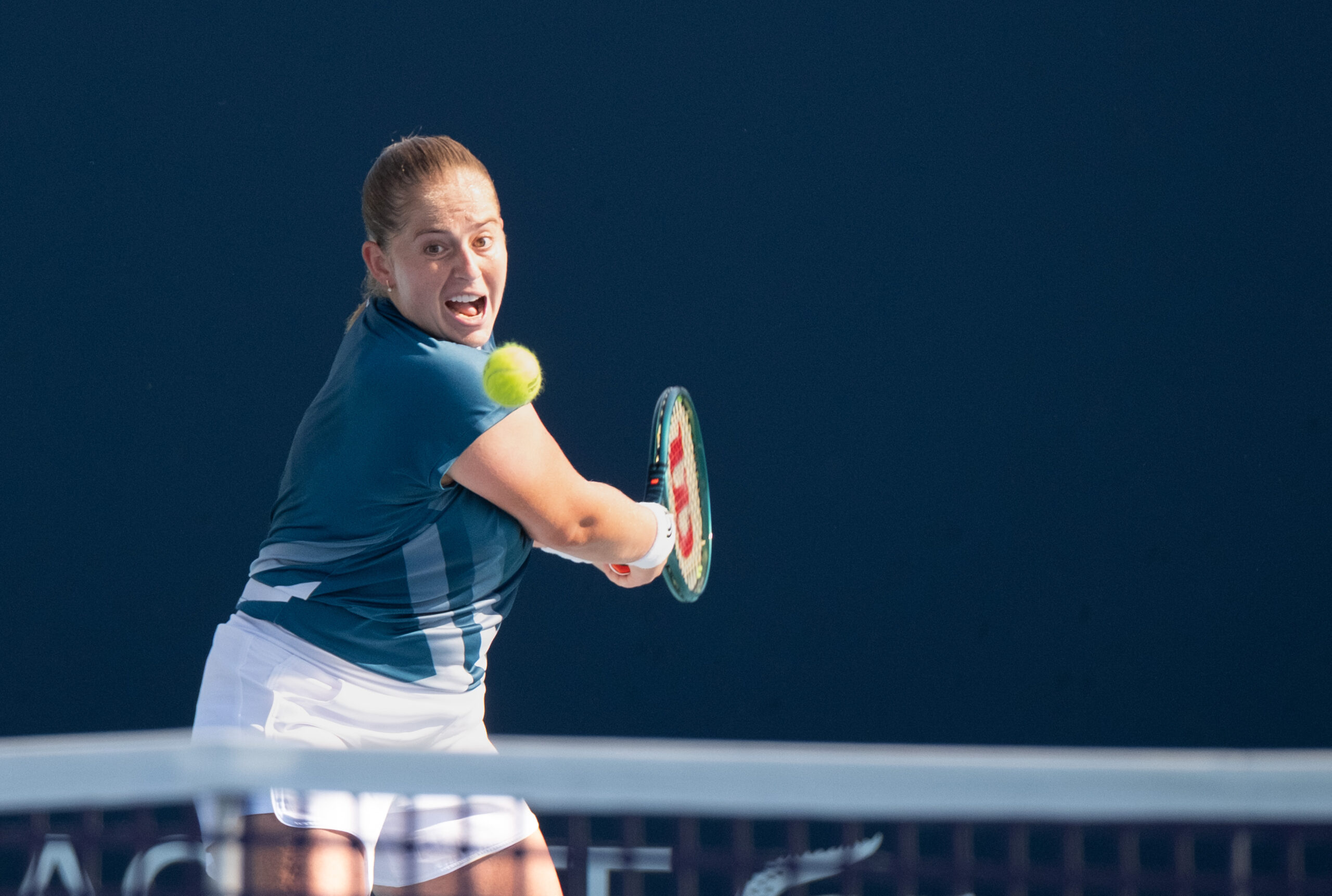
Jelena Ostapenko was born in Riga on 8 June 1997, the day Gustavo Kuerten won his first Roland Garros title. Twenty years and two days later she won Roland Garros herself, unseeded, ranked 47th, and without a tour-level title of any kind to her name before that fortnight.
Paris, 2017
She had never been ranked inside the top 30 before that Roland Garros, according to the WTA, and had never gone past the third round at a major, according to the Associated Press. She hit her way through the draw instead: 245 winners across the tournament, past Samantha Stosur, Caroline Wozniacki and Timea Bacsinszky, into a final against third seed Simona Halep, who was playing for her first major title and the world No. 1 ranking.
Halep led by a set and 3-0 and had three break points for 4-0. Ostapenko held, won the next three games as well, took the second set and then, from a break down at 3-1 in the third, won the last five games. The score was 4-6, 6-4, 6-3. She finished with 54 winners and 54 unforced errors, the AP counted; Halep had eight winners. Ostapenko became the first unseeded woman to win the title in the Open Era and the first Latvian to win a Grand Slam singles title.
“I think there are similarities because, of course, when I was born he won the first Roland Garros,” she said afterwards of Kuerten. “So I think it kind of maybe lucky, lucky number or something.”
After Paris
The breakthrough had been building. Ostapenko started on the ITF circuit in 2012, made her WTA main-draw debut as a wild card in Tashkent in 2014, and scored her first top-10 win at Wimbledon in 2015, over Carla Suárez Navarro. She reached her first WTA final in Quebec City that year and the Doha final in 2016, which lifted her into the top 50.
The rest of 2017 confirmed the Paris result was not a one-off. She reached the Wimbledon quarter-finals, won her second title in Seoul by beating Beatriz Haddad Maia in the final, reached the Charleston final and qualified for the WTA Finals for the first time. She returned to Seoul as the runner-up in 2022.
Doubles, and the full set
Ostapenko has built a second career in doubles without stepping away from singles. With Lyudmyla Kichenok she won the 2024 US Open women’s doubles title without dropping a set, beating Kristina Mladenovic and Zhang Shuai 6-4, 6-3 in the final, Reuters reported. “We didn’t expect anything, we were just playing better and better every match,” she said.
The third major came at Wimbledon in July 2026, in mixed doubles with Marcelo Arévalo. The second seeds trailed Storm Hunter and Marc Polmans by a set and a break on Centre Court before winning 4-6, 7-5, 6-2 in an hour and 56 minutes, the first title of the Championships. “In the second set, we were down a break. But I told myself just fight till the last moment,” Ostapenko said. It was her first Wimbledon title and gave her major titles in singles, women’s doubles and mixed doubles.
The game
The numbers from Paris describe the game better than any adjective. She hit 245 winners across that tournament, and in the final she broke Halep in the opening game with return winners, according to the WTA. She finished that match with as many unforced errors as winners and kept swinging anyway. The risk is built in: the same approach that won her a major from outside the top 40 is the one that produces the wide swings in her results.
Grand Slam titles
- Roland Garros: women’s singles (2017)
- US Open: women’s doubles, with Lyudmyla Kichenok (2024)
- Wimbledon: mixed doubles, with Marcelo Arévalo (2026)
Season Snapshot — 25 September 2026
Ostapenko was the top seed at the Korea Open in Seoul this week, the event she won in 2017. Her first-round match against Anastasia Zakharova was her first win since July, according to the WTA: she came from 3-1 down in the first set to win 11 of the next 13 games, 6-4, 6-1. Her run ended in the second round.
Her current singles and doubles rankings are deliberately not listed here: we could not confirm them against an approved primary source, so they have been left out rather than guessed.
This snapshot is dated and will change. The career record above does not.
More: The Asian Swing Explained, the China Open Guide, and the full ATP and WTA player index.