

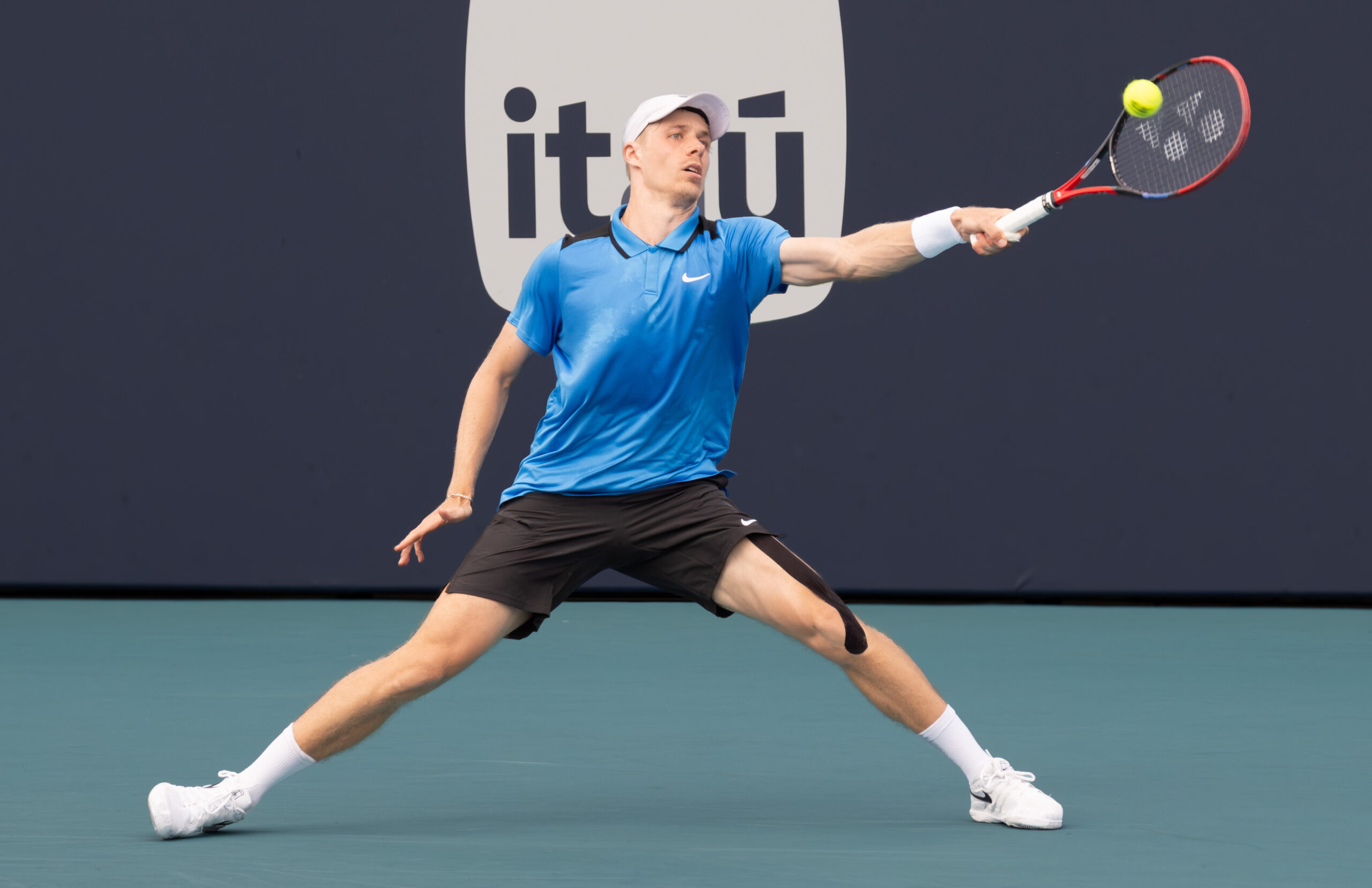
Denis Shapovalov was 18 when he played Rafael Nadal in the third round in Montreal in August 2017. According to his ATP biography, he ripped a poster of Nadal off the wall before the match, and he was sleeping in Felix Auger-Aliassime’s basement that week. He beat the world No. 2, kept winning, and left the tournament as the youngest Masters 1000 semi-finalist since the series began in 1990.
The climb
Montreal was the first big result, not the first sign. Shapovalov had finished his junior career by winning the Wimbledon boys’ singles title in 2016, and he broke into the top 50 of the rankings less than 15 months later. The ATP named him both its Newcomer of the Year and its Most Improved Player for 2017.
The first title took longer than the early results suggested. It came at the Stockholm Open in October 2019, where the fourth seed beat Filip Krajinovic 6-4, 6-4 without dropping a set all week, the first Canadian to win the event. “I am definitely super happy and just really proud,” he said. Weeks later he reached the final of the Paris Masters. In 2020 he became the first Canadian man to reach a US Open quarter-final and then joined Milos Raonic as only the second Canadian man to break into the top 10.
Wimbledon, Melbourne and Malaga
His deepest run at a major came on his favourite surface. At Wimbledon in 2021 he beat two-time champion Andy Murray and won five-set matches against Philipp Kohlschreiber and Karen Khachanov on the way to his first Grand Slam semi-final, at 22. “Having been in semi-finals here in 2021, I think Wimbledon always has a very special place in my heart,” he said three years later.
Six months after that semi-final he reached his first Australian Open quarter-final, beating third seed Alexander Zverev 6-3, 7-6(5), 6-3 in the fourth round. And in November 2022 he opened the Davis Cup final in Malaga by beating Thanasi Kokkinakis 6-2, 6-4, before Auger-Aliassime beat Alex de Minaur to give Canada its first title. “Denis and I grew up together, dreaming of these types of stage, dreaming of winning the Davis Cup,” Auger-Aliassime said. Canada’s place in the competition’s history is on our list of Davis Cup winners.
The knee, and the way back
Then came the injury years. A knee problem wrecked his 2023, and by the time he returned to Wimbledon in 2024 he was ranked No. 136 in the live rankings. “There were a lot of times where I didn’t know if I was going to step back onto the tennis court, if I was even going to come back at all,” he said later. “Sometimes I had good days, sometimes I couldn’t even step with my leg because my knee was hurting.”
The way back ran through indoor hard courts. He won Belgrade in November 2024, then took the Dallas Open in February 2025, the biggest title of his career. He had gone into that week with an 11-33 record against top-10 players and beat three of them: Taylor Fritz, then the world No. 4, in the second round, defending champion Tommy Paul in the semi-finals and Casper Ruud 7-6(5), 6-3 in the final, with 13 aces. Later that season he won Los Cabos on his tournament debut.
The game, and where it comes from
Shapovalov is a left-hander with a one-handed backhand, a combination that is rare on the modern tour. He was born in Israel and raised in Canada from the age of nine months, and his mother Tessa, a former professional player, coached him from the age of five. The backhand was, by his own account, a matter of irritation: “When I was small a lot of people would get the ball up to my backhand. I remember one practice I just got tired of going back all of the time, so I hit a couple in the air and they worked out well.”
At his best the pattern is the one the Dallas final showed: a big first serve, the lefty angles that sent Ruud from corner to corner, the forehand used to open the court, and a willingness to follow it forward. His idol growing up was Roger Federer; as a 15-year-old junior he warmed Federer up before the Swiss played a semi-final in Toronto in 2014. His favourite surface is grass.
Grand Slam best results
- Australian Open: quarter-final (2022)
- Wimbledon: semi-final (2021)
- US Open: quarter-final (2020)
Career titles: four — Stockholm (2019), Belgrade (2024), Dallas (2025) and Los Cabos (2025). Team: Davis Cup champion with Canada, 2022.
Season Snapshot — 25 September 2026
Shapovalov went back to Los Cabos as defending champion at the start of August, reached the final again with an 8-0 record at the event, and lost it 6-3, 6-4 to 21-year-old Arthur Gea. “A few weeks ago we didn’t know if I would even be at this tournament,” he said. “So to be back, playing at such a high level, is definitely very special.”
This week he is the seventh seed at the Chengdu Open, his first appearance there since 2019. His opening win over Tallon Griekspoor, 6-4, 7-6(3), was the 250th tour-level win of his career, making him the third Canadian man to reach that mark after Raonic (383) and Auger-Aliassime (300). He followed it by beating Vit Kopriva 6-2, 6-3 in 64 minutes, winning 23 of 25 first-serve points, to reach his fourth tour-level quarter-final of the season. Third seed Alejandro Tabilo or Adrian Mannarino is next.
His current ranking is deliberately not listed here: we could not confirm it against an approved primary source, so it has been left out rather than guessed.
This snapshot is dated and will change. The career record above does not.
More: the Chengdu Open Guide, The Asian Swing Explained, and the full ATP and WTA player index.