

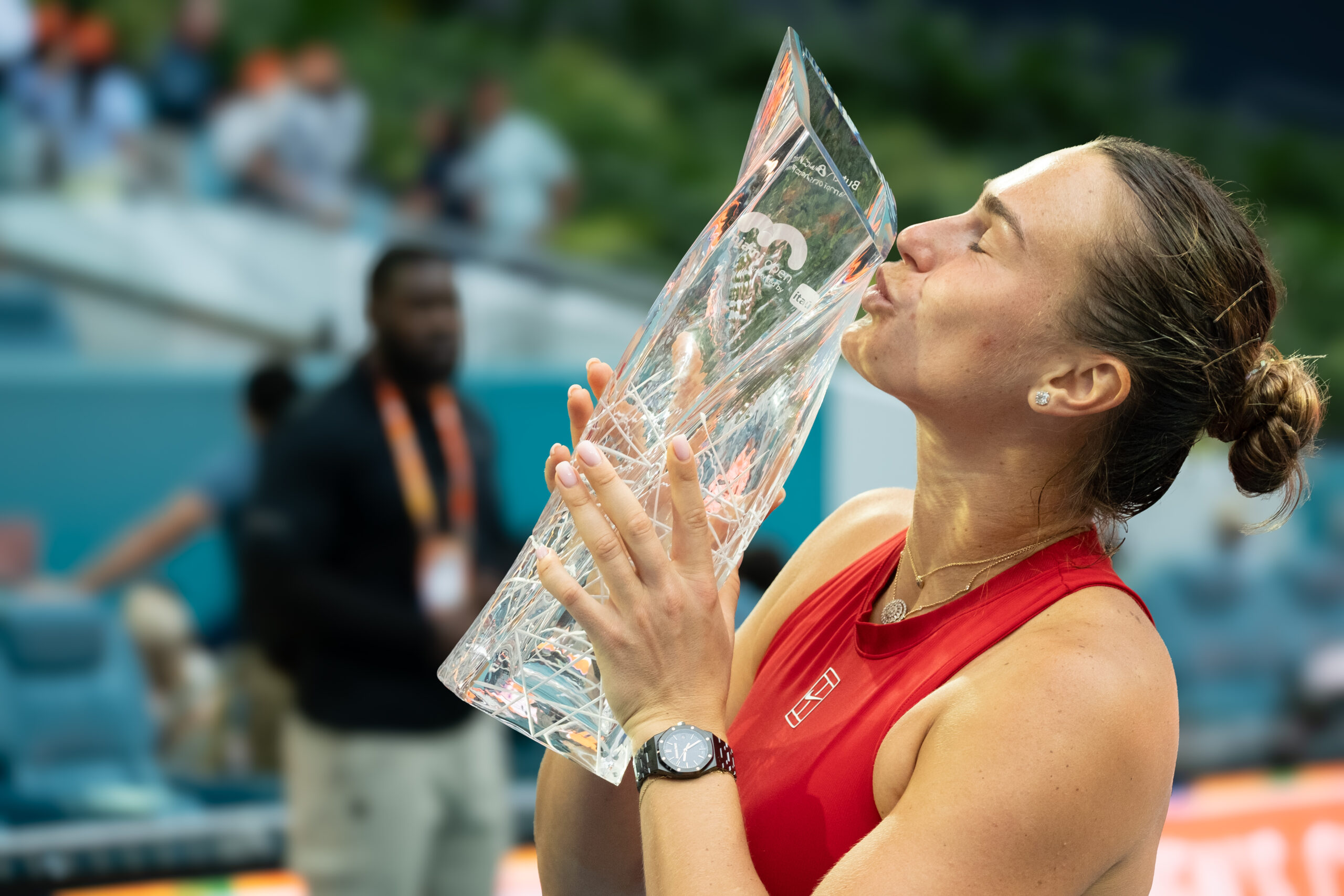
When the WTA rankings refresh on Monday, Aryna Sabalenka is set to complete her 100th week at world No. 1 — a mark reached by only a handful of players in the half-century history of the computerised rankings.
Sabalenka is currently in her 99th week at the top, having retained the position comfortably through Wimbledon. Her grip was never seriously threatened at the All England Club: nearest challenger Elena Rybakina, the only player who could have displaced her, fell in the third round, and Sabalenka’s advantage is now measured in thousands of ranking points rather than hundreds.
The 100-week mark carries historical weight. On the WTA’s all-time record for total weeks at No. 1, Sabalenka has already edged past former Grand Slam champion Lindsay Davenport, who spent 98 weeks on top, to move into the top 10. Reaching triple figures would make her one of only around ten women to have spent 100 weeks or more at the summit since the rankings began in 1975 — company that includes Steffi Graf, Martina Navratilova, Serena Williams, Chris Evert, Martina Hingis, Monica Seles, Iga Swiatek, Ashleigh Barty and Justine Henin.
Sabalenka regained the No. 1 ranking in October 2024 and has held it almost without interruption since, a run of consistency that has outlasted the form of every rival. Where Swiatek — the most decorated active player at the summit, with 125 total weeks — has slipped to No. 3 and endured a title drought, Sabalenka has remained the sport’s fixed point.
Yet the milestone arrives in the middle of an uncomfortable paradox. For all her ranking dominance, Sabalenka has converted just one of the seven Grand Slams she has contested as world No. 1 into a title — the 2025 US Open. The rest tell a story of near-misses: runner-up at the 2025 Australian Open, the 2025 French Open and the 2026 Australian Open; a semi-final exit at Wimbledon in 2025; a quarter-final loss to Diana Shnaider at this year’s Roland Garros; and, most recently, a fourth-round defeat to Naomi Osaka at Wimbledon — her earliest exit at a major since the 2022 French Open.
That inconsistency at the majors has been offset by relentless accumulation elsewhere. Sabalenka opened 2026 by defending her Brisbane title, then swept the Sunshine Double with back-to-back triumphs at Indian Wells and Miami, only the second woman to complete that double as world No. 1. A three-set loss to Rybakina in the Australian Open final remains a rare blemish on an otherwise commanding hard-court record — and it is that surface, where both her major titles have come, that shapes the weeks ahead.
Sabalenka is expected to return to action on the North American hard-court swing, the stretch of the calendar she owns more than any other. She arrives as the two-time defending US Open champion, with the Canadian Open in early August and Cincinnati serving as the build-up to a title defence in New York later that month. Success there would not only extend her reign but also begin to answer the one question the rankings cannot: whether a player this dominant week to week can assemble the Slam haul her position implies.
For now, the number speaks for itself. One hundred weeks at No. 1 is a marker of sustained excellence that only the greatest names in the sport have reached, and at 28 Sabalenka has time to climb the list further. The debate over her place among her generation’s best will be settled at the majors. The debate over her week-to-week supremacy has, in effect, already been won.
Aryna Sabalenka is about to join one of the most exclusive lists in tennis. When the WTA rankings refresh on Monday, the Belarusian is set to complete her 100th week at world No. 1 — a mark reached by only a handful of players in the half-century history of the computerised rankings.
Sabalenka is currently in her 99th week at the top, having retained the position comfortably through Wimbledon. Her grip was never seriously threatened at the All England Club: nearest challenger Elena Rybakina, the only player who could have displaced her, fell in the third round, and Sabalenka’s advantage is now measured in thousands of ranking points rather than hundreds.
The 100-week mark carries historical weight. On the WTA’s all-time record for total weeks at No. 1, Sabalenka has already edged past former Grand Slam champion Lindsay Davenport, who spent 98 weeks on top, to move into the top 10. Reaching triple figures would make her one of only around ten women to have spent 100 weeks or more at the summit since the rankings began in 1975 — company that includes Steffi Graf, Martina Navratilova, Serena Williams, Chris Evert, Martina Hingis, Monica Seles, Iga Swiatek, Ashleigh Barty and Justine Henin.
Sabalenka regained the No. 1 ranking in October 2024 and has held it almost without interruption since, a run of consistency that has outlasted the form of every rival. Where Swiatek — the most decorated active player at the summit, with 125 total weeks — has slipped to No. 3 and endured a title drought, Sabalenka has remained the sport’s fixed point.
Yet the milestone arrives in the middle of an uncomfortable paradox. For all her ranking dominance, Sabalenka has converted just one of the seven Grand Slams she has contested as world No. 1 into a title — the 2025 US Open. The rest tell a story of near-misses: runner-up at the 2025 Australian Open, the 2025 French Open and the 2026 Australian Open; a semi-final exit at Wimbledon in 2025; a quarter-final loss to Diana Shnaider at this year’s Roland Garros; and, most recently, a fourth-round defeat to Naomi Osaka at Wimbledon — her earliest exit at a major since the 2022 French Open.
That inconsistency at the majors has been offset by relentless accumulation elsewhere. Sabalenka opened 2026 by defending her Brisbane title, then swept the Sunshine Double with back-to-back triumphs at Indian Wells and Miami, only the second woman to complete that double as world No. 1. A three-set loss to Rybakina in the Australian Open final remains a rare blemish on an otherwise commanding hard-court record — and it is that surface, where both her major titles have come, that shapes the weeks ahead.
Sabalenka is expected to return to action on the North American hard-court swing, the stretch of the calendar she owns more than any other. She arrives as the two-time defending US Open champion, with the Canadian Open in early August and Cincinnati serving as the build-up to a title defence in New York later that month. Success there would not only extend her reign but also begin to answer the one question the rankings cannot: whether a player this dominant week to week can assemble the Slam haul her position implies.
For now, the number speaks for itself. One hundred weeks at No. 1 is a marker of sustained excellence that only the greatest names in the sport have reached, and at 28 Sabalenka has time to climb the list further. The debate over her place among her generation’s best will be settled at the majors. The debate over her week-to-week supremacy has, in effect, already been won.