

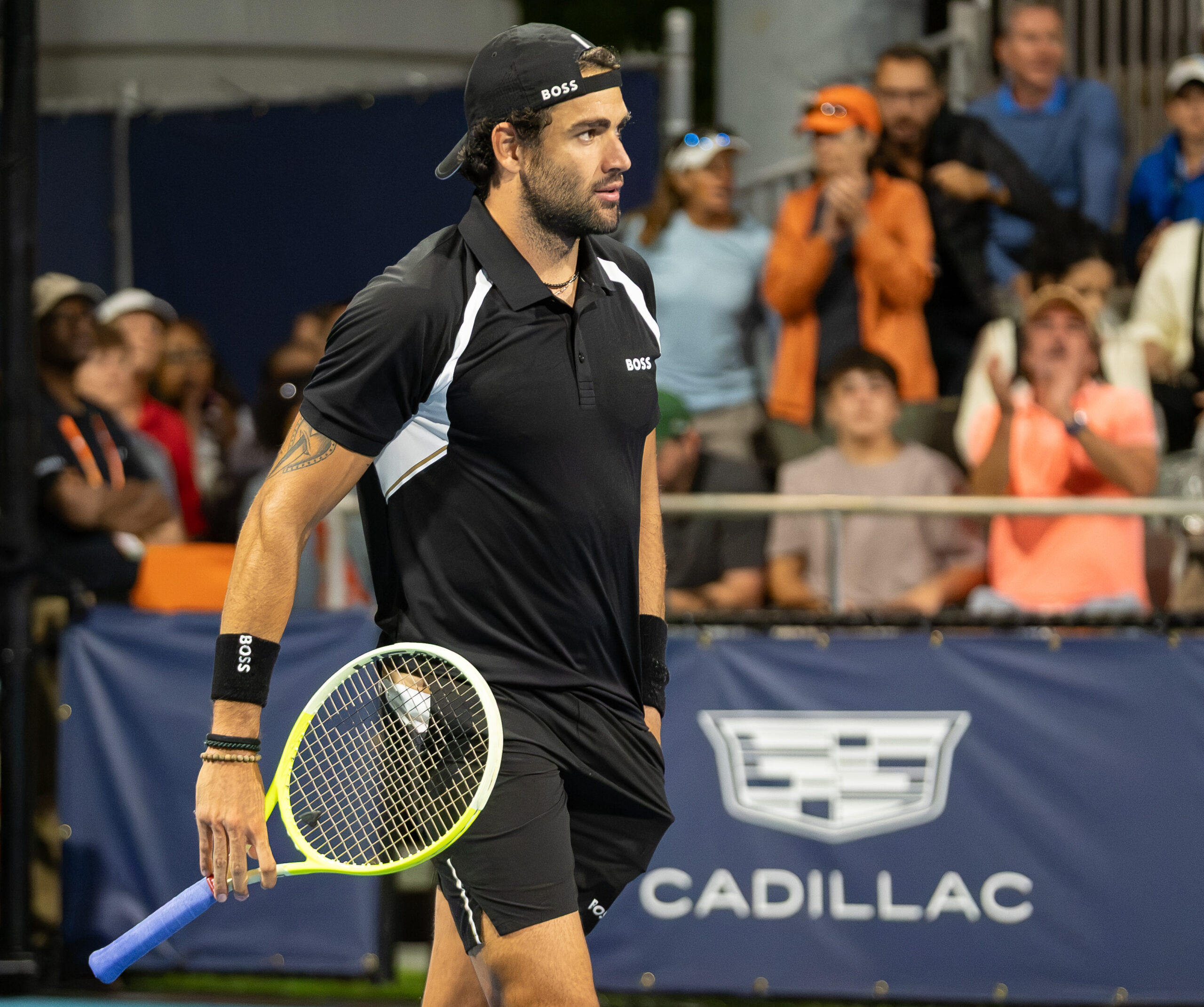
Matteo Berrettini has been diagnosed with chronic hip pain and will withdraw from the ATP events in Gstaad and Kitzbühel on medical advice, the Italian confirmed in a statement posted to his social media accounts, choosing rest over competition to give himself the best chance of being fit for the North American hard-court swing and the US Open.
The 2021 Wimbledon runner-up, who reached the third round at the All England Club this year before his grass-court summer was cut short, said the call came after consultations with his medical team. The decision removes one of the sport’s most recognisable names from two tournaments that have carried personal significance across his career, and reframes the rest of his season around a single objective: arriving in New York healthy.
“Hi all, just wanted to share an update that unfortunately I will no longer be playing Gstaad and Kitzbuhel,” Berrettini wrote. “After discussions with my doctor and team, I’ve been diagnosed with chronic hip pain and advised the best course of action is to withdraw and rest in order to be ready for the US swing. Thank you for your continued support and see you on the hard courts.”
The diagnosis puts a name to a problem that has shadowed Berrettini since early June. The 30-year-old was forced to retire from his Roland Garros quarter-final against compatriot Matteo Arnaldi, trailing 7-5, 5-2, after being unable to move freely on a hip issue he described at the time as unlike anything he had experienced before. He told reporters in Paris that he did not yet know exactly what the injury was and would wait on scans, adding that he hoped stopping when he did had protected the rest of his season.
He recovered sufficiently to compete at Wimbledon, where he won his opening matches before exiting in the third round. A follow-up medical examination after the tournament indicated the underlying problem had not fully resolved and that rest was required — the assessment that has now been formalised as chronic hip pain and has taken him out of the Swiss and Austrian clay events.
For a player whose career has been repeatedly interrupted by physical setbacks, the latest diagnosis lands as both a blow and, in a narrow sense, a form of clarity. Berrettini rose as high as world No. 6 and reached the 2021 Wimbledon final, but recurring injuries have made sustained runs difficult in the seasons since. His 2026 campaign had offered genuine encouragement before Paris, including a return to a Grand Slam quarter-final for the first time since the 2022 US Open, evidence that his level remains high when his body cooperates.
The timing frames the story around a countdown. The US Open main draw begins on Sunday, 30 August at the USTA Billie Jean King National Tennis Center, leaving Berrettini roughly six weeks from his announcement to recover, rebuild and re-enter competition on the North American hard courts that precede it. He has strong history on the surface, having reached the US Open semi-finals in 2019, and the medical guidance to rest now is explicitly aimed at protecting that window rather than risking further damage in the European summer.
His absence also feeds into a thinning field at Gstaad, where he is among several names to have come out of the draw in the days around the tournament — a reminder of how heavily the post-Wimbledon calendar can be reshaped by fitness in a congested stretch of the season.
What happens next depends on the scans and on how his hip responds to a period without matches. Berrettini has spoken openly this year about his weariness with injury-forced stoppages, having said after his Roland Garros retirement that he is “tired of retiring” and does not want to keep making that choice. The framing of this withdrawal is deliberately different: not a mid-match capitulation but a planned pause, taken early enough that recovery, rather than damage limitation, is the goal.
For now, the Italian’s season narrows to a single line of sight. The clay events in Switzerland and Austria go on without him, and the question that follows Berrettini into August is the one his own body keeps posing — whether rest can buy him a clean run at the Grand Slam he has always played well.