

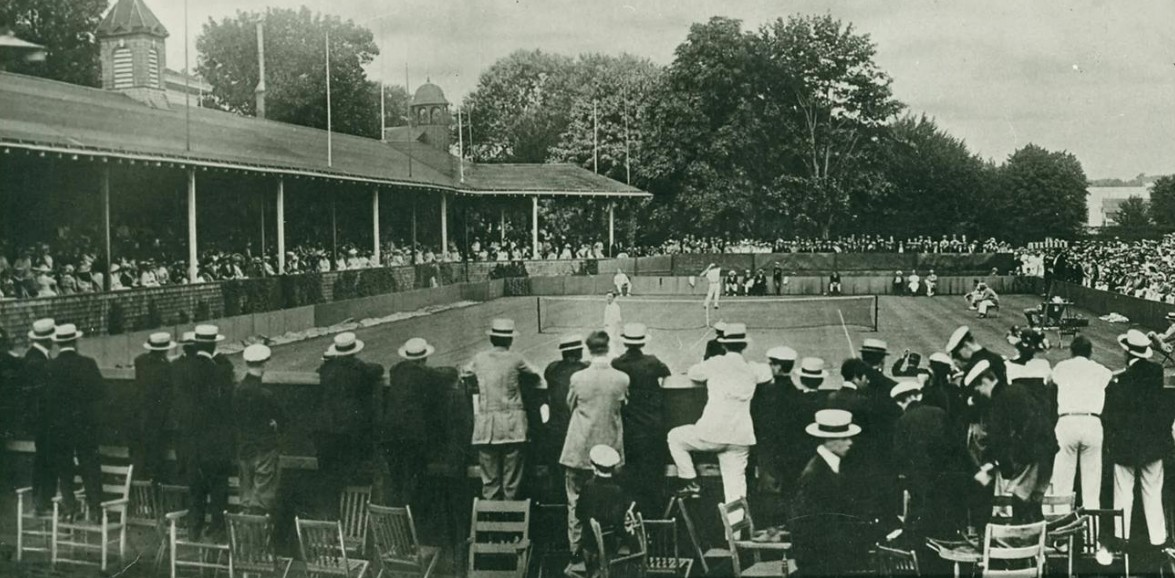
The US Open is the second-oldest tennis tournament in the world, the only Grand Slam to have been played on three different surfaces, and the largest tennis event by capacity and attendance ever staged. Its history is a story of continuous transformation — across cities, across surfaces, across centuries — that has produced, in 2026, a tournament barely recognisable from the genteel Victorian event held on the grass courts of a Newport social club in 1881.
Here is the complete story of how the US Open was founded, how it survived two world wars and a pandemic, and how the United States Tennis Association built what has become the most commercially powerful Grand Slam in the modern game.
Newport, 1881: The Beginning
The story begins on 31 August 1881, when the U.S. National Men’s Singles Championship was contested for the first time at the Newport Casino in Newport, Rhode Island. Twenty-five players competed on the casino’s manicured grass courts, accompanied — characteristically for the era — by a string quartet playing throughout the matches.
The Casino itself had opened just one year earlier, in July 1880. Designed by the architectural firm McKim, Mead & White at the request of James Gordon Bennett Jr., publisher of the New York Herald, the Casino was conceived as a social club for Newport’s wealthy summer residents — a refined alternative to the more austere existing Reading Room club. The Casino’s amenities included tennis courts, an indoor tennis facility, a bowling alley, and a 500-seat theatre.
The 1881 tournament was organized by the newly formed United States National Lawn Tennis Association (USNLTA), founded earlier that year by clubs across the East Coast to standardize the rules of competitive tennis and establish a national championship. Entry was restricted to USNLTA member clubs — the first and only time this restriction would apply. The inaugural champion was Richard “Dick” Sears, a 20-year-old Harvard student from Boston, who defeated William Glyn in the final.
Sears would go on to dominate the tournament’s first seven editions. He won every U.S. National Championship from 1881 to 1887 — a run of seven consecutive titles under the now-abolished challenge round system, in which the reigning champion played only the final each year against the winner of the all-comers’ draw. Sears retired undefeated in 1888 at age 27, his streak unbroken. The seven consecutive titles he won remain the longest unbroken championship run in the tournament’s history.
The Women Arrive: 1887
The women’s championship was added in 1887, six years after the men’s event. Held initially at the Philadelphia Cricket Club rather than Newport, the first U.S. Women’s National Singles Championship was won by Ellen Hansell, a 17-year-old from Philadelphia, who defeated Laura Knight in the final.
The women’s championship continued at the Philadelphia Cricket Club until 1921, and was held under a five-set format from 1887 to 1901 — making the early US National Championship women’s matches the longest-format women’s tennis matches in history. The five-set format was abandoned after the 1901 tournament, replaced by the three-set structure that has remained standard in women’s Grand Slam tennis ever since.
The women’s doubles championship was added in 1889, and mixed doubles in 1892, completing the five-event tournament structure that, with adjustments, has continued in some form ever since.
Forest Hills, 1915: The Move to New York
By 1914, the Newport Casino had become too small to accommodate the rapidly growing audience for tennis. The Casino’s grass courts and bleacher seating could host perhaps 2,500 spectators at maximum; demand for top-level tournament tennis was vastly exceeding what the venue could supply. After 33 years in Newport, the tournament moved.
A group of New York-based tennis players, led by Karl Behr, had been petitioning to relocate the championship to New York since 1911 — arguing that most of the country’s tennis clubs, players, and fans were located in the New York metropolitan area, and that the sport’s growth demanded the tournament move there.
In 1914, the USNLTA voted 128 to 119 in favour of relocation. The decision was narrow — eight former national singles champions opposed the move — but the future of the tournament had been decided.
In 1915, the U.S. National Championships moved to the West Side Tennis Club in Forest Hills, Queens, a private club founded in 1892 that had relocated to its 14-acre Forest Hills site shortly before the tournament arrived. The men’s championship was held at Forest Hills from 1915 through 1920, then moved to the Germantown Cricket Club in Philadelphia from 1921 to 1923 (the women’s championship was simultaneously moved to Forest Hills), before all events returned to Forest Hills permanently in 1924.
Forest Hills opened the Forest Hills Stadium in 1923, with the first major tournament played there in 1924. With a capacity of around 14,000 — substantial for the era — the new stadium gave the tournament a purpose-built venue. The horseshoe-shaped concrete stadium would host every U.S. National Championship from 1924 through 1977.
Open Era Begins: 1968
For its first 87 years, the U.S. National Championships was an amateur tournament. Professional players — including some of the greatest names in the sport’s history, like Pancho Gonzales, Rod Laver, and Ken Rosewall — were prohibited from competing. The contradiction between this rule and the increasingly professional reality of tennis grew untenable through the 1960s.
In 1968, the Open Era began. The four Grand Slam tournaments — the U.S. National Championships, Wimbledon, the French Open, and the Australian Open — all opened their draws to professional players for the first time. The tournament was renamed simply the US Open.
Arthur Ashe won the inaugural Open Era US Open men’s singles title in 1968, defeating Tom Okker in the final. Ashe, the first African American man to win a Grand Slam singles title, was still officially classified as an amateur — having served as a U.S. Army officer through much of the tournament — and could not accept the $14,000 winners’ cheque under the rules of amateur status. The prize money went instead to runner-up Okker, who held the status of “registered player” (an amateur permitted to accept prize money at certain events). Ashe received a per-diem payment of $20 per day for his appearance, a total of roughly $280.
Virginia Wade, who won the inaugural Open Era women’s title in 1968, did collect her $6,000 prize. The disparity in their prize money would be addressed five years later, when the US Open became the first Grand Slam to adopt equal prize money for men and women.
The Tiebreak Revolution: 1970
In 1970, the US Open became the first Grand Slam to introduce the tiebreak, adopting Jimmy Van Alen’s nine-point sudden-death format at Forest Hills. When a set reached 6-6, a red flag bearing the letters “S” and “D” (for Sudden Death) was raised at the chair umpire’s seat. Most top players disliked the format. Television broadcasters and fans loved it.
The tiebreak — eventually standardised to first-to-seven with a two-point margin — would eventually become universal across professional tennis. The US Open’s willingness to be the first Grand Slam to make a wholesale change to how the sport was scored set the pattern for everything that would follow in the institution’s modern history.
Equal Prize Money: 1973
In 1973 — five years after Wade had collected $6,000 while Ashe could not collect $14,000 — the US Open became the first Grand Slam, and the first sporting event of any kind, to offer equal prize money to men and women. Both John Newcombe and Margaret Court received $25,000 in winners’ prize money that year.
The 1973 decision was driven by Billie Jean King, who had publicly threatened a boycott by the top women players if equal pay was not introduced. King met with US Open tournament director Bill Talbert in 1972 with three things: data from a fan survey showing women’s matches were nearly as popular as men’s, a list of female stars prepared to skip the 1973 tournament, and a $55,000 commitment from sponsor Ban Deodorant to help fund the gap between men’s and women’s prize pools.
The USTA accepted. The other Grand Slams would not follow for decades: Roland Garros in 2006, Wimbledon in 2007, and the Australian Open in 2008.
The Three-Surface Decade: 1975-1977
In 1975, the USNLTA — now the USTA — made a decision that surprised the tennis world: the grass courts at Forest Hills were converted to Har-Tru, a green clay surface made from crushed igneous basalt. The change was driven by complaints about the unpredictability of Forest Hills’s grass bounce and by tournament officials’ belief that the slower clay surface would produce more television-friendly tennis.
Floodlights were installed during the clay era, enabling night sessions for the first time — a change that proved so popular it was retained permanently when the surface changed again.
The three-year clay era produced three distinct men’s champions — Manuel Orantes in 1975, Jimmy Connors in 1976, and Guillermo Vilas in 1977 — and Chris Evert winning all three women’s editions. Evert’s 1976 victory was particularly significant because it came in the same year Connors defeated Björn Borg, the reigning Roland Garros champion, on the very surface Borg had owned. The contrast between American green clay and European red clay was made plain.
But three years was enough for the experiment. When the tournament moved venues in 1978, the surface changed again.
Flushing Meadows, 1978: The Modern Era Begins
The USTA National Tennis Center in Flushing Meadows, Queens, opened in 1978. The new facility was purpose-built for the rapid growth of professional tennis and the tournament’s expanding commercial ambitions. Forest Hills had charm, but it was fundamentally a private club with a public tennis tournament bolted onto it. The new venue was built on public land in a public park — a deliberate ideological choice that mirrored the broader social shift Billie Jean King and the equal-pay movement had set in motion five years earlier.
The new venue was anchored by Louis Armstrong Stadium, a renovated version of the old Singer Bowl from the 1964 World’s Fair. The Singer Bowl, originally built as a concert venue and later used for boxing and basketball, was converted into the tournament’s main court. Capacity was approximately 20,000.
The surface chosen for the new venue was DecoTurf, a rubberized acrylic hard-court compound. In its early years at Flushing Meadows, the courts were painted green — the same color used on the previous Har-Tru clay courts. The distinctive blue-and-green color scheme that has become synonymous with the US Open would not be introduced until 2005, when the inside of the courts was repainted blue as part of a broader site refresh.
The 1980s and 1990s: Tradition and Transformation
The US Open’s first decade at Flushing Meadows produced some of the most celebrated tennis in the tournament’s history. John McEnroe and Björn Borg contested the 1980 and 1981 men’s finals — McEnroe winning both, ending Borg’s pursuit of a Calendar Grand Slam in 1980 and, less officially, Borg’s professional career in 1981.
Chris Evert and Martina Navratilova contested some of the great women’s finals of the era. Jimmy Connors won the tournament five times across three surfaces — grass at Forest Hills in 1974, clay at Forest Hills in 1976, and hard courts at Flushing Meadows in 1978, 1982, and 1983 — making him the only player ever to win the tournament on all three of its competitive surfaces.
The 1990s saw Pete Sampras’s five US Open titles (1990, 1993, 1995, 1996, 2002), the Sampras-Agassi rivalry that became one of the defining stories of the era, and the rise of the Williams sisters, with Venus winning her first US Open in 2000 and Serena winning her first in 1999.
Arthur Ashe Stadium: 1997
By the mid-1990s, Louis Armstrong Stadium — which had been expanded and modified repeatedly since 1978 — was no longer sufficient for the tournament’s commercial scale and global profile. In 1997, the USTA opened Arthur Ashe Stadium at Flushing Meadows — a new 23,771-seat main court named after the man who had won the inaugural Open Era US Open at Forest Hills nearly three decades earlier.
The stadium cost $254 million and was, at opening, the largest dedicated tennis venue in the world. Designed by Detroit-based architecture firm ROSSETTI, the stadium was built on the site of the demolished 1964 World’s Fair United States Pavilion. Ashe himself had died in 1993 — and the decision to name the world’s largest tennis stadium after a man whose life had been defined by his integration of an all-white sport carried weight that has only grown in the decades since.
The Billie Jean King Name: 2006
In 2006, on the eve of the tournament that year, the USTA renamed the facility the USTA Billie Jean King National Tennis Center — the first major sports venue in the United States named after a woman. The naming honored King’s role as a four-time US Open singles champion, as the leader of the equal-pay movement that had transformed the tournament in 1973, and as one of the most consequential figures in American sport.
The renaming was accompanied by a permanent display of King’s image and a stainless steel sculpture of her at the entrance to the facility. The naming, like the dedication of Arthur Ashe Stadium nine years earlier, expressed a deliberate institutional choice to honour figures whose impact on American culture extended beyond their athletic achievements.
The Retractable Roof: 2016
For the first 38 years at Flushing Meadows, Arthur Ashe Stadium was uncovered — leaving the men’s singles final in particular vulnerable to the rain that frequently affected the late-summer tournament. Between 2008 and 2012, five consecutive men’s finals were affected by inclement weather. Something had to change.
In 2010, the USTA initiated a master planning process to add a roof to Arthur Ashe Stadium. The engineering challenge was substantial — the original 1997 structure was not designed to support the additional load — and the solution required eight new steel columns driven 175 to 200 feet into the bedrock beneath Flushing Meadows. The retractable roof, designed by ROSSETTI, was completed in time for the 2016 US Open. The 190,000-square-foot Teflon-coated fiberglass membrane could be opened or closed in under 10 minutes.
The roof transformed both the tournament’s weather resilience and its acoustic character. When closed, Arthur Ashe Stadium became one of the loudest tennis venues in the world — an unintended consequence that has since become central to the tournament’s modern identity.
Louis Armstrong Stadium received its own retractable roof in 2018, as part of a broader $600 million renovation of the National Tennis Center that also added the new Grandstand court with 8,125 seats.
The COVID Year: 2020
The 2020 US Open became the first tournament to be played behind closed doors, with no spectators in the stadium, in response to the global pandemic. The decision to proceed with the tournament — when Wimbledon had been cancelled entirely — was driven by the USTA’s calculation that the financial cost of a cancelled US Open would have been catastrophic for the organization.
The tournament was unmistakably different. The largest tennis venue in the world played host to matches contested before empty stands, with player coaches and family in a guest box and the only ambient sound being the players themselves. Naomi Osaka won the women’s title, Dominic Thiem won the men’s. The tournament proceeded, prize money was distributed (though at a reduced total), and the global broadcast continued — but the US Open’s defining characteristic, the crowd noise of Arthur Ashe Stadium, was absent for the first time in the venue’s history.
The 15-Day Format: 2025
In 2025, the US Open expanded its main draw to 15 days for the first time, adding a Sunday start to the schedule. The change extended the tournament by one day and introduced opening-round play on the Sunday before what had previously been the Monday start. The 2025 expansion was part of a broader USTA strategy to maximize commercial returns from the tournament — more days of play meant more revenue from broadcasts, ticketing, and on-site concessions.
The 2025 tournament also broke the prize money record for any tennis tournament in history, distributing $90 million in total prize money — including a record $5 million to each singles champion, won by Carlos Alcaraz and Aryna Sabalenka.
The Bottom Line
The US Open has been transformed across nearly a century and a half — from a 25-player gentlemen’s tournament with a string quartet at a Newport summer club to a 15-day, $90 million enterprise at the largest tennis venue ever built. The tournament has changed cities four times, surfaces three times, names twice, and approximately every other operational, structural, and competitive element on multiple occasions.
What has remained continuous is the institutional willingness to keep changing — to be the first Grand Slam to adopt the Open Era, the tiebreak, equal prize money, retractable roofs (chronologically after Australia and Wimbledon, but with the largest stadium and most ambitious roof engineering), and the expanded 15-day format. The US Open is, in 2026, the most commercially powerful Grand Slam in tennis. It is also the Grand Slam most willing to remake itself.
That willingness — paired with the decisions to name its facilities after Arthur Ashe and Billie Jean King, to play in Queens rather than Manhattan, to commit to equal pay before any other sporting institution had even seriously considered the question — is what makes the US Open the Grand Slam it is. The tournament that began at the Newport Casino in 1881 with 25 players is now a global enterprise watched by more than 200 countries. It has come a long way. And it has not stopped moving.