

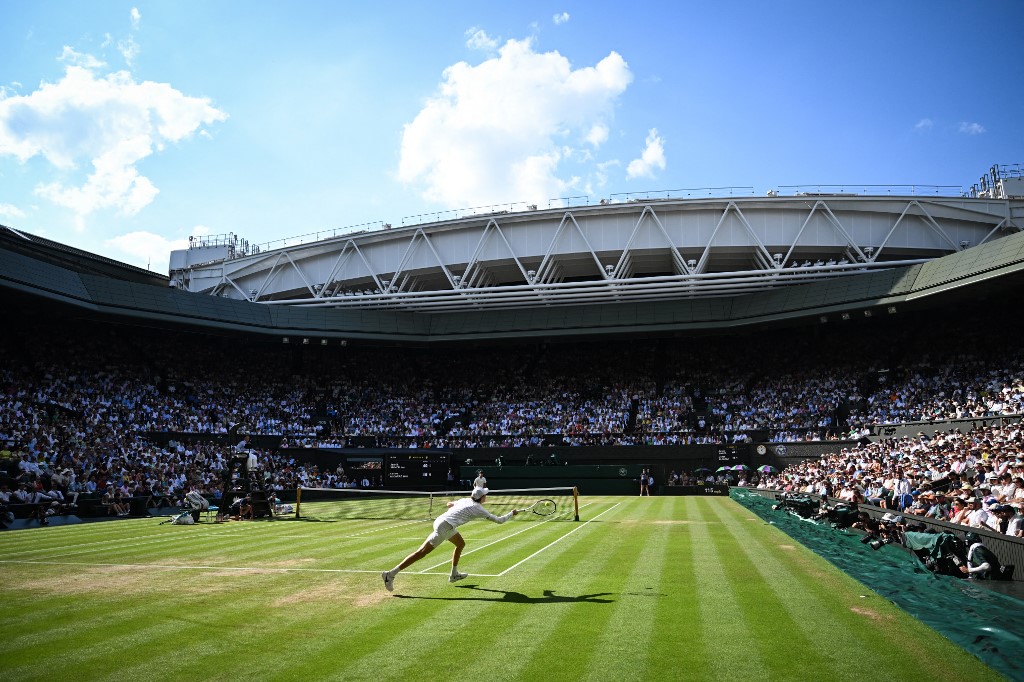
Among the four Grand Slams, Wimbledon presents a set of challenges that no other major imposes on its competitors. The surface is unique. The preparation window is shorter than for any other Grand Slam. The institutional weight of nearly 150 years of tradition lives on every court. The weather is the least predictable in the calendar. The crowd’s expectations of behaviour are stricter than at any other tennis venue in the world.
Players who have won all four Grand Slams routinely identify Wimbledon as the hardest of the four to win — not because the field is deeper or the format is more demanding, but because the cumulative pressure of competing at the All England Club is qualitatively different from competing anywhere else. Here is a complete examination of why Wimbledon is the hardest Grand Slam to win, broken down across the specific factors that make it so.
The Surface That Belongs to Almost No One
Grass is the rarest surface in professional tennis. The clay season fills more than two months of the ATP and WTA calendars. The hard-court season fills more than half of the year. Grass-court tennis occupies just three to four weeks each summer, contains six to seven tournaments worldwide, and ends with Wimbledon as its inescapable centrepiece.
For most professional players, this means they spend less than five percent of their competitive year on grass — and most of that time is concentrated into the final two weeks before Wimbledon begins. A player who specialises in grass-court tennis simply cannot exist in the modern professional game. There are not enough events. There are not enough ranking points available. The economics do not support a grass-court specialist career in the way that clay or hard-court specialisation can be sustained.
The result is that virtually every player arriving at Wimbledon — including those who have won the tournament before — is rusty on the surface they are required to compete on. Their footwork is calibrated to clay or hard courts. Their groundstrokes are built around bounces that grass does not produce. Their default tactical instincts assume rallies that grass does not allow. They have, at best, a week or two of competitive grass-court tennis before The Championships begin.
No other Grand Slam imposes this kind of structural unfamiliarity on its field. At the Australian Open, players have had the full off-season to prepare on hard courts. At Roland Garros, they have completed a two-month European clay-court swing. At the US Open, the entire North American hard-court season is the lead-in. At Wimbledon, the lead-in is two to three weeks of grass-court tennis after months on clay — and the surface they’re transitioning to is mechanically the opposite of the one they just left.
The Surface Transition From Clay Is the Cruelest in Tennis
The gap between Roland Garros and Wimbledon is three weeks. Until 2014, it was two — short enough that the Queen’s Club Championships traditionally started the day after the French Open men’s final. The gap was extended specifically to give players slightly more time to recover from the physical demands of clay and adapt to grass.
But three weeks is still, in practical terms, a very short window for a transition that requires almost every element of a player’s game to be rebuilt. Clay tennis is played from deep behind the baseline, with heavy topspin, sliding footwork, and long rallies that reward defensive endurance. Grass tennis is played close to the baseline or at the net, with flat groundstrokes, controlled small-step footwork, and short points that reward serve, return, and immediate aggression.
A player coming off Roland Garros — and particularly one who reached the final or semi-finals there — has spent six weeks training and competing in a way that is, in critical respects, the opposite of how they will need to play at Wimbledon. The muscular memory of sliding into shots must be suppressed. The instinct to position deep behind the baseline must be replaced. The patience required for long clay-court rallies must give way to the urgency of grass-court tennis, where points end in two or three shots rather than ten or fifteen.
Few players manage the transition cleanly. Even Rafael Nadal — perhaps the most successful clay-court player in history and a two-time Wimbledon champion — described the post-Roland Garros adjustment as among the hardest physical and mental tasks of his year. The combined demand of Roland Garros and Wimbledon, played within five weeks of each other, represents the toughest five-week stretch in professional tennis.
The Unpredictability the Surface Produces
Because so few players are genuinely at home on grass, Wimbledon produces upsets at a rate the other Grand Slams do not. In the women’s draw in particular, recent champions have arrived at the All England Club ranked well outside the favourites: Elena Rybakina was ranked 23rd in 2022, Marketa Vondrousova was unseeded entirely in 2023 (the first unseeded women’s champion in Wimbledon history), and Barbora Krejcikova was 32nd in 2024.
The men’s draw is more predictable at the very top — Djokovic, Federer, and Nadal have dominated the men’s titles since 2003 — but the early rounds at Wimbledon consistently produce results that the rankings would not have predicted. Big servers ranked outside the top 50 can beat top-ten players on grass in ways they almost never could on hard courts. Players whose games are built around flat, aggressive baseline tennis can suddenly look more dangerous than the world’s number five if that fifth-ranked player happens to be a topspin grinder whose game is partially disarmed by the surface.
This unpredictability cuts both ways. It means that the path to the Wimbledon title can open up unexpectedly for players who would not normally contend. It also means that even the best players in the world cannot afford a single bad performance — because their first-round opponent may be a grass-court specialist whose ranking belies their actual danger on the surface.
The combination of an unfamiliar surface and a high-stakes Grand Slam format produces a competitive volatility that does not exist at the other three majors. Every match at Wimbledon contains the possibility of an outcome that the seedings did not anticipate.
The Mental Weight of Centre Court
No other tennis venue carries the cumulative psychological weight of Centre Court. The Kipling inscription above the players’ entrance — “If you can meet with Triumph and Disaster / And treat those two impostors just the same” — is not merely decorative. It is the explicit reminder, placed at the moment of greatest competitive tension, that the institution itself believes the moment matters more than most things players have prepared for.
Players walking onto Centre Court for the first time consistently describe the experience as physically distinct from walking onto any other tennis court in the world. The size of the venue. The closeness of the crowd. The silence between points. The awareness that every great player in the history of the sport has stood on that exact rectangle of grass and been measured against the same standard. The Royal Box. The white clothing. The deliberate weight of nearly 150 years of competitive tradition.
This pressure is qualitatively different from the pressure of Arthur Ashe Stadium, the largest tennis venue in the world. It is different from the heat-baked atmosphere of Rod Laver Arena, the most physically punishing venue. It is different from the long, slow tension of Court Philippe-Chatrier, the most strategically demanding. Centre Court’s pressure is institutional, historical, and ceremonial in a way that requires players to manage not just the match in front of them but the consciousness of what they are participating in.
Some players thrive on it. Roger Federer, more than any other modern player, treated Centre Court’s institutional weight as a competitive advantage — the venue’s reverence for his style of play seemed to lift him rather than burden him. Others find the same atmosphere disorienting. The list of top-ranked players who have underperformed at Wimbledon is longer than the equivalent list for any other Grand Slam.
The Enforced Silence Changes How Tennis Is Played
Wimbledon’s audience does not cheer during points. They do not react audibly to errors. They do not bring the sounds of any other major sporting event to their watching of tennis. This silence is not enforced by rule but by social convention — and the convention is more absolute at Wimbledon than at any other tennis venue.
The competitive consequence is significant. Players who feed on crowd energy during long rallies — whose game improves when an audience reacts to their shots — find this energy unavailable at Wimbledon. The atmosphere they need to play their best tennis is structurally suppressed by the venue itself.
The silence also makes the moments of release — the post-rally applause, the gasp at a great shot, the standing ovation after a long point — disproportionately loud in their effect. A player who hits a great shot at the US Open hears continuous noise that gradually swells around it. A player who hits a great shot at Wimbledon hears total silence break suddenly into a wall of sound. The contrast is physical. Some players find it inspiring. Others find it destabilising.
No other Grand Slam imposes this kind of acoustic discipline on its field. And no other Grand Slam requires players to perform their craft in conditions that so deliberately suppress the normal energy exchange between athlete and audience.
The Weather Is a Genuine Participant
Wimbledon is held in late June and early July in southwest London — a region whose summer climate is famously unreliable. Rain disrupts the tournament every year. The temperature can swing from 30°C heat to 12°C drizzle within 48 hours. The grass courts respond to weather changes in ways that hard courts and clay courts simply do not — drying out and becoming slick after rain, softening overnight from dew, behaving differently in afternoon sun than in evening overcast.
Players preparing for Wimbledon have to prepare for conditions they cannot predict and that will frequently change mid-match. The retractable roofs on Centre Court and No. 1 Court (the latter added in 2019) have reduced the chaos on the show courts, but Wimbledon’s other 16 grass courts remain entirely exposed to whatever the English summer produces.
The Australian Open contends with extreme heat, but the temperatures are predictable. Roland Garros has occasional rain, but the clay holds up under it. The US Open has heat and humidity, both of which players prepare for. Wimbledon has a climate that genuinely contributes to who wins and loses, often in ways that have nothing to do with the player’s tennis.
The Format Is Punishing in Specific Ways
The men’s singles draw at Wimbledon is best-of-five sets, like every Grand Slam. But the specific demands of grass-court tennis make a best-of-five match on grass uniquely punishing. The serve dominates more than on any other surface, which means service games are short and break points are rare — meaning that long matches feature large numbers of tiebreaks, and tiebreaks at Wimbledon are decided by margins of inches and moments.
The 11pm London curfew compounds this. A match that begins late in the day on Centre Court — particularly one that goes to a fifth set — can be suspended at 11pm with the players in mid-rally form, forcing them to return the next afternoon and resume from a different psychological state. The most famous recent example was the 2018 men’s semi-final between Novak Djokovic and Rafael Nadal, suspended at 11pm with the match tied at two sets each, the roof closed, and the lights on.
The combination of best-of-five tennis, dominant serving, narrow break-point margins, weather interruptions, and the 11pm curfew creates a tournament format in which the championship can be decided by minutes of marginal play — and in which physical and emotional fatigue accumulates across the fortnight in ways that the other Grand Slams do not produce.
The Tradition Burden — and Its Specific Tax on Players
The all-white dress code. The 11pm curfew. The strict crowd silence. The Royal Box and its protocols. The walk-on ceremony with its Kipling inscription. The deliberate preservation of customs that other tournaments have abandoned. The expectation that every player will conduct themselves in accordance with standards the All England Club has maintained since the Victorian era.
Players talk about this often, and almost always in coded terms — the institutional culture, the unique atmosphere, the special character of the place. What they mean, in practical competitive terms, is that Wimbledon requires them to perform their job while also performing as participants in a ceremonial tradition. Some find this energising. Many find it psychologically expensive.
The specific cost is the cognitive bandwidth required to manage the surrounding conditions in addition to playing tennis. A player at Wimbledon must remember to wear only white, observe the silence, respect the Royal Box, manage the weather, manage the surface, and play a Grand Slam match — all in conditions where any deviation from expectation is more likely to attract attention than at any other venue in the world.
This is a real performance tax, and players experience it as such. It is part of what makes the tournament harder to win than the other three Grand Slams.
The Statistical Evidence
The numbers support the intuition. Across the Open Era, Wimbledon has produced the most variable champion list of any Grand Slam in women’s tennis. Wimbledon’s reputation for upsets is statistically documented and consistent. The seeding committee that operated at Wimbledon for nearly two decades — adjusting men’s seedings based on grass-court form — was created specifically because the All England Club recognised that ATP rankings did not accurately predict who would do well at Wimbledon. The formula was discontinued in 2021, but the underlying recognition remains: grass-court tennis produces outcomes that other surfaces do not.
Career Grand Slam analyses also support the pattern. Andre Agassi, who achieved the rare career Grand Slam, identified Wimbledon as the toughest of the four for him to win — and his game, built around flat returns and aggressive baseline play, should theoretically have suited grass better than clay. Pete Sampras, who won seven Wimbledons, never won the French Open. Rafael Nadal, who won 14 Roland Garros titles, won Wimbledon only twice. Even players whose games are well-suited to one surface have found that Grand Slam success is hardest to translate onto grass.
The Bottom Line
Wimbledon is the hardest Grand Slam to win not because the field is deeper than at the other three majors — it is not — but because the cumulative effect of all the specific challenges the tournament imposes creates a competitive environment that the other Grand Slams do not require players to navigate. The surface. The transition. The unpredictability. The institutional weight. The enforced silence. The unreliable weather. The format. The traditions. The protocols. Each is, individually, manageable. Combined, they produce a tournament in which the gap between excellence and victory is wider than at any other major in tennis.
The players who win Wimbledon — particularly those who win it multiple times — earn a different kind of recognition than the players who dominate any other Grand Slam. The tournament asks more, in more ways, than any other event in the sport. That is what makes Wimbledon, in the specific assessment of the players who compete there year after year, the hardest Grand Slam to win.