

Every Grand Slam tournament begins with a draw ceremony. Before any ball is struck, the bracket is constructed — 128 players arranged into their first-round matchups, with the seeds placed into protected positions that determine who they can and cannot face until the later rounds.
The seedings that structure that bracket are not assigned by reputation, by past performance at the specific tournament, or by any subjective assessment of competitive quality. They are determined almost entirely by the world ranking.
Understanding exactly how Grand Slam seedings are determined — which ranking is used, when it is measured, how seeds are placed in the draw, and what exceptions exist — is one of the most practically useful things a tennis fan can know.
It explains why certain players are placed in certain quarters of the draw, why the projected semifinal matchups are predictable before the tournament begins, and why a ranking movement of a few positions in the weeks before a Grand Slam can have dramatic consequences for a player’s projected path to the title.
The Basic Principle: Rankings Determine Seeds
The foundational principle of Grand Slam seeding is straightforward. The player ranked first in the world becomes the first seed. The player ranked second becomes the second seed. The players ranked third and fourth become the third and fourth seeds. And so on, down through the seeded positions, with the ranking at the seeding cutoff date determining the order.
This ranking-based approach to seeding is not unique to tennis — most sports that use seeded draws apply a similar principle — but it is worth stating clearly because it contrasts with other approaches the sport has occasionally considered. Seeding by surface-specific results — giving clay court specialists higher seeds at Roland Garros regardless of their overall ranking — has been discussed periodically but has never been adopted at the Grand Slam level.
Seeding by recent form — using a rolling three-month or six-month ranking rather than the full 52-week total — has also been proposed but not implemented. The current system uses the standard 52-week ATP or WTA ranking at the specific cutoff date, with limited exceptions.
The Seeding Cutoff Date
The ranking used for seeding is not the ranking published on the Monday before the tournament begins. It is the ranking at a specific cutoff date — typically several weeks before the tournament starts — that is set by each Grand Slam in advance.
The cutoff date matters because players are still competing in the weeks between the cutoff and the tournament — winning matches, accumulating points, and changing their rankings. A player who wins a title in the week after the seeding cutoff will have accumulated points that improve their ranking but will not change their seed at the upcoming Grand Slam.
The specific cutoff dates vary by Grand Slam and can change from year to year. At most Grand Slams the seeding cutoff falls approximately two to three weeks before the main draw begins.
For players near the seeding threshold — competing to move from unseeded to seeded, or to move from the fourth seed into the third — a single tournament result in the weeks around the cutoff can have significant consequences for their draw placement.
How Many Seeds Each Grand Slam Has
All four Grand Slams use a 128-player singles draw and seed 32 players. The 32 seeds are placed into the draw in a structured way that determines who can face whom and when.
The 32-seed structure is not arbitrary. With 128 players and 7 rounds of competition, the 32 seeds are distributed so that:
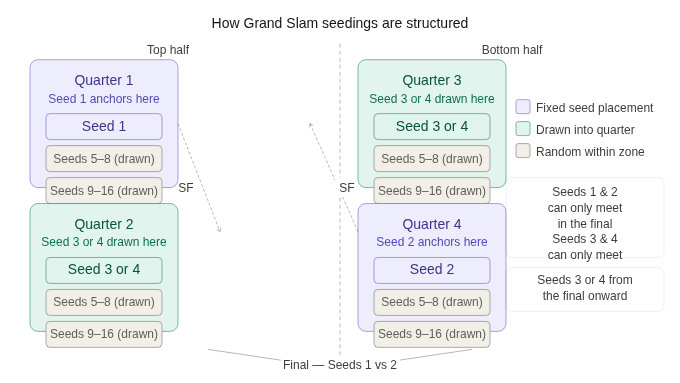
The first seed and second seed are guaranteed to be on opposite sides of the draw — they can only meet in the final if both win every match. The third and fourth seeds are drawn into the two quarters not occupied by the first and second seeds, ensuring they cannot meet the top two seeds until the semifinals.
The fifth through eighth seeds are placed so they cannot meet the top four until the quarterfinals. The ninth through sixteenth seeds cannot meet the top eight until the fourth round. The seventeenth through thirty-second seeds cannot meet the top sixteen until the third round.
This structure creates the projected path that analysts discuss when evaluating a player’s draw — the sequence of opponents a player would face if all higher seeds win their matches. A first seed in a quarter containing multiple dangerous lower seeds faces a harder projected path to the final than a first seed in a quarter with weaker opponents — even though both first seeds receive the same draw protection against other top seeds.
Wimbledon’s Historical Surface Adjustment
Wimbledon has historically made the most significant exception to pure ranking-based seeding in Grand Slam tennis — adjusting seedings to account for grass court performance in a way that the other three Grand Slams have not.
For many years Wimbledon used a modified seeding formula that gave additional weight to grass court results when determining seeds — placing players with strong grass court records higher than their ATP ranking would suggest and adjusting players with poor grass court records downward.
The specific formula changed multiple times over the years as the tournament tried to balance surface-specific relevance with the objectivity of the ranking-based approach.
The most discussed consequence of Wimbledon’s grass court adjustment was its effect on Rafael Nadal’s seeding in the mid-2000s. Despite being ranked second in the world, Nadal was seeded lower than second at Wimbledon in certain years because the adjustment formula weighted his limited grass court results against him — a decision that generated significant controversy given that Wimbledon’s seedings were simultaneously diverging from the ATP ranking that every other tournament used as the definitive measure of player quality.
Wimbledon has moved progressively toward the standard ATP and WTA ranking-based approach in recent years, reducing though not entirely eliminating the surface-based adjustment from its seeding formula.
The current Wimbledon seeding methodology is closer to pure ranking-based seeding than at any previous point in the tournament’s history, though the specific formula retains elements of surface consideration that differentiate it from the other three Grand Slams.
Protected Rankings and Their Effect on Seeding
Protected rankings — the mechanism by which players returning from injury can use their pre-injury ranking for entry purposes — do not automatically translate into seeding benefits at Grand Slams.
A player using a protected ranking for tournament entry receives a position in the draw based on that protected ranking — meaning they can enter a tournament they would not have qualified for on their current ranking.
But protected rankings are generally not used for seeding purposes. A player who enters Wimbledon on a protected ranking of tenth in the world but whose current ranking is fiftieth will typically be placed in the draw as an unseeded player rather than being seeded based on their protected ranking.
This distinction — between entry and seeding — matters for how protected rankings affect the competitive experience of returning players. They provide access to tournaments without providing the draw protection that seeding offers.
A player returning from injury on a protected ranking may find themselves in the main draw of a Grand Slam but facing a top seed in the first round — competitive circumstances that their pre-injury ranking would have protected them from.
Wild Cards and Their Seeding Status
Wild card players — those who receive discretionary entries from the tournament rather than qualifying through ranking — are never seeded at Grand Slams regardless of their ranking. A former world number one competing on a wild card because their current ranking is outside the direct acceptance range does not receive seeding based on their historical ranking or their previous performance at the tournament.
This rule reflects the specific purpose of Grand Slam seedings — to protect the highest-currently-ranked players from meeting each other in the early rounds. A wild card player, regardless of their reputation or history, is competing on the basis of the tournament’s discretionary generosity rather than their current ranking, and seeding based on historical merit rather than current ranking would undermine the objectivity of the seeding system.
The Draw Ceremony: How Seeds Are Placed
The draw ceremony is the process by which the 128 players — 32 seeds and 96 unseeded players — are assigned their specific bracket positions. Understanding how it works clarifies both why certain matchups are possible and why others are not.
Seeds 1 and 2 are not drawn — they are automatically assigned to the top and bottom halves of the draw. Seed 1 goes to the top half, seed 2 goes to the bottom half. Their specific quarter and eighth assignments within those halves may vary by tournament.
Seeds 3 and 4 are drawn to determine which of the two quarters not occupied by seeds 1 and 2 each player is placed in. One player is drawn to the top half’s second quarter, the other to the bottom half’s first quarter. This ensures they cannot meet seeds 1 or 2 until the semifinals.
Seeds 5 through 8 are drawn to determine which eighth of the draw each player occupies — ensuring they cannot meet the top four until the quarterfinals but with random placement within those protected zones.
Seeds 9 through 32 follow a similar process — drawn into protected sections of the bracket that prevent specific early-round matchups between high seeds while allowing random placement within those protected zones.
Unseeded players — direct acceptances, qualifiers, and wild cards — are placed into the remaining draw positions by random draw after all seeds have been assigned. Unseeded players can be drawn against any seeded player in the first round.
What Seeding Means for a Player’s Draw
The practical consequence of seeding — the draw protection it provides — is one of the most significant factors in determining a player’s path to a Grand Slam title.
A first seed who wins their section of the draw will face, in theory, the fifth or eighth seed in the quarterfinals, the third or fourth seed in the semifinals, and the second seed in the final. The specific players in those positions are determined by the draw and their own results, but the projected path is structured by the seeding.
An unseeded player faces no such protection. They can be drawn against the first seed in the first round — a result of pure random draw placement that reflects no competitive judgment about the matchup.
The frequency with which unseeded players face top seeds in Grand Slam first rounds is one of the most visible expressions of the draw’s random element and one of the recurring narratives of Grand Slam coverage.
The practical difference between being seeded and unseeded at a Grand Slam is not limited to the first round. A seeded player’s entire projected path — the opponents they might face at each stage of the tournament — is structured around the protection that their seeding provides. An unseeded player’s path is entirely random, determined by the draw without any protection against difficult early matchups.
Seeding Changes Between the Cutoff and the Draw
Because the seeding cutoff date precedes the draw ceremony by several weeks, players’ rankings can change significantly in the intervening period. A player who wins a major title between the seeding cutoff and the draw ceremony will improve their ranking but not change their seed at the upcoming Grand Slam. A player who withdraws injured between the cutoff and the draw may leave a seeded position vacant.
When a seeded player withdraws after the seeding cutoff but before the draw, the standard procedure is for the seeds to move up — the player seeded 33rd effectively becomes seed 32, and so on up the order — though the specific procedures vary by tournament.
This can produce situations where a player who was not seeded at the cutoff date finds themselves seeded at the draw ceremony because withdrawals above them in the ranking have created a vacancy.
Rankings and Seedings at Non-Grand Slam Events
The same ranking-based seeding principle applies at non-Grand Slam events, with adjustments for the smaller draw sizes and fewer seeded positions at ATP 1000, 500, and 250 events and their WTA equivalents.
At Masters 1000 events with 96-player draws, typically 32 players are seeded. At 64-player draws, 16 players are seeded. At 32-player draws, 8 players are seeded. The specific seeding cutoff dates and draw procedures at non-Grand Slam events follow the same basic principles as the Grand Slams but with tournament-specific variations in timing and procedure.
Why the Ranking-Based Seeding System Works
The ranking-based approach to Grand Slam seedings has been the standard for the Open Era because it provides the clearest, most objective, and most defensible basis for distributing players across the bracket.
The alternatives — surface-specific seeding, recent form seeding, reputation-based seeding — all introduce subjective elements that the ranking-based system avoids. The ranking is calculated through a specific, publicly transparent formula that every player and every observer can understand and verify.
Its use as the basis for seedings means that seeding decisions are not influenced by tournament organizers’ preferences, by commercial considerations, or by subjective assessments of competitive quality that different observers might evaluate differently.
The system is not perfect — the specific timing of the seeding cutoff means that recent form is not fully reflected, and the standard 52-week ranking does not always capture current competitive level as accurately as a shorter rolling window might.
But it is transparent, consistent, and resistant to the kind of manipulation that more subjective seeding approaches would be vulnerable to. For a sport in which competitive integrity is fundamental to commercial value, those qualities matter.
Part of the Rankings series. Related: How Tennis Tournaments Work — Draws, Seeds, and the Road to a Championship · How ATP Rankings Work — The Complete Guide · Who Has Spent the Most Weeks at World Number One in Tennis History