

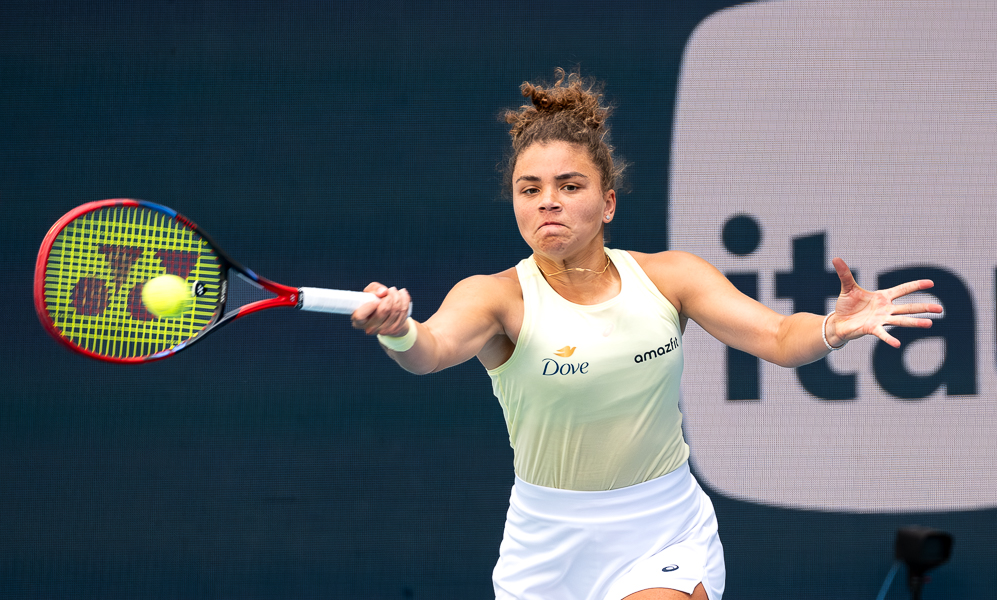
Jasmine Paolini’s breakthrough is one of the best recent stories in Italian tennis. Standing just 5 ft 4 in, she defied the power-first trend of the modern game to reach both the Roland Garros and Wimbledon finals in 2024, climbed to a career-high World No. 4, and became a national figure. Alongside Sara Errani she also built one of the strongest doubles partnerships on tour, winning Olympic gold and a Grand Slam doubles title.
Her 2026 singles season has been quieter. Paolini slipped out of the top 10 for the first time in roughly two years after an early defense of her Rome points, and is rebuilding her singles ranking even as she remains elite in doubles. The profile is a proven multi-surface contender working to recapture her 2024–25 singles form.
Quick facts
- Full name: Jasmine Paolini
- Nationality: Italy (born Castelnuovo di Garfagnana; based in Bagni di Lucca)
- Born: January 4, 1996
- Height: 5 ft 4 in (1.63 m)
- Turned pro: 2015
- Plays: Right-handed, two-handed backhand
- Coach: Danilo Pizzorno (with Sara Errani joining the team in late 2025)
- Identity: Compact, high-energy all-courter with exceptional movement and ball-striking
Season snapshot — June 2026
- Current standing: Ranked around World No. 13 (verify against the live WTA list before publishing); career-high was No. 4, reached October 28, 2024
- Ranking context: Dropped out of the top 10 after Rome, ending a streak of more than 100 consecutive weeks inside it — a first for an Italian woman
- 2026 Grand Slams: Early exit at Roland Garros (lost to Solana Sierra)
- Doubles standing: Remains among the world’s best, with a Miami final alongside Errani in 2026
- Career singles titles: 3, including two at WTA 1000 level (Dubai 2024, Rome 2025)
Snapshot data is time-sensitive and scheduled for quarterly review.
Snapshot
Paolini’s game is built on speed, energy, and clean hitting rather than size. She covers the court exceptionally well, takes the ball early off both wings, and competes with relentless positivity. That blend carried her to two major finals in a single 2024 season and remains the template she is working to rediscover in singles after a quieter run of results.
Playing style and strengths
Footwork and court coverage. Among the quickest on tour, she neutralizes bigger hitters with defense and retrieval.
Clean two-wing hitting. She strikes the ball early and flat, generating pace without the leverage of height.
Doubles excellence. An Olympic gold medalist and Grand Slam doubles champion with Errani, she is tactically sharp and comfortable at the net.
Pressure points and vulnerabilities
- Generating free points on serve given her height, especially against power players
- Recapturing the singles consistency of 2024–25 after a ranking slide
- Defending big points across a calendar where she rose so quickly
- Margin against top hitters on faster surfaces
Career milestones
- 2024: Finals at both Roland Garros and Wimbledon; Olympic doubles gold with Errani; career-high World No. 4
- 2024–2025: Billie Jean King Cup titles with Italy
- 2025: Rome WTA 1000 singles title; French Open doubles title with Errani
- Career: First Italian woman to spend 100 consecutive weeks in the top 10
Grand Slam record in context
Paolini’s singles major record is defined by her remarkable 2024, when she reached finals on clay and grass within weeks of each other — a feat no Italian woman had managed in the modern era. Her 2026 has yet to produce a comparable singles run, with an early Roland Garros exit, but her doubles results keep her among the most accomplished players on tour. Rediscovering her singles form at the majors is the clear next step.
What to watch next
- Singles form — whether she can climb back toward the top 10 in the season’s second half
- Grass and hard courts — building on her 2024 Wimbledon final run
- Doubles — continued success alongside Errani across the majors