

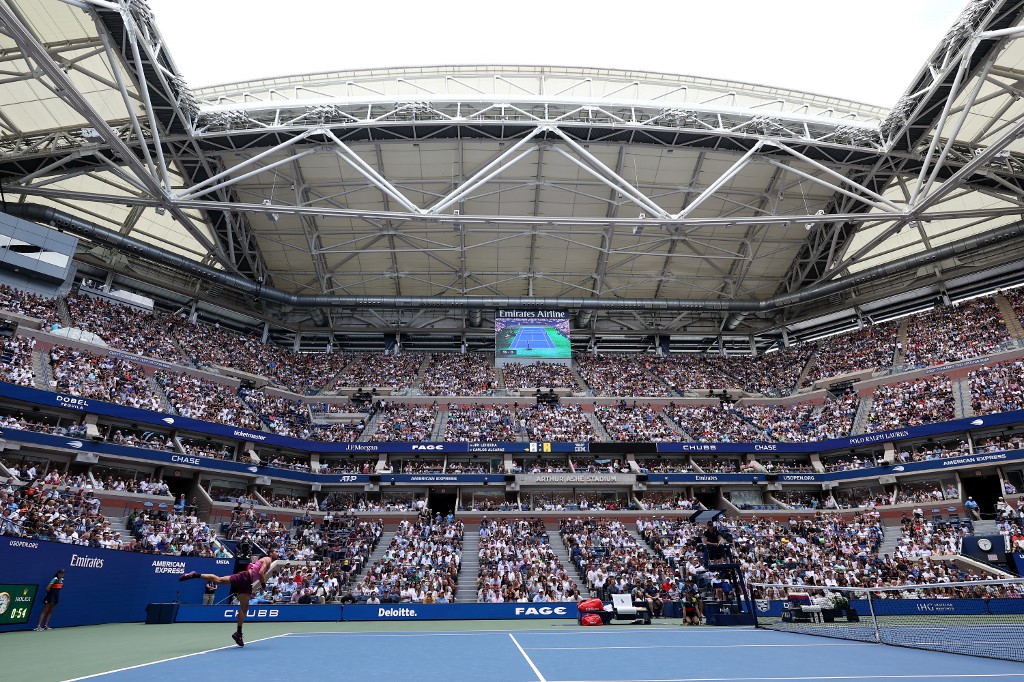
The US Open will pay out $108 million in total player compensation this year, the largest package in the history of the sport and a 20 percent increase on the $90 million record it set in 2025. It is the second consecutive year the tournament has raised the figure by a fifth, a 44 percent rise across two seasons. The headline numbers travelled quickly. The shape of the increase did not.
The money did not rise evenly. It rose fastest at the bottom of the draw and slowest at the top. A player who loses in the first round of the men’s or women’s singles will earn $140,000, up 27 percent and the highest first-round payment in Grand Slam history. A player who loses in the first round of qualifying earns $32,000, up 16 percent. At the other end, the runner-up collects $2.8 million, a 12 percent rise on last year’s $2.5 million, and the champion collects $5.5 million, a 10 percent rise on $5 million. Every round between moves by a smaller margin than the round below it.
The champion’s share is falling. That pattern is not new, and it compounds. Sportico calculates that a decade ago the men’s and women’s singles champions took 18.3 percent of everything paid to singles players at the tournament; this year that figure is 12.9 percent. The absolute cheque is the biggest ever written in tennis. The proportion it represents has been contracting for years. USTA chief executive Craig Tiley described the package as “a significant first step in a multi-year investment in athletes,” which is a fair reading of the direction of travel. The tournament is buying depth rather than headlines.
Doubles did not move. The men’s, women’s and mixed doubles champions each split $1 million per team, unchanged from last year, with only marginal increases in the earlier rounds. Karolina Muchova and Jakub Mensik collected that $1 million on Arthur Ashe Stadium on Wednesday night after beating Belinda Bencic and Flavio Cobolli. Set against the singles champion’s $5.5 million, the doubles winners take 18 percent. At the 2000 US Open, by Sportico’s reckoning, they took 43 percent.
The timing of that flat line matters more than it would in an ordinary year. In July, ATP officials presented roughly 50 doubles specialists with a reform package for 2028 that would cut the doubles share of tour prize money from 20 percent to 10 percent and halve draw sizes, from 32 teams to 16 at Masters 1000 events and from 16 to eight at the 500 and 250 level. A group of leading doubles players responded with a statement rejecting the idea that they are “a carnival sideshow,” and warning that nobody outside the top 30 would be able to make a living under it. The proposal does not touch the Grand Slams, where doubles players earn most of what they earn. That makes a year of no increase at the richest of the four majors a data point worth holding onto.
What the $108 million is not. Not all of it is on-court prize money. The package includes an initial $2 million for a new US Open Player Support Program, held in escrow while the details are settled, split equally between men and women, and aimed at mid-career events and retirement transitions rather than results. Eligibility is not tied to ranking tiers; it covers main-draw singles and doubles competitors. The US Open is the first major to create one, and the newly formed Grand Slam Player Council will advise on how it is deployed.
Qualifying finishes this week on the outside courts, free to the public. The players losing there are collecting $32,000 apiece — more than a full season’s earnings for most of them, and the clearest evidence of where the extra $18 million actually went.