

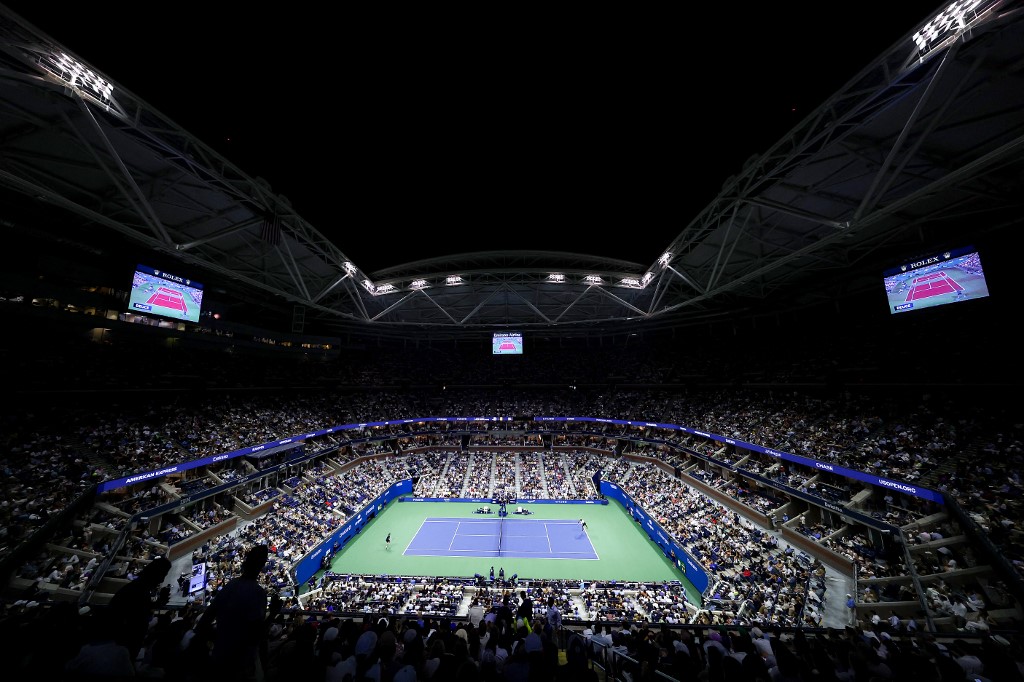
The US Open closes the Grand Slam calendar each year, bringing the professional tennis season to New York in late summer. Played on outdoor hard courts at the USTA Billie Jean King National Tennis Center, it awards 2,000 ranking points to singles champions and often reshapes the year-end race.
First held in 1881 and part of the Open Era since 1968, the US Open is known for its night-session atmosphere and large, high-energy crowds. This guide explains how the tournament is structured, how the draws work, how ranking points are distributed and what distinguishes it from the other majors.
Where It Is Played
Venue: USTA Billie Jean King National Tennis Center
City: New York, United States
Surface: Outdoor hard court
Main stadium: Arthur Ashe Stadium
The US Open hard court typically plays medium to medium-fast, rewarding strong serving and aggressive baseline play.
Tournament Format
Main Draw Size
- 128-player singles draw (men and women)
- 64-team doubles draw
- Mixed doubles event
- Junior and wheelchair competitions
Match Format
- Men’s singles: Best of five sets
- Women’s singles: Best of three sets
- Final-set tiebreak: First to 10 points at 6–6 in the deciding set
How the Draw Works
The singles draw includes 128 players, with 32 seeds.
- Seeds are distributed to prevent early-round meetings
- The top two seeds cannot meet before the final
- Seeds 1–4 cannot meet before the semifinals
- Unseeded players are drawn randomly
- Qualifiers earn entry through a three-round qualifying event
The US Open is often influenced by ranking movement during the North American hard-court swing.
Ranking Points Distribution (Singles)
As a Grand Slam, the US Open awards the maximum ranking points.
- Champion: 2,000 points
- Finalist: 1,300 points
- Semifinalist: 800 points
- Quarterfinalist: 400 points
- Fourth Round: 200 points
Points apply within the ATP and WTA 52-week ranking systems.
Prize Money
The US Open distributes prize money across all rounds, including qualifying and early-round exits. The total purse is announced annually and ranks among the highest in professional tennis.
Scheduling Structure
- Two-week main draw
- Late August through early September
- Day and night sessions
- Prominent primetime matches inside Arthur Ashe Stadium
The tournament’s evening matches are a defining feature, often producing some of the most dramatic atmospheres in the sport.
What Makes the US Open Unique
- Final Grand Slam of the calendar year
- Large stadium environment
- Night-session culture
- Hard-court season climax
- Influence on year-end rankings and ATP/WTA Finals qualification
The timing of the event often shapes the narrative heading into the closing stretch of the season.
How It Compares to Other Grand Slams
| Tournament | Surface | Typical Pace |
|---|---|---|
| Australian Open | Hard | Medium |
| Roland Garros | Clay | Slow |
| Wimbledon | Grass | Fast |
| US Open | Hard | Medium-Fast |
Surface variation across the four majors plays a central role in defining player legacies and historical comparisons.
Frequently Asked Questions
When is the US Open played?
Typically late August through early September.
How many players are seeded?
32 in singles.
How many ranking points does the champion receive?
2,000 points.
What surface is used?
Outdoor hard court at the USTA Billie Jean King National Tennis Center.