

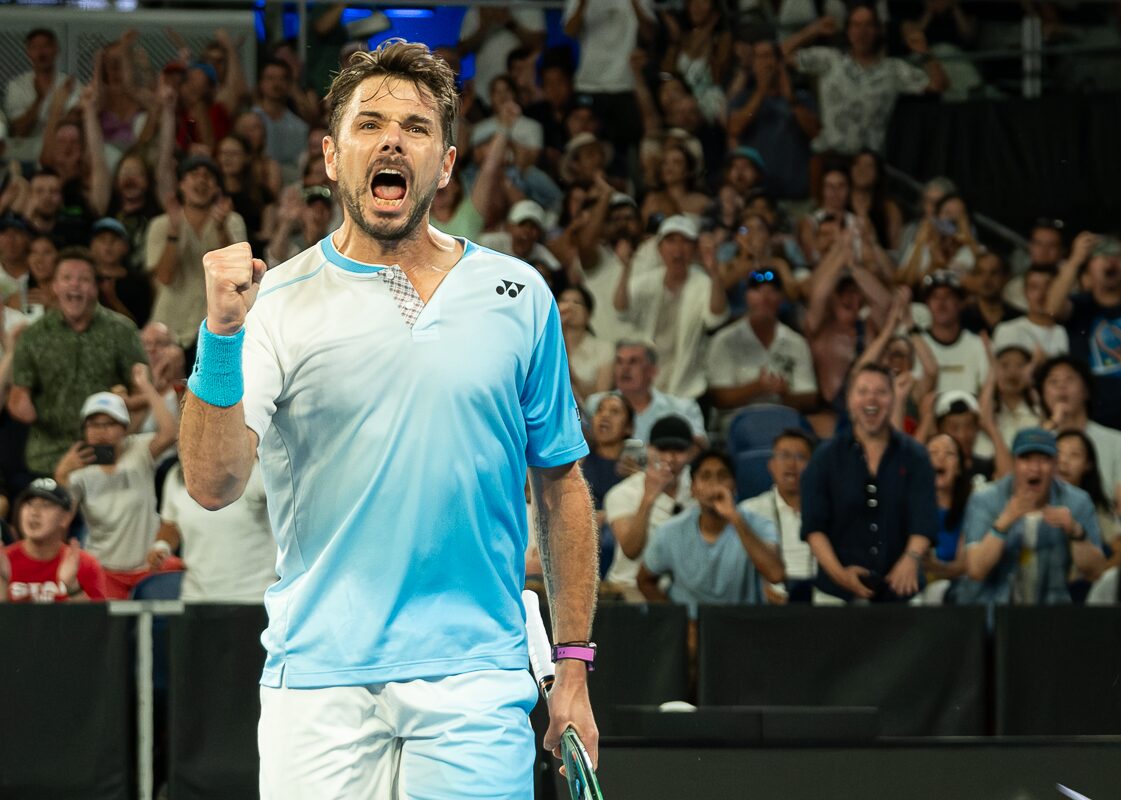
Stan Wawrinka returns to Wimbledon this week for what is expected to be his farewell appearance at the All England Club, carrying one of the strangest and most compelling résumés in modern tennis.
He is a three-time Grand Slam champion. He won the Australian Open in 2014, Roland Garros in 2015 and the US Open in 2016. He reached No. 3 in the world, won 16 ATP titles, beat every member of the Big Three multiple times, and produced some of the most fearless major-final tennis of his generation.
But Wimbledon never bent to him.
Now 41, Wawrinka enters the 2026 Championships as a wild card and opens against Matteo Berrettini, the 2021 finalist whose own grass-court credentials make this a fitting first-round test. Wimbledon’s draw lists Wawrinka as a wild card against Berrettini, while Reuters framed the match as Wawrinka’s 19th and likely final appearance at the tournament.
That is the hook, but the deeper story is the paradox: Stan Wawrinka had the weapons to win anywhere, yet Wimbledon remained the one major he never solved.
Wawrinka announced in December that 2026 would be his final season, writing that every book needs an ending and that this year would be the final chapter of his career. The announcement turned every major appearance this season into a farewell, but Wimbledon carries a different weight because it is the one place where his career Grand Slam chase never truly came alive
His best results at the All England Club were back-to-back quarterfinals in 2014 and 2015. In 2014, he lost to Roger Federer. In 2015, just weeks after producing one of the great Roland Garros final performances against Novak Djokovic, Wawrinka fell to Richard Gasquet in a five-set Wimbledon quarterfinal that ended 11-9 in the fifth.
That loss remains the closest Wimbledon came to opening for him.
On paper, Wawrinka should have been more dangerous on grass. He had a heavy first serve, a brutal forehand, and one of the most famous one-handed backhands in tennis history. He could finish points with a single swing. He was not a clay grinder dependent on long rallies. His best tennis was aggressive, direct and violent.
But grass asked different questions.
Wawrinka’s power game was built on rhythm. He liked time to load, plant and strike through the ball. On hard courts and clay, especially when he was at his peak from 2014 to 2016, he could absorb pace, create space, and turn baseline exchanges into physical punishment. His backhand did not just hold up under pressure. It became a weapon that could break the best defensive players in the sport.
Wimbledon gave him less time, lower bounces and more awkward contact points. The same long, beautiful swing that made his backhand so devastating elsewhere could be rushed on grass. Against elite servers and players comfortable taking the ball early, Wawrinka often had to defend before he could dictate.
That was the problem. Wawrinka’s game was explosive, but it was not naturally compact. Grass rewards players who make the first move quickly: the blocked return, the short backswing, the slice that stays low, the first volley, the half-step forward. Wawrinka could do some of that, but it was never the foundation of his identity.
His best version needed room to become Stan the Man.
That is why his Grand Slam career looks so unusual. Most players who win three majors do it by dominating one surface or finding one tournament that fits their game perfectly. Wawrinka did something different. He won in Melbourne, Paris and New York, beating Rafael Nadal in the 2014 Australian Open final and Djokovic in the 2015 French Open and 2016 US Open finals. Those were not soft draws or opportunistic runs. They were heavyweight title wins.
Wimbledon, though, never gave him that fortnight where his timing, body and draw all aligned.
The Berrettini match only sharpens the symbolism. Berrettini is the kind of player Wimbledon has historically rewarded: huge serve, huge forehand, short points, grass-court confidence. Reuters noted that the Italian reached the 2021 Wimbledon final and remains dangerous on grass when fit, though injuries have disrupted his recent seasons.
For Wawrinka, the match is not just another first round. It is a final look at the one major that refused him.
The phrase “Stan Wawrinka Wimbledon career Grand Slam” will always carry a sense of unfinished business. He did enough to be remembered as one of the great champions of his era. He won majors in the age of Federer, Nadal, Djokovic and Murray. He gave Djokovic some of the most damaging Grand Slam defeats of his prime. He made a one-handed backhand feel dangerous in an era increasingly built around two-handed control.
Still, Wimbledon stands apart.
Not as a failure. More as the missing chapter.
Wawrinka’s career does not need Wimbledon to be validated. But as he walks onto the grass this week, the absence is impossible to ignore. The Australian Open proved he could break through. Roland Garros proved he could reach a level almost nobody could touch. The US Open proved it was no accident.
Wimbledon proved that even a champion with every weapon can still meet one place that will not yield.