

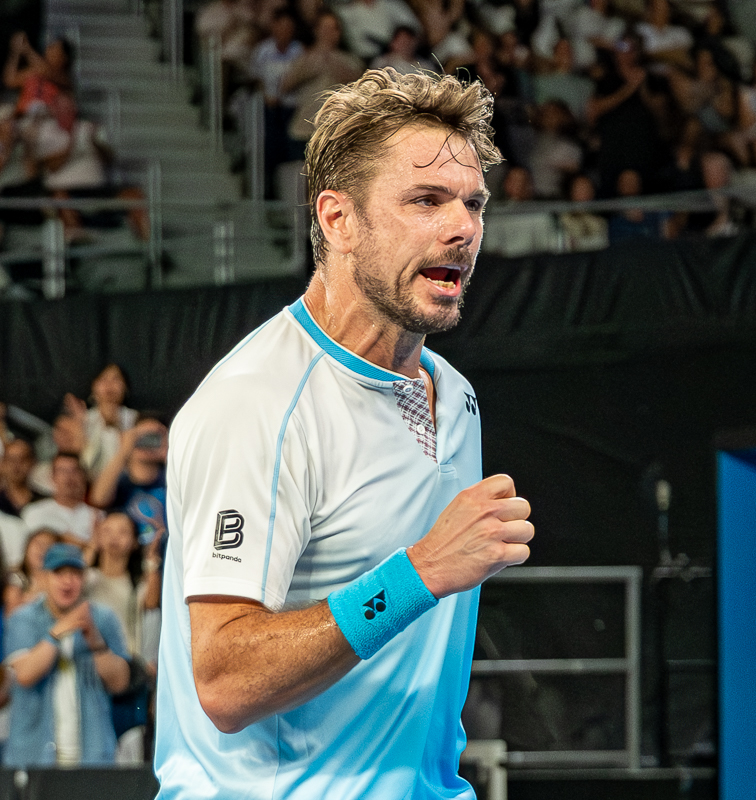
Stan Wawrinka walked off the clay at Roland Garros for the final time on Monday, his 21st and last appearance at the tournament ending in a 6-3, 3-6, 6-3, 6-4 first-round loss to Dutch lucky loser Jesper de Jong on Court Simonne-Mathieu. The 2015 champion, who turns 42 in March, will retire at the end of the 2026 season.
The Swiss, who announced his retirement plans in December, had hoped for one last meaningful run at the major that defined his career. Instead, under a punishing Paris sun with temperatures climbing to 33 degrees Celsius, his three-hour battle against the 106th-ranked de Jong slowly slipped away. The Dutchman finished the match with a whipped forehand winner and immediately turned to urge the crowd to applaud the man across the net, whose face was almost as red as the clay beneath his feet.
The ceremony. What followed turned a routine first-round result into one of the tournament’s most affecting moments. Tournament director Amelie Mauresmo and French Tennis Federation president Gilles Moretton presented Wawrinka with a glass case containing a section of clay from the court, while video tributes played on the big screens. Roger Federer, Rafael Nadal and Novak Djokovic — the rivals who defined Wawrinka’s era — each recorded messages, joined by world number one Jannik Sinner, defending champion Carlos Alcaraz and fellow retiring Frenchman Gael Monfils, who would lose his own farewell match later that night.
“It’s hard, it’s hard to say goodbye to you here,” an emotional Wawrinka told the crowd. “It’s because of Roland Garros that I wanted to become a tennis player.” Responding to cheers of “we love you, Stan” from the stands, he added: “Me too, I love you. Thanks to all your support, I wanted to go on as long as possible, to 41 years of age, to continue living moments like this.”
Djokovic, who Wawrinka famously beat in the 2015 final on Court Philippe-Chatrier and again at the 2016 US Open, kept his message direct. “You have been so inspirational to me and for many other players,” the Serbian said. “I’m very honored to call you a friend.” Federer’s tribute was warmer still: “I am impressed by all that you accomplished. Enjoy your moment.”
The opponent. De Jong, who had originally lost in qualifying and only entered the main draw as a lucky loser after Arthur Fils withdrew, handled the occasion with grace. “He was playing against my coach when I was a ball kid. I don’t want to say you’re that old,” the Dutchman joked, drawing a smile from Wawrinka. “It’s all about Stan today, the way he was fighting.” Wawrinka, never one to lose a one-liner, shot back: “I know I played against your coach, it doesn’t make me any younger.”
The career. Wawrinka leaves Roland Garros having accumulated 46 main-draw wins in Paris, the ninth-most in tournament history, with 11 five-set victories at the venue — second only to Monfils. Across his 25-year professional career he amassed 160 Grand Slam match wins. Each of his three majors — the 2014 Australian Open, the 2015 French Open and the 2016 US Open — came against an opponent ranked world number one at the time, with Nadal and Djokovic both beaten in the deciding match. He also claimed Olympic doubles gold in Beijing alongside Federer in 2008 and helped Switzerland win the Davis Cup in 2014.
His 2015 title remains the signature performance of his career. Down a set against Djokovic, then the heavy favourite chasing his own career Grand Slam, Wawrinka unleashed one of the most fearless final-set displays the modern game has seen to win in four. Nadal, who would deny him in straight sets in the 2017 final, made his own appearance on the screens Monday to send Wawrinka off.
Looking ahead. Wawrinka is expected to play a handful of further events before bringing his career to a close later in 2026, with his on-tour goodbyes set to continue through the grass-court swing and beyond. His departure from Paris closes one of the longest active Roland Garros chapters in the modern game — a 21-year run that began when he was a teenage qualifier and ends as one of only seven men in the Open Era to have won three or more Grand Slam titles outside the so-called Big Four.
“You never want to say goodbye when you’re passionate about something,” Wawrinka said. “I know it was the end. I gave everything for this sport, and I know it is the right choice.”