

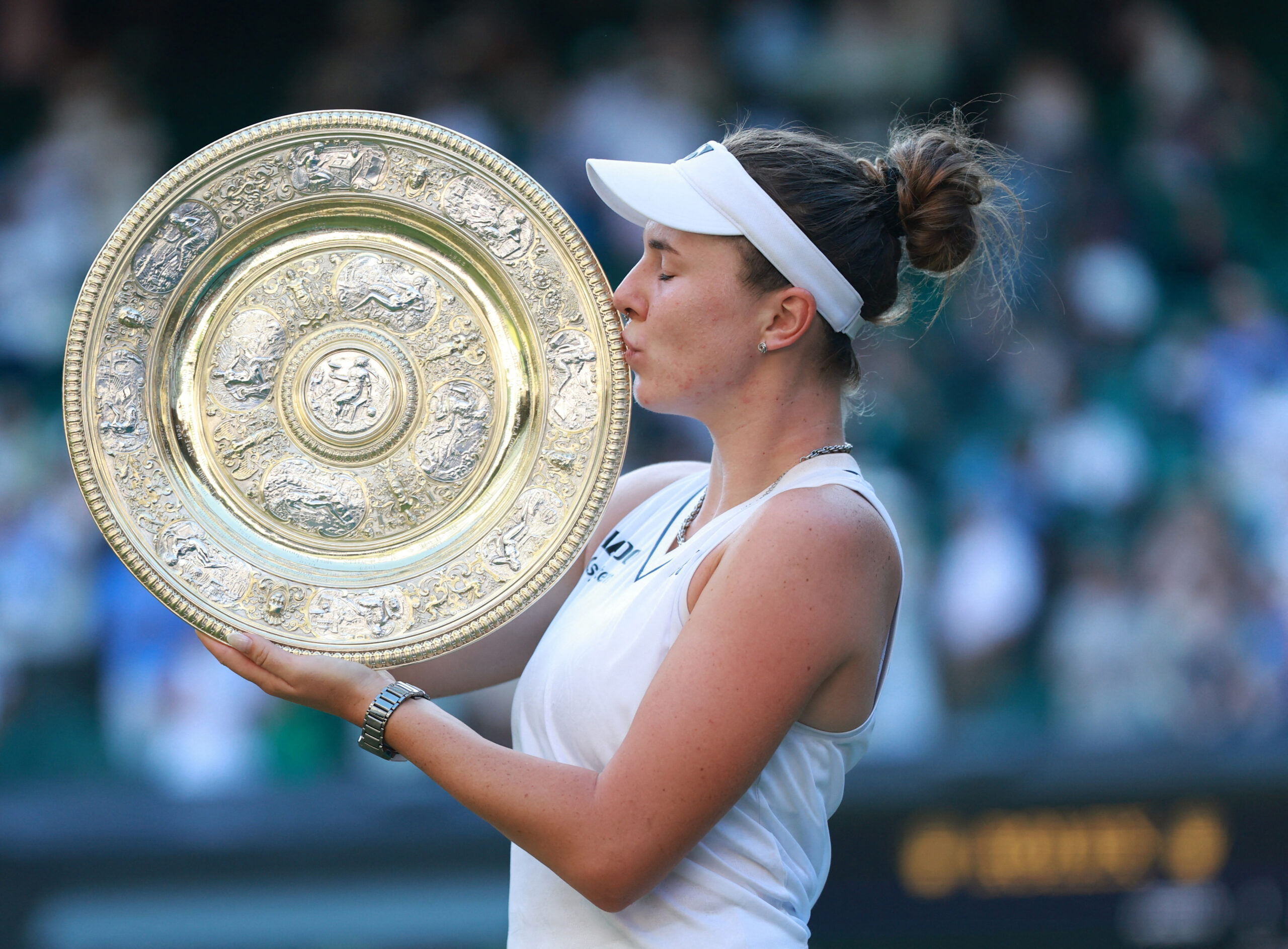
A maiden Slam is a player’s first Grand Slam singles title. That is the whole definition. The term carries no technical weight. It is not written into any rulebook, it earns no extra ranking points, and the trophy handed over on court is the same one every other champion receives. What it describes is a threshold. A player has crossed it, or a player has not.
Where the Term Comes From
“Maiden” is a general English adjective meaning the first of its kind. A maiden voyage is a ship’s first crossing. A maiden speech is a legislator’s first address to a chamber. Sport borrowed the word freely, and tennis borrowed it for the single moment that converts a contender into a champion.
The conversion can only happen at four tournaments: the Australian Open, Roland Garros, Wimbledon and the US Open. Nothing else on either tour counts. A player can hold Masters 1000 and WTA 1000 trophies, a tour-finals title, even an Olympic gold medal, and still be described as chasing a maiden Slam. The four majors are the only currency the phrase recognizes.
What a Maiden Slam Is Not
The term is routinely confused with three others. The distinctions are worth keeping straight, because commentary rarely pauses to explain them.
It is not the Grand Slam
A capital-G Grand Slam means winning all four majors within a single calendar year. A maiden Slam is one title, at one event, on one afternoon. The overlap in vocabulary is unfortunate but entrenched, and context is usually the only thing separating the two.
It is not the Career Slam
A Career Slam means winning all four majors at some point across a career, in any order and across any number of seasons. A maiden Slam is the first brick in that wall, if the wall is ever built at all. Most maiden Slams lead nowhere near a Career Slam, and that does not diminish them.
It is not a maiden title or a maiden final
A maiden title is a player’s first tour-level trophy of any kind, at any event, and for most professionals it arrives at a modest tournament years before a major is realistic. A maiden final is a first appearance in a title match, which resolves nothing on its own. A player can reach a maiden Grand Slam final and lose it, in which case the maiden Slam remains outstanding and the wait continues.
Why the First One Is Different
Every major a player wins after the first is an addition to a total. The first one is a reclassification.
Tennis keeps a long, unofficial list of the best players never to win a major. It is an awkward honorific. It follows a player from press conference to press conference, it gets heavier with every season it survives, and it is applied most aggressively to exactly the players who least want to hear it — the ones good enough to be asked about it. Winning a maiden Slam is the only exit. It is why first-time champions so often reach for the language of relief before the language of joy.
The waiting periods vary enormously. Some players convert at an early attempt and never appear on the list at all. Others accumulate finals without converting one. Andy Murray lost his first four Grand Slam finals before winning the 2012 US Open at the fifth attempt — the same path walked by his coach Ivan Lendl, who also needed five major finals to land his own maiden title. And some players reach the top of the sport by every other measure, ranking included, and never take the last step.
That asymmetry is what gives the phrase its charge. A second Slam is a data point. A maiden Slam is a verdict.
How the Term Is Used in Coverage
Reporters and commentators use “maiden Slam” in three standard constructions.
Chasing a maiden Slam. The player has no major title and is still alive in a draw. This is the most common usage and the least loaded.
Won her maiden Slam. The conversion has happened. The phrase is applied once and then, by definition, never again to that player.
A maiden Slam is guaranteed. Both finalists are without a major, so the tournament will produce a first-time champion regardless of the result. This construction is the rarest and, for a preview writer, the most useful — it removes all uncertainty from one storyline before a ball is struck.
Frequently Asked Questions
Does a maiden Slam have to be a singles title?
By convention, yes. A first doubles or mixed-doubles major is described as a first Grand Slam doubles title, not a maiden Slam.
Can a player win more than one maiden Slam?
No. A player has exactly one maiden Slam, or none. Every subsequent major is simply the second, third and so on.
Is a maiden Slam worth extra ranking points?
No. A Grand Slam singles title carries identical ranking points whether it is a player’s first or fifteenth. The significance is entirely narrative and psychological.
Is a maiden Slam the same as a breakthrough?
Not quite. A breakthrough is loose and can describe a first deep major run, a first top-10 win, or a first title of any size. A maiden Slam is precise and admits only one qualifying event.
What is the opposite of a maiden Slam?
There is no formal antonym. Coverage tends to reach for “title defence” or “first since,” neither of which is a true opposite.
Most Recent Maiden Slam — Updated July 11, 2026
Linda Nosková won her maiden Grand Slam title at Wimbledon 2026, beating fellow Czech Karolína Muchová 6-2, 5-7, 6-3 on Centre Court on Saturday, July 11.
It was the first all-Czech final at any Grand Slam, and it guaranteed a first-time major champion before a ball was struck — neither finalist had won a Slam. Muchová, runner-up at Roland Garros in 2023, was contesting her second major final; Nosková was contesting her first. Muchová saved five championship points before Nosková converted the sixth.
At 21 years and 237 days, Nosková is the youngest women’s singles champion at Wimbledon since Petra Kvitová in 2011. Both players are projected to reach career-high rankings when the WTA update is published, with Muchová at No. 6 and Nosková at No. 7.
The coverage that followed is a clean illustration of the term in use. Sky Sports and Olympics.com both reached for “maiden” in their headline and lede to describe what had happened — a player crossing the threshold for the first and only time.