

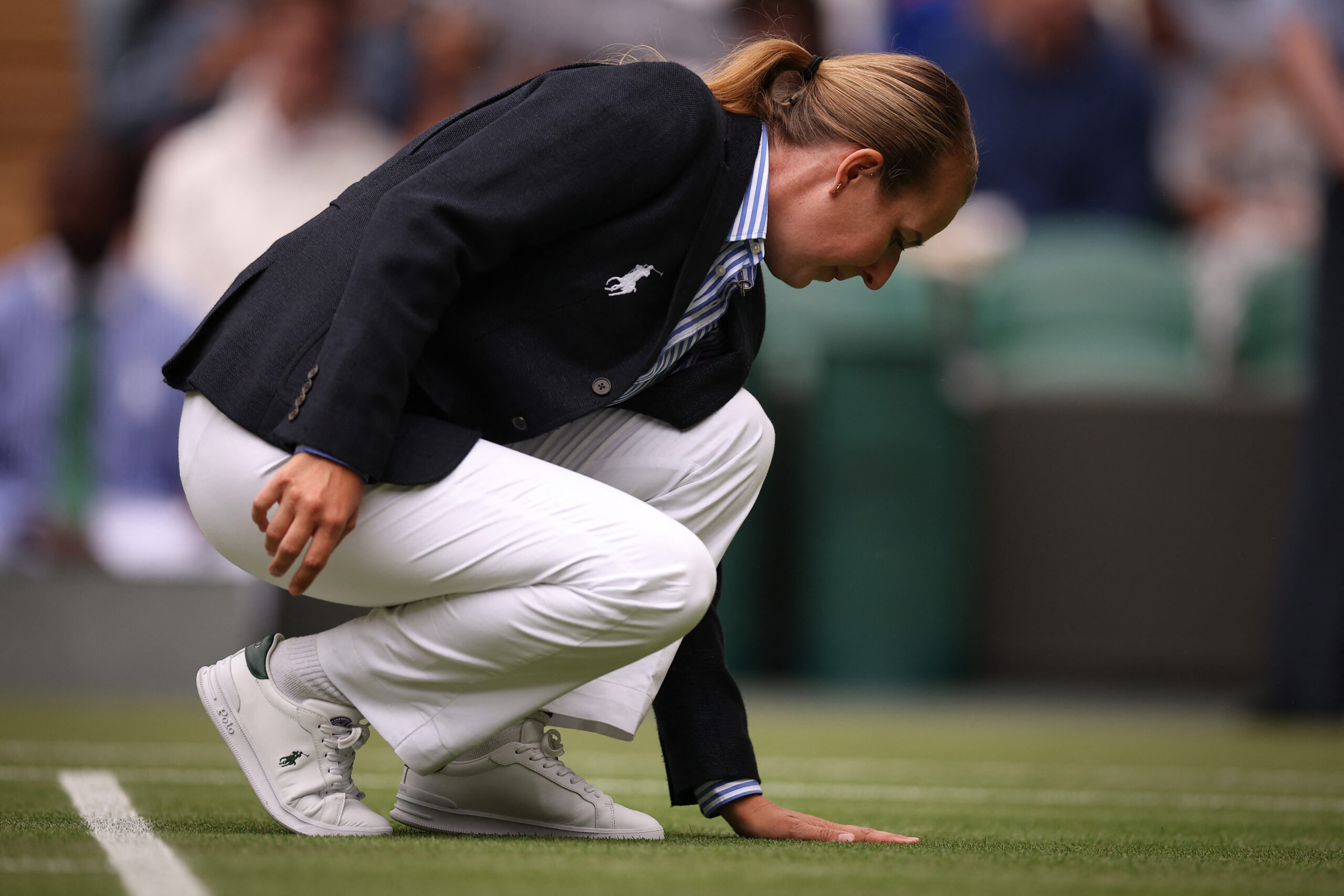
Grass is the surface tennis was born on, and the one its modern players understand least. It is the fastest of the three Grand Slam surfaces, the rarest on tour, and the most likely to produce an early-round surprise. Understanding why means looking at how a ball behaves when it meets a living lawn rather than a coating of acrylic or crushed brick.
A ball that skids instead of grips
The defining trait of grass is the skid. On clay, the loose top layer grabs the ball, slowing it and kicking it upward. On grass there is almost nothing to grab it. The blades offer little friction, so the ball sheds far less speed at the bounce and stays low, sliding through the court rather than sitting up. A shot that climbs to shoulder height on clay can stay below the knee on grass.
Two forces explain this. The first is friction, which governs how much horizontal speed the ball loses when it lands. Grass has very little, which is why the ball keeps moving. The second is the firmness of what lies beneath the turf. Bounce height is driven largely by the soil rather than the blades, and a hard, dry subsoil returns more of the ball’s energy as a low, fast rebound. The combination produces the quickest, lowest bounce in the professional game.
Eight millimetres of lawn
A grass court is an engineered surface that happens to be alive. Wimbledon’s courts are sown with perennial ryegrass, chosen for durability under heavy footwork, and cut to eight millimetres during the Championships. Beneath the grass sits a carefully built rootzone of sand and drainage designed to stay firm and dry, so the courts play consistently and recover quickly after rain.
That maintenance is relentless because grass is fragile. Courts wear visibly along the baselines and service boxes over a fortnight, take more than a year to prepare, and are unplayable in heavy rain. The grass season on tour lasts only a few weeks, and only a small share of professional events are staged on it, which is why most players spend the bulk of their careers on hard courts and clay.
How the modern grass court changed
Grass once played even faster than it does now. Through the 1980s and 1990s the courts used a ryegrass-and-fescue mix that produced an extremely low, skidding, often unpredictable bounce, rewarding serve-and-volley specialists who finished points before a bad bounce could intervene. After the 2001 Championships, Wimbledon moved to a denser, all-ryegrass surface over a firmer subsoil.
The change was made for durability and consistency, but it had a tactical side effect. The denser turf added a little friction and the firmer ground lifted the bounce slightly, taking the extremes off the surface. Points lengthened, the baseline became viable, and the title began going to complete players who could attack and rally rather than only serve and volley. Grass today is best described as fast rather than wild.
Shorter points, bigger serves
Even in its modern form, grass compresses time. The low skid gives the returner less of it, which makes a strong serve disproportionately valuable and tilts play toward the first few shots of a point. Rallies are shorter than on any other surface, service games are harder to break, and momentum can swing on a single loose return game. Patterns built around the serve, the blocked return and taking the ball early carry more weight here than anywhere else.
Why grass produces upsets
Those same traits make grass the most volatile surface in the game. Because service games are hard to break, sets often hinge on one or two points, leaving a favorite less room to grind back into a match than on slower courts. Because the surface rewards specific skills, a low-ball striker, a heavy server or a natural mover can trouble a higher-ranked opponent whose game depends on time and high bounces.
The short season magnifies all of it. Players arrive at the grass major with fewer competitive matches on the surface than they bring to any other Slam, so adaptation happens in real time, under pressure, against opponents who may be better suited to the conditions. The result is a draw where seeds fall early more often than reputations alone would predict.
Frequently asked questions
Is grass the fastest tennis surface? Yes. On the ITF’s court-pace scale, grass rates as the fastest of the main surfaces, ahead of hard courts and well ahead of clay, because the ball skids and keeps its speed off the bounce.
Why does the ball bounce low on grass? The bounce comes mostly from the firm soil beneath the turf, which, combined with grass’s low friction, produces a rebound that is both low and fast.
Why is the serve so powerful on grass? The low, quick bounce leaves the returner less reaction time, so accurate first serves are harder to read and return, and points are often decided in the opening exchanges.
Why are there so few grass tournaments? Grass is expensive, slow to prepare and easily damaged, and the season lasts only a few weeks, so most of the tour is played on hard courts and clay.