

The tennis racket receives most of the attention when the sport’s equipment history is examined — and deservedly so, given the dramatic impact of the graphite revolution on how professional tennis is played.
But the racket does not act alone. Every shot struck in professional tennis is the product of a three-way interaction between the racket, the ball, and the surface — and changes in any one of those three elements affect the competitive outcome as surely as changes in the others.
The history of how tennis balls and court surfaces have evolved is less dramatic than the racket story and less frequently told, but it is no less consequential for understanding why the professional game looks the way it does today.
Slower balls, modified court surfaces, and deliberate decisions by tournament organizers about the conditions they wanted to produce have shaped professional tennis alongside equipment evolution — sometimes reinforcing the same competitive trends, sometimes partially counteracting them, and always reflecting specific judgments about what kind of tennis the sport’s organizers wanted their events to produce.
The Tennis Ball: A Surprisingly Complex Object
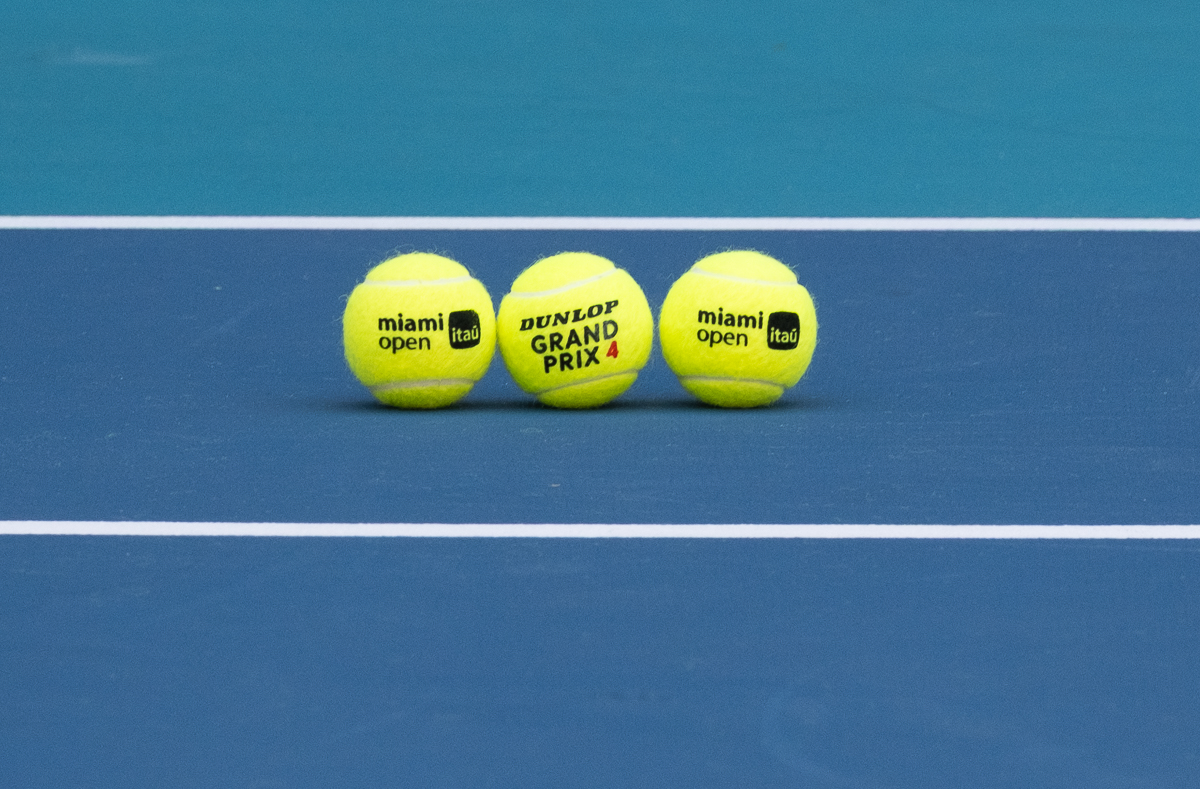
The tennis ball is one of the most precisely specified objects in professional sport. Its diameter, weight, compression, bounce height, and felt covering are all regulated within tight tolerances by the ITF, which publishes detailed technical specifications that approved balls must meet before they can be used in professional competition.
Within those specifications, there is meaningful variation — and that variation has been used deliberately by tournament organizers to influence the style of play their events produce.
The modern tennis ball consists of a hollow rubber core pressurized with air or nitrogen, covered with a felt fabric that provides the aerodynamic and friction properties that determine how the ball behaves in the air and off the court surface.
The rubber core’s compression determines how the ball bounces — harder cores produce lower, faster bounces while softer cores produce higher, slower bounces. The felt covering determines how much air resistance the ball encounters and how much friction it generates when contacting the court surface.
These properties interact with the court surface in specific ways that affect the pace and height of the bounce — the two variables that most directly determine how much time a player has to prepare their shots and from what height they make contact.
A harder ball on a faster surface produces a low, fast bounce that gives players minimal preparation time. A softer ball on a slower surface produces a higher, slower bounce that gives players more time but forces them to handle the ball from a more difficult height.
How Ball Specifications Have Changed
The ITF classifies tennis balls into three speed categories — slow, medium, and fast — that reflect the ball’s compression and felt characteristics. This classification system was introduced specifically to give tournament organizers a sanctioned way to modify the playing conditions of their events within regulated parameters.
Slow balls — also called Type 1 balls — are harder and heavier than standard, producing faster, lower bounces. They are used on slower surfaces — primarily clay — where their faster bounce compensates for the surface’s pace-absorbing properties and prevents the game from becoming excessively slow.
Medium balls — Type 2 — are the standard ball used at most professional events, including most Grand Slams. Their compression and felt properties are designed to produce a balanced combination of pace and bounce height on hard court surfaces.
Fast balls — Type 3 — are larger than standard, producing more air resistance and therefore slower flight through the air while maintaining similar bounce characteristics. They were introduced specifically for high-altitude venues — Mexico City, Bogotá, and other locations where the thinner air reduces aerodynamic drag on standard balls, producing pace levels that would be unmanageable with a standard ball at altitude.
The pressureless ball — used primarily in recreational tennis and at altitude — maintains its bounce characteristics longer than pressurized balls because it does not rely on internal air pressure to maintain its compression.
Professional players use pressurized balls exclusively, which is why professional matches require new balls at regular intervals — typically every nine games after the first seven in most Grand Slams — as the internal pressure diminishes and the ball’s playing characteristics change.
Wimbledon’s Ball Decision: A Case Study
The most significant recent deliberate modification of ball specifications at a major tournament was Wimbledon’s decision in 2002 to switch from a faster grass court ball to a slower, heavier ball with a thicker felt covering.
That decision — combined with changes to the grass preparation that produced a slower, higher-bouncing surface — was the most consequential single equipment change in Grand Slam history since the graphite revolution.
The old Wimbledon grass — fast, low-bouncing, receptive to serve-and-volley tactics — combined with the faster ball that had historically been used at the event had produced a service-dominant game in which aces, service winners, and short points defined the competitive texture of the tournament.
Players like Pete Sampras and Goran Ivanisevic, whose games were built around massive serves and net approaches, had dominated for years because the conditions so specifically rewarded their style.
Wimbledon’s decision to slow down the conditions — through both the surface modification and the ball change — was motivated by a desire to produce longer rallies, more baseline exchanges, and a competitive environment more hospitable to all-court players rather than pure serve-and-volley specialists.
The practical consequence was exactly what was intended: the Wimbledon champion since 2003 has almost exclusively been a baseline player rather than a serve-and-volley specialist, and the serve’s dominance at Wimbledon — while still significant — is considerably less extreme than it was in the Sampras era.
The Wimbledon ball and surface change is the clearest example of tournament organizers deliberately using equipment and conditions to influence the style of tennis their event produces — a form of institutional intervention in the competitive environment that the racket evolution story does not contain.
The ITF’s ball specifications give tournaments a legitimate tool for modifying conditions, and Wimbledon’s use of that tool has permanently changed the competitive character of the sport’s most prestigious event.
Court Surfaces: A History of Change and Standardization
Court surfaces are the most visually obvious variable in professional tennis — the red clay of Roland Garros, the green grass of Wimbledon, the blue hard courts of the Australian and US Opens are among the sport’s most recognizable visual identities.
But beneath those visual identities lies a history of surface change and standardization that has significantly shaped the competitive landscape of professional tennis.
Grass: From Universal to Rare
Lawn tennis was invented on grass and played almost exclusively on grass in its first decades of competitive existence. All four Grand Slams were originally played on grass — Wimbledon, the US Championships, the Australian Championships, and even the French Championships in their early years used grass courts.
The sport’s first generation of champions developed their games entirely on grass, and the competitive culture of early professional tennis was built around the surface on which the game was born.
The decline of grass as a professional playing surface was driven by practical rather than competitive considerations. Grass courts are expensive to maintain — requiring consistent mowing, watering, rolling, and fertilization — and deteriorate rapidly under competitive use.
The cost and logistics of maintaining high-quality grass courts at the standard required for professional competition limited their availability to well-funded private clubs and national tennis associations in temperate climates.
As the professional tour expanded globally through the Open Era, the practical constraints of grass court maintenance made it impossible to build a tour calendar around a surface that only a small number of venues worldwide could provide to the required standard.
The grass court season contracted to the short window preceding Wimbledon, supported by a handful of events in England and Germany, while the rest of the tour moved to surfaces that could be constructed and maintained at more venues and in more climates.
The surface changes at the Grand Slams illustrate the trajectory. The US Open played on grass through 1974 before switching to clay and then to hard courts. The Australian Open played on grass through 1987 before switching to hard courts.
Only Wimbledon and, for a period, the Australian Open maintained grass as their surface, and the Australian Open’s switch to hard courts in 1988 left Wimbledon as the sole Grand Slam on the sport’s original surface.
Clay: The Global Baseline
Clay has been the most consistently present surface across the professional tour’s history and remains the most widely played surface globally — not just in professional tennis but in the recreational game across Europe and South America, where clay court culture is deeply embedded in the sport’s social and competitive traditions.
The clay used at Roland Garros — crushed brick, technically — produces the sport’s most distinctive playing conditions: slow, high-bouncing, physically demanding, and receptive to the heavy topspin game that the surface’s properties amplify.
Other clay court tournaments use similar crushed brick surfaces, sometimes with slightly different preparation that produces minor variations in pace and bounce. Green clay — a different compound used primarily in North American clay court tournaments — produces faster conditions than the red clay of the European circuit, though the competitive dynamics remain broadly similar.
Clay court maintenance is considerably more straightforward than grass — the surface can be re-prepared between matches by watering and rolling, maintaining consistent playing characteristics across a full day of competition and between days across a two-week tournament.
This maintenance efficiency, combined with clay’s global availability and its association with the baseline game that the modern professional tour has predominantly adopted, has supported clay’s continued prominence in the professional calendar.
Hard Courts: The Dominant Surface
Hard courts — acrylic-coated concrete or asphalt — became the dominant surface in professional tennis through the 1980s and 1990s, driven by the same practical considerations that reduced grass’s presence on the tour.
Hard courts can be constructed virtually anywhere, maintain their playing characteristics across a wide range of weather conditions, require minimal ongoing maintenance relative to grass or clay, and are durable enough to host professional competition without deterioration for years or decades.
The acrylic coating applied to hard court surfaces is the primary variable that tournament organizers can adjust to influence the surface’s playing speed. A smooth, fine-grained acrylic coating produces a faster surface with a lower, skidding bounce.
A coarser, more textured coating produces a slower surface with a higher, truer bounce. The US Open’s hard courts and the Australian Open’s hard courts use different acrylic formulations that produce meaningfully different playing characteristics — the Australian Open playing slightly faster than the US Open, with a slightly lower bounce — within the broad category of hard court surfaces.
The physical consequences of hard courts for professional players — examined in detail in the burnout article in this series — are the primary competitive concern about hard court dominance.
The rigid, unforgiving nature of asphalt and concrete surfaces transmits impact forces through the feet, ankles, knees, and hips in ways that clay and grass do not, and the accumulation of those impact forces across long careers played predominantly on hard courts is a significant contributor to the injury patterns observed across the modern professional tour.
Carpet and Indoor Surfaces
Carpet courts — low-pile synthetic surfaces stretched over a hard base — were once a significant presence on the professional indoor circuit, producing very fast conditions with a low bounce that rewarded serving and net play even more extremely than grass.
The autumn indoor European circuit — which runs from October through November following the US Open summer hardcourt swing — was historically played on carpet at many venues, and the surface produced some of the most serving-dominant tennis of any circuit.
Carpet has largely disappeared from the professional tour over the past two decades, replaced by indoor hard courts at most venues. The reasons were primarily practical — carpet surfaces are expensive to install and remove, require specific maintenance, and the indoor hard courts that replaced them are more economical and logistically flexible.
Some players mourned the loss of carpet’s specific playing characteristics, but the transition reflected the same practical considerations that had driven surface changes throughout the professional tour’s history.
The Surface Standardization Debate
The diversity of surfaces across the professional tour — clay, grass, hard courts of varying speeds — is one of tennis’s most distinctive features and one of its most contested.
No other major professional sport asks its participants to adapt to playing conditions that change as dramatically from event to event as professional tennis does, and that diversity produces both the surface-specific narratives that enrich the sport’s competitive history and the physical and tactical demands that make sustained excellence across all surfaces so rare and so celebrated.
The periodic argument for surface standardization — playing all professional events on the same surface, or at least reducing the range of surface variation — is motivated by several considerations. A standardized surface would allow players to develop a single optimized game rather than managing the tactical and physical transitions that the current surface diversity requires.
It would reduce the physical stress of competing across surfaces with very different impact characteristics. And it would simplify the commercial and operational logistics of running a global professional circuit.
The arguments against standardization are equally substantial. Surface diversity is one of professional tennis’s most significant competitive differentiators — the reason Roland Garros produces different champions from Wimbledon, the reason the surface-specific rivalries and narratives that define the sport’s competitive history exist.
Standardization would reduce the breadth of skills required for sustained excellence and diminish the competitive significance of surface versatility — the quality that most clearly distinguishes all-court champions from surface specialists.
The sport has not moved toward standardization, and the current surface diversity is likely to persist as a fundamental feature of professional tennis’s competitive structure. The four Grand Slams’ surface identities — clay, grass, and two differently calibrated hard courts — are among the sport’s most commercially and historically embedded characteristics, and changing them would require institutional agreement that shows no sign of developing.
The Ball and Surface Together
Understanding the evolution of tennis balls and court surfaces requires recognizing them as a system rather than separate variables — because their interaction, combined with the racket evolution discussed in the previous article, is what determines the actual competitive conditions of professional tennis.
Wimbledon’s slower grass preparation combined with its heavier ball produces conditions that are fast by the standards of the full professional tour but significantly slower than the Wimbledon of the Sampras era. Roland Garros’s clay combined with its Type 1 ball produces the slowest conditions at any Grand Slam.
The Australian Open and US Open’s differently textured hard courts combined with standard balls produce the middle-speed conditions that support the all-around baseline game that dominates the modern professional game.
These combinations are not accidental. They reflect deliberate institutional decisions about the competitive character each tournament wants to produce, made within the technical framework that the ITF’s equipment specifications provide.
The resulting variation in conditions across the four Grand Slams — and across the broader professional tour — is as much a product of institutional choice as of natural surface diversity.
That institutional dimension of conditions is one of professional tennis’s least discussed but most consequential features. The conditions that determine which players win, which playing styles succeed, and which matches become the ones that define careers are not simply the product of natural surface properties.
They are the product of choices — about balls, about surface preparation, about the specific conditions that tournament organizers want their events to produce. Understanding that the conditions are chosen as well as found is understanding something important about how professional tennis actually works.
Part of the Tennis History series. Previous: How Tennis Rackets Changed the Professional Game. Next: The Most Grand Slam Singles Titles in Tennis History.