

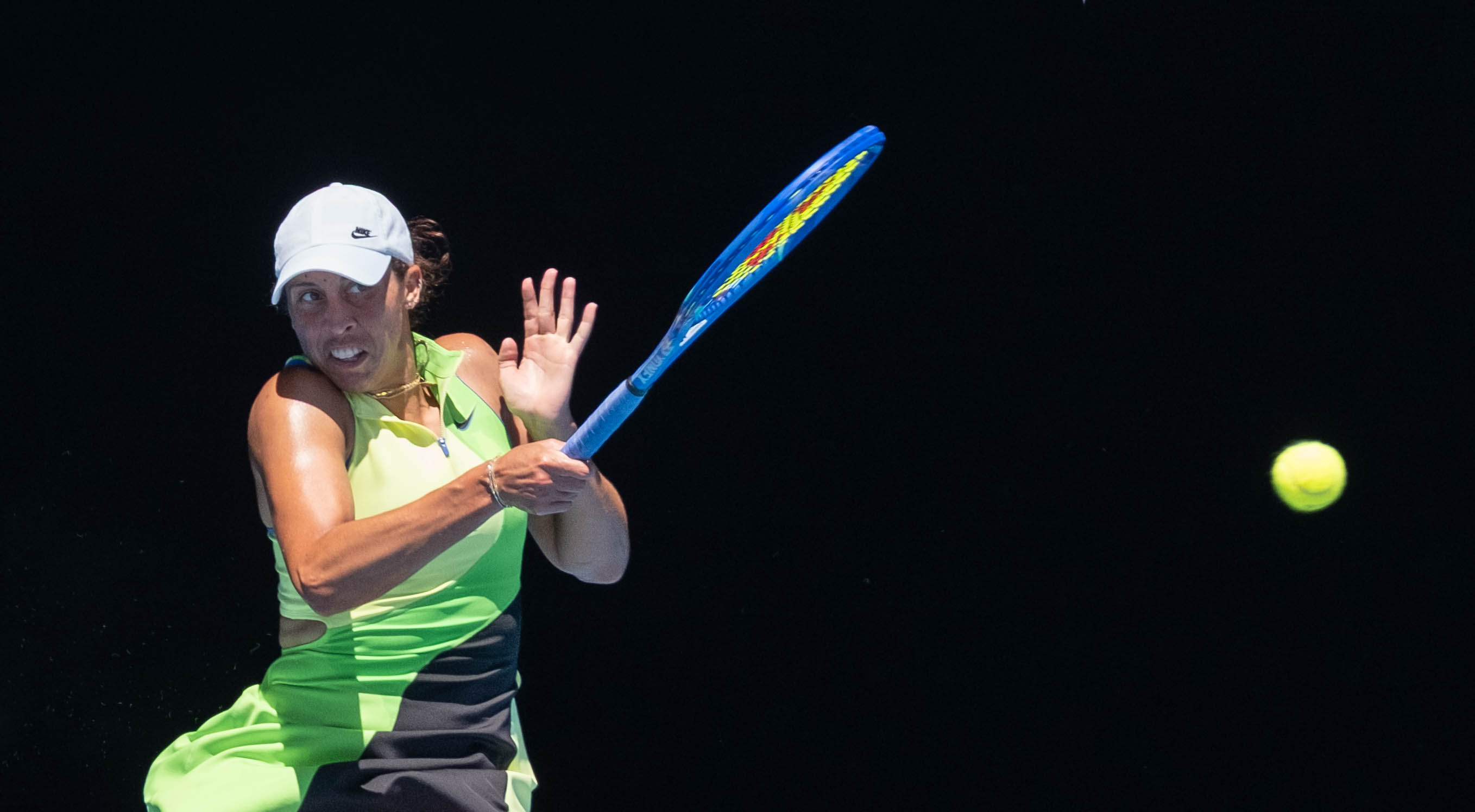
The Eastbourne Open 2026 final lineup is set, giving Wimbledon one last grass-court form check before the All England Club opens on Monday. Madison Keys will face Tatjana Maria in the women’s singles final at the Lexus Eastbourne Open, while Ugo Humbert and Zizou Bergs will meet for the men’s title after ending British hopes at Devonshire Park.
The combined ATP and WTA 250 event has become the final serious test of who is comfortable on grass, who is short of matches and who may be carrying real momentum into Wimbledon. Keys and Maria reached Saturday’s women’s final after both semifinals ended with retirements. Keys had taken the first set 6-1 against Petra Marcinko before the Croatian retired with an abdominal injury. Maria led Jelena Ostapenko 6-1, 1-2 when the Latvian stopped because of illness after a rain delay.
That means the final comes with a small caveat. Neither Keys nor Maria had to finish a full semifinal. But the larger grass-court signal is still clear: Keys has been efficient and powerful all week, while Maria’s slice-heavy game continues to cause problems on grass.
Madison Keys looks sharp before Wimbledon
Keys is not just another player finding form in Eastbourne. She is a two-time champion at the tournament and one of the few players in the women’s draw with a proven power game that can translate quickly to grass.
Her run has been clean. Before the Marcinko retirement, Keys had already beaten Talia Gibson, Jessica Bouzas Maneiro and McCartney Kessler, with her serve and return doing the main damage. Against Kessler in the quarterfinals, Keys won 6-3, 6-1 and kept the match away from the long, physical exchanges that can become dangerous in the week before a Grand Slam.
That matters for Wimbledon. Grass rewards first-strike tennis, and Keys has the serve, forehand and flat ball-striking to rush opponents who are still adjusting to the lower bounce. Eastbourne has given her matches without draining her legs.
For a player with major experience, that is almost the ideal pre-Wimbledon equation.
Tatjana Maria’s grass game remains awkward and dangerous
Maria is the more unusual Wimbledon prep story. At 38, the German has turned Eastbourne into a reminder that grass still rewards variety, timing and patience. Her sliced backhand, changes of pace and willingness to disrupt rhythm make her a difficult assignment, especially for players who prefer predictable pace.
Maria’s run started with a statement win over top seed Jasmine Paolini, a 6-4, 6-3 result that immediately changed the shape of the draw. She later beat Anastasia Zakharova and Tereza Valentova before Ostapenko’s retirement sent her into the final. The appeal of Maria’s game is not power. It is discomfort. On grass, that can be enough to drag better-ranked opponents into bad decisions.
That is why the Keys-Maria final is more useful than it may first appear. Keys will test whether Maria can absorb pace and keep the ball low under pressure. Maria will test whether Keys can stay patient when the match gets choppy. It is exactly the kind of contrast that can expose what a player is really bringing to Wimbledon.
British hopes end, but Jack Draper gets useful grass minutes
The men’s draw had been building toward a possible British finish, but Humbert and Bergs stopped that storyline cold. Humbert beat Jack Draper 7-5, 6-3 in the semifinals, ending Draper’s return run after three straight wins. Draper had not competed since April because of a knee injury, so the result should be viewed in context. The loss hurts. The week still helped.
Draper reached the semifinals, tested his body on grass and got competitive points before a brutal Wimbledon first-round match against Taylor Fritz. That is a far better place to be than arriving at the All England Club with no rhythm at all.
There is also a bigger British subplot. Draper is working with Andy Murray during the grass swing, which makes every match part of a longer adjustment. Eastbourne did not deliver a title chance, but it gave him something he badly needed: match evidence.
The evidence is mixed. His level was good enough to beat Marcos Giron, Jack Pinnington Jones and Gabriel Diallo in straight sets. Against Humbert, the margin tightened. Draper had chances early in the second set, missed four break points, and Humbert took control soon after.
That is the kind of detail that matters before Wimbledon. Draper is close enough to be dangerous, but not yet sharp enough to waste chances against elite grass-court opponents.
Toby Samuel’s breakthrough changes his season
Toby Samuel’s Eastbourne run ended one match short of the final, but it was still the best story of the British week. Samuel entered as a lucky loser, had not won a tour-level match before Eastbourne and then pushed Bergs deep before losing 4-6, 7-6(5), 6-2. He even served for the match at 5-4 in the second set before Bergs recovered and took control of the decider.
For Samuel, this was not just a strong home tournament. It was a career marker. He proved he could win matches at ATP level, handle a home crowd and compete deep into a grass-court event against established tour players.
That does not make him a Wimbledon threat yet. It does make him a name British tennis will track more closely after this week.
Humbert and Bergs turn Eastbourne into a Wimbledon preview
The men’s final carries an unusual twist: Humbert and Bergs are also drawn to face each other in the first round at Wimbledon. That makes Saturday’s Eastbourne final more than a title match. It becomes a scouting session with immediate consequences.
Humbert is the more established grass-court player. He has already won an ATP title on grass at Halle and came through Draper with a controlled serving performance. His left-handed patterns, quick first strike and comfort moving forward make him a natural fit on the surface.
Bergs is chasing his first ATP title after previous final losses in Auckland and ’s-Hertogenbosch. His Eastbourne run is even more notable because he arrived after a six-match losing streak. One week later, he is in a final and one win from the biggest trophy of his career.
That is the kind of sudden form shift that can carry into Wimbledon.
Why Eastbourne still matters before Wimbledon
Eastbourne is not Wimbledon, and results here should not be overread. Some players are protecting their bodies. Others are still adjusting to the grass. A few are simply trying to get through the week healthy. But the tournament remains one of the clearest final signals before the grass-court major.
Keys looks like one of the women most comfortable with the short points and fast conditions. Maria has shown that her disruptive grass game is still capable of beating higher-ranked opponents. Humbert has confirmed he is dangerous on the surface. Bergs has rescued his grass season at the perfect time.
For the British players, the story is more complicated. Draper leaves with useful matches but no final. Samuel leaves with a breakthrough but also the sting of a missed chance. That is the reality of the final week before Wimbledon. Some players leave with trophies. Others leave with information.
At Eastbourne, both may prove valuable.