

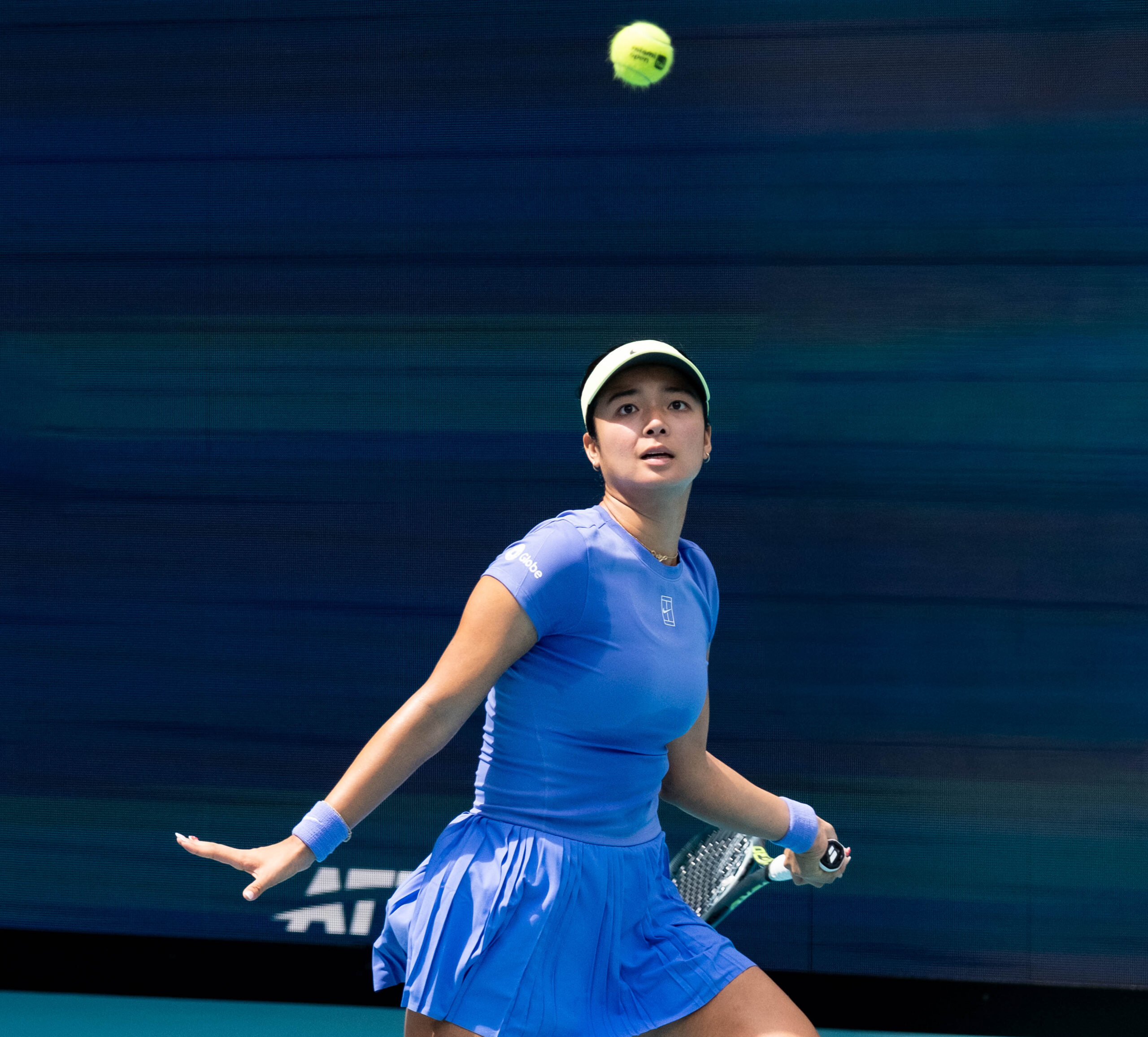
Alexandra Eala has surged to the edge of history. A breakout week at the Berlin Open has lifted the 21-year-old Filipina to a projected world No. 30, putting her in line to become the first player from the Philippines to be seeded at a Grand Slam when Wimbledon begins on 29 June.
Eala was the story of the grass-court week in Germany. Making her tournament debut, she opened by beating reigning Queen’s Club champion Donna Vekic in straight sets, then produced the upset of the fortnight by knocking out world No. 2 Elena Rybakina in the round of 16. She followed it with a second top-10 scalp in as many days, dispatching Ukraine’s Elina Svitolina 6-3, 6-4 to reach her first WTA 500 semi-final.
It was the sixth top-10 win of her young career, and the second time she has beaten multiple top-10 players at a single event — a feat she first achieved at Miami in 2025, where wins over Iga Swiatek and Madison Keys announced her on the global stage. “I can’t believe it, I’m in shock right now,” she said after the Svitolina win, paying tribute to an opponent she had watched since childhood.
The run finally ended in the last four, where 21-year-old Czech Linda Noskova outhit her 6-2, 6-4 in a contest delayed by rain. Eala was broken three times in the opening set and could not match Noskova’s first-strike power, but the defeat did little to dim a week that reshaped her season. By reaching the semi-finals she banked 195 ranking points and roughly €57,000 in prize money, climbing from her starting position of No. 35 to a live ranking of No. 30 — just one place outside her career high of No. 29.
That ranking surge is the real prize. With Wimbledon’s seedings tied to the rankings cut-off, Eala is now positioned inside the top 32 and on course to be seeded at a major for the first time — a status that would, by most projections, make her the first Filipino player ever to earn one. It is the latest in a series of national firsts: she was the first from her country to break into the world’s top 100 and the first to reach a WTA 1000 semi-final.
Eala’s rise has been built on grass this season, a surface that was once thought to be among her weakest. After winning the WTA 125 title in Birmingham earlier this month, she carried a 9-1 grass-court record into Berlin, evidence of a game that has matured quickly from clay-court promise into all-surface threat. Her returning has been the standout weapon — she broke Svitolina five times in the quarter-final — and her composure in tight moments has visibly improved.
Beyond the results, Eala has become one of the sport’s most bankable draws. Her matches routinely pull large, vocal Filipino crowds; at this year’s Australian Open, thousands of supporters packed the grounds to watch her, creating queues that stretched through Melbourne Park. A seeded run at Wimbledon, on tennis’s most-watched stage, would amplify that following considerably and hand Philippine tennis its biggest mainstream moment yet.
She is expected to continue her preparation at the Bad Homburg Open before turning her attention to the All England Club. Whether seeded or not, Eala arrives at Wimbledon as a genuine danger to the established order — a player who has now beaten Rybakina, Svitolina, Swiatek, Keys and Vekic, and who looks increasingly at home in the second week of big tournaments.
For a 21-year-old who entered her first Grand Slam through qualifying just three years ago, the trajectory has been remarkable. The seeding question will be settled at the cut-off, but the larger point is already clear: Eala is no longer an underdog story. She is a player the top seeds will be relieved to avoid.