

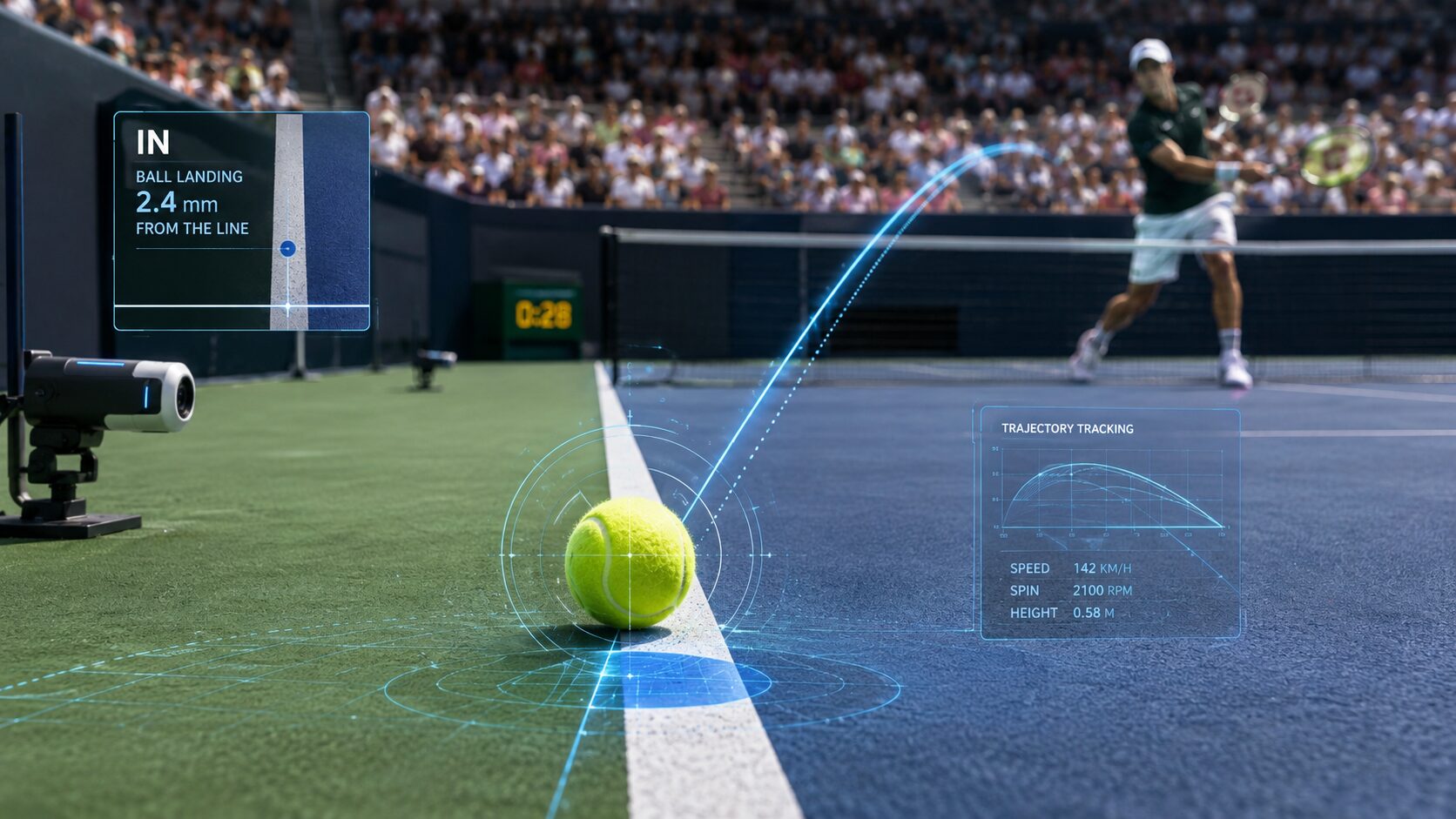
For most of tennis history, a ball was in or out because a person said so. That is no longer the case at three of the four Grand Slams and across both professional tours. Electronic line calling, the automated system most fans still call Hawk-Eye, now makes the overwhelming majority of in-or-out decisions in elite tennis. This guide explains what the technology is, how it tracks the ball, how the sport came to rely on it, and why one major still refuses it.
What electronic line calling is
Electronic line calling, or ELC, is a camera-based system that determines whether a ball lands inside or outside the court lines. It replaces the human line judge for that single task. The most widely used system is Hawk-Eye, a computer-vision platform that tracks the ball’s flight, builds a model of its path, and calculates where it touched the ground relative to the line.
The name Hawk-Eye is often used as shorthand for the whole category, much as people say “Velcro” for hook-and-loop tape. Other vendors exist, but the underlying principle is the same: cameras plus software, replacing the naked eye.
How Hawk-Eye tracks the ball
The system relies on a ring of high-speed cameras positioned around the court, typically up to ten, often mounted high on the stadium structure. Each camera records the ball many times a second, at frame rates around 340 per second, capturing its position from a different angle.
Software then triangulates those simultaneous views to fix the ball’s location in three dimensions at every instant. From that sequence of points it reconstructs the full trajectory and, crucially, predicts the shape of the bounce, the small ellipse where the ball compressed against the surface. That predicted contact area is compared to the line to produce the call.
The makers advertise an average margin of error of roughly 2.6 millimeters. For context, a tennis ball is about 67 millimeters across, so the claimed precision is a small fraction of the ball itself. The system is not infallible, and its accuracy depends on camera calibration, lighting, and a clean view of the ball at contact.
From challenge system to automatic calls
ELC has gone through two distinct eras, and confusing them is the most common mistake fans make.
In the first era, line judges still worked the court and the technology served as a review tool. A player who disagreed with a call could challenge it, the stadium screen showed the Hawk-Eye reconstruction, and the umpire applied the result. Challenges were limited in number per set, which turned reviews into a small tactical game of their own.
In the second era, the technology stopped being a backup and became the primary official. In this fully automated form, often labeled live ELC, there are no line judges at all. The system calls every ball in real time, with an electronic or recorded voice announcing “out” or “fault.” There is nothing to challenge, because the machine is already making the call.
How tennis adopted it
Hawk-Eye began in cricket, where it was first used in 2001 for television analysis. Tennis took notice after a series of disputed calls, most notably a 2004 US Open quarterfinal in which several errors went against Serena Williams. Pressure for an objective tool grew quickly after that.
The challenge system reached the tour in March 2006 and made its Grand Slam debut at the US Open later that year; Jamea Jackson is generally credited as the first player to use a formal challenge. The shift to fully automated calling came later and faster than many expected. The Australian Open adopted live ELC in 2021 and the US Open completed its move in 2022. Both professional tours followed, with the ATP mandating electronic line calling at all its events from 2025 and the WTA moving in step. Wimbledon made the most symbolic change of all, retiring its line judges ahead of the 2025 Championships and ending a tradition that had stood since 1877.
Why Roland Garros is the exception
The French Open remains the only Grand Slam that still uses human line judges. The reason is the surface. Clay holds the imprint of the ball, so officiating can rely on a physical mark rather than a camera prediction. A line judge makes the initial call, and the chair umpire can climb down to inspect a disputed mark at a player’s request. Roland Garros also continues to bar formal challenges and video replays for line calls, keeping the human decision final.
The ball-mark method is not without controversy. Players occasionally dispute which mark belongs to the shot in question, and the clay swing regularly produces arguments that ELC tournaments simply do not have.
Accuracy and the debate
Automated calling has reduced obvious errors, but it has not silenced criticism. On clay, fans and players have long pointed to gaps between a visible skid mark and what a tracking system shows, one reason the French held out. On other surfaces, some players have questioned whether the technology catches every millimeter, and high-profile malfunctions have shaken confidence at individual events.
The deeper objections are cultural as much as technical. Removing line judges removed a visible human element from the court, along with the theater of a player challenging a call and waiting for the screen. What the sport gained in consistency, some argue, it lost in spectacle.
Electronic line calling is not video review
A final distinction matters as the technology expands. ELC decides in-or-out. It does not rule on the other judgments a chair umpire makes, such as double bounces, touches, or a player reaching over the net. Some tournaments are now adding a separate video review system that lets players challenge those specific calls, a layer arriving at Wimbledon for the first time in 2026. That system works differently from line calling and is covered in its own guide.
Officiating technology by tournament — 2026 season
- Live electronic line calling, no line judges: Australian Open, Wimbledon, US Open, and all ATP and WTA tour events.
- Human line judges and clay ball marks, no challenges: Roland Garros.
- Video review for chair-umpire calls: introduced at Wimbledon in 2026 on the main show courts.
Frequently asked questions
How accurate is Hawk-Eye? The manufacturer advertises an average error of about 2.6 millimeters, far finer than the human eye, though performance depends on calibration, lighting, and conditions, and the system is not flawless.
What is the difference between Hawk-Eye and live ELC? Hawk-Eye originally backed up line judges through player challenges. Live ELC removes line judges entirely and lets the system call every ball automatically in real time.
Why doesn’t the French Open use electronic line calling? Clay records a physical ball mark, so Roland Garros relies on line judges and umpire inspection of marks, and has chosen to preserve that tradition.
Is electronic line calling the same as video review? No. Line calling handles in-or-out automatically; video review lets players challenge other chair-umpire decisions and is a separate system.
Related reading
- Wimbledon’s video review system, explained
- The Wimbledon seeding formula, explained
- How ATP and WTA rankings work