

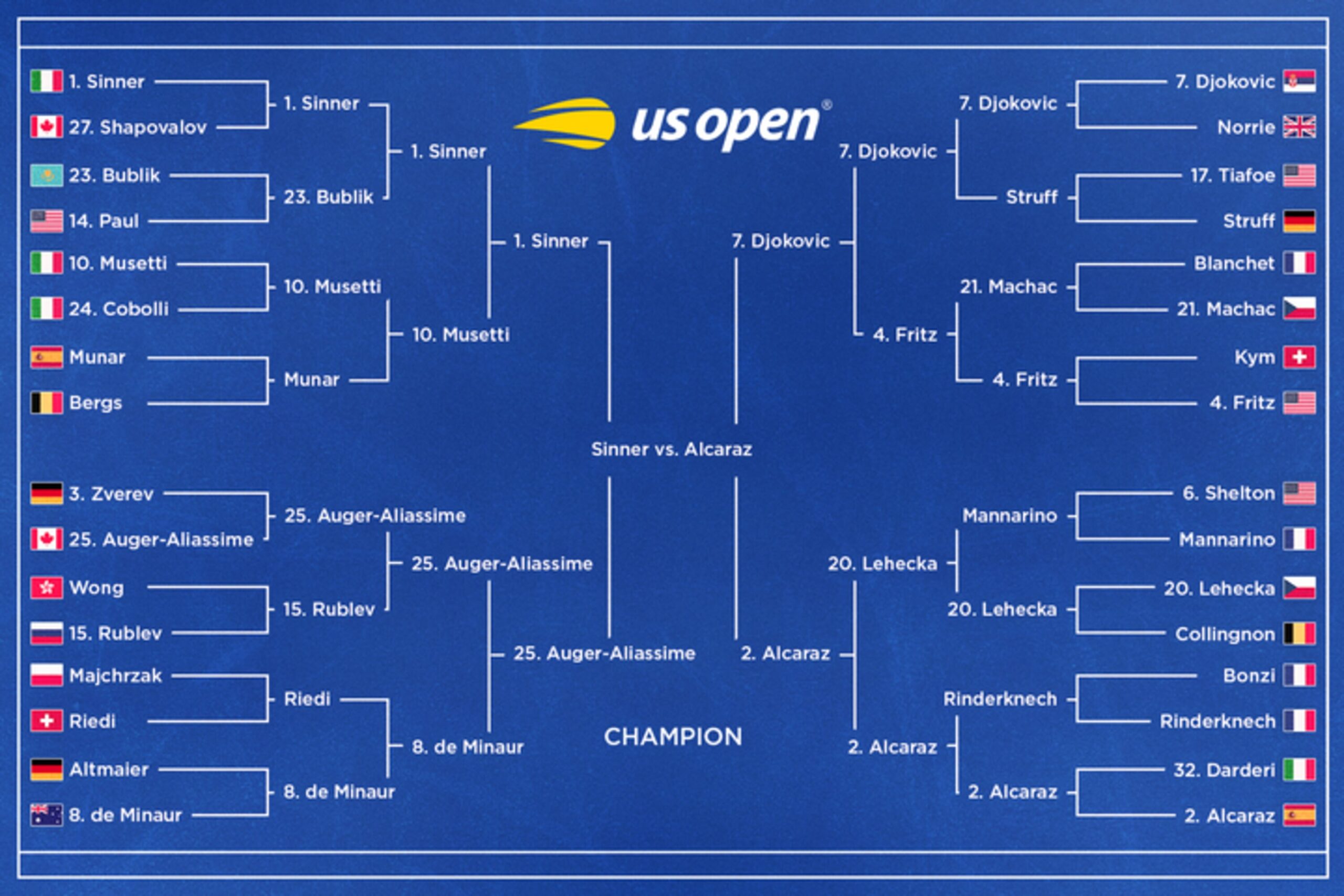
Every US Open begins not on Arthur Ashe Stadium but in a draw ceremony held days before the first ball is struck. In the space of an hour, 128 men and 128 women are assigned their positions in a bracket that determines who plays whom, when, and under what competitive conditions.
The draw does not determine who will win the US Open. But it shapes every player’s path to the title, creates the projected quarter-final and semi-final matchups that analysts will discuss for the entire opening week, and produces the first competitive narrative of the tournament before a single point is played.
Understanding how the US Open draw works — how players enter, how seeds are placed, what the draw ceremony involves, and how the bracket structure shapes projected paths — turns the draw announcement from a scheduling document into the first chapter of the tournament’s competitive story.
The US Open Draw Size
The US Open main draw contains 128 players in both the men’s and women’s singles competitions — the same draw size used at all four Grand Slams.
With 128 players and seven rounds of competition, the structure is straightforward. The first round eliminates 64 players. The second round eliminates 32 more. The third round cuts the field to 16. The fourth round leaves 8 quarter-finalists. The semi-finals leave two. The final determines the champion.
Winning the US Open requires seven consecutive victories across roughly two weeks at Flushing Meadows — each match played under the specific competitive conditions that distinguish the tournament: hot New York humidity in the early rounds, the size and noise of Arthur Ashe Stadium for the marquee matches, and the late-night sessions that have become the tournament’s signature.
How Players Enter the US Open Main Draw
The 128 spots in each US Open singles draw are filled through four distinct pathways.
Direct Acceptances
The majority of main-draw places — approximately 104 — are filled through direct acceptance. Players ranked inside the cutoff at the entry deadline, set roughly six weeks before the tournament begins, receive automatic entry based on their ATP or WTA ranking.
The specific cutoff varies year to year depending on how many wild cards have been awarded and how many higher-ranked players have withdrawn. A player ranked around 90th to 100th in the world at the entry deadline can generally expect direct acceptance into the US Open main draw.
Wild Cards
The USTA allocates eight wild cards in each of the men’s and women’s singles main draws. The selection process is controlled entirely by the USTA — a power it uses with a clear set of editorial priorities.
US Open wild cards are weighted heavily toward American players, particularly emerging young Americans, returning veterans, and rising juniors who have qualified through specific USTA development pathways. A reciprocal wild card arrangement with the Australian Open, French Open, and the LTA (the British federation) also accounts for several spots each year — meaning that top non-American players who hold those federations’ wild cards may also receive a US Open wild card in exchange.
Notable historical wild card recipients have included Kim Clijsters on her 2009 return from retirement (she went on to win the title), Venus Williams at age 45 in 2025 after extended time away from tour competition, and numerous Americans whose rankings have placed them just outside the direct-acceptance cutoff.
Qualifiers
Sixteen qualifying spots in each main draw are earned through the qualifying tournament held on-site at the USTA Billie Jean King National Tennis Center during the week before the main draw begins.
The qualifying draw contains 128 players competing across three rounds for the sixteen main-draw spots. The competitive field is drawn primarily from players ranked roughly 100 to 250 in the world, plus a small number of qualifying wild cards.
Unlike Wimbledon — where qualifying happens at a separate site in Roehampton, three miles from the All England Club — US Open qualifying is played on the field courts of the main venue itself, with free public admission as part of the tournament’s Fan Week programming. Spectators can watch the world’s most determined challengers compete for main-draw access without paying a ticket — one of the most accessible elite tennis experiences in the international calendar.
Players who win three qualifying matches arrive in the main draw with match rhythm on the actual courts they’ll play on the following week — a meaningful advantage in the first round, particularly against direct acceptances who may not have played a competitive match on the surface in months.
Protected Rankings
Players returning from injury who hold a protected ranking can use that ranking for entry into the US Open main draw if their current ranking falls outside the direct acceptance cutoff. Protected ranking entries receive a main-draw spot but are not seeded — they compete as unseeded players regardless of the ranking they are using for entry.
How US Open Seedings Work
The seeding structure at the US Open follows the standard Grand Slam format: 32 seeds placed into protected positions across the 128-player draw to prevent the highest-ranked players from meeting each other in the early rounds.
Seeds are determined by the ATP or WTA ranking at a cutoff date set by the USTA, typically about two weeks before the tournament begins. The player ranked first in the world at the cutoff becomes the first seed, the player ranked second becomes the second seed, and so on through to seed 32.
Unlike Wimbledon — which between 2002 and 2019 applied a surface-specific adjustment to its men’s seedings based on grass-court form — the US Open has always seeded purely on the published ATP and WTA rankings, with no adjustment for hard-court performance. The reasoning is structural: hard courts are the dominant surface on the tour, the ATP and WTA rankings are largely shaped by hard-court results, and no adjustment is needed to make the seedings reflect surface-specific performance.
How Seedings Shape the Draw
The practical effect of seeding is to divide the draw into protected zones that guarantee specific matchups cannot occur before specific rounds:
- Seeds 1 and 2 are placed in opposite halves of the draw, so they cannot meet before the final
- Seeds 3 and 4 are drawn into the two quarters not occupied by 1 and 2, so the top four cannot meet before the semi-finals
- Seeds 5 through 8 are distributed across the four quarters, so the top eight cannot meet before the quarter-finals
- Seeds 9 through 16 are drawn into the remaining eighths, protected from meeting the top eight until the fourth round
- Seeds 17 through 32 are protected from meeting the top 16 until the third round
This protection creates the concept of a player’s quarter of the draw — the specific section they occupy, which determines which seeds they could potentially face at each stage.
The Draw Ceremony
The US Open draw ceremony is held on the Thursday before the main draw begins, typically as a live event broadcast on ESPN, with the draws conducted in the presence of officials, media, and ceremonial figures. In recent years the USTA has staged the unveiling as a public event at venues including Brookfield Place in Lower Manhattan — a deliberate effort to extend the US Open’s footprint beyond Flushing Meadows and into the broader cultural fabric of New York City during tournament week.
The process works in stages that mirror the protection structure. Seeds 1 and 2 are assigned to the top and bottom halves. Seeds 3 and 4 are drawn into the remaining quarters. Seeds 5 through 8 are drawn into the four eighths not occupied by the top four. Seeds 9 through 32 are drawn into their protected sections in stages.
The unseeded players — direct acceptances, qualifiers (whose specific identities are still being determined when the main draw is made, with their slots held as placeholders), and wild cards who are not among the 32 seeds — are drawn into the remaining positions. An unseeded player can be drawn against any seeded player in the first round, including the first or second seed.
Reading the US Open Draw
Once the draw is announced, the competitive analysis that follows focuses on several specific elements.
Quarter of the Draw
The quarter a player occupies determines which seeded player they could potentially face in the quarter-finals if all favourites advance. A player drawn into the first seed’s quarter faces a projected quarter-final against the world number one — a significantly harder path than a player drawn into a quarter anchored by, say, the seventh or eighth seed. The analysis of who has received favourable and unfavourable quarters is typically the first significant discussion following the draw.
Projected Semi-Final Matchups
The seeding structure creates projected semi-finals based on which seeds occupy which halves. If seeds 1 and 4 are in the top half and seeds 2 and 3 are in the bottom half, the projected semi-finals are 1-versus-4 and 2-versus-3 — producing specific matchup narratives that analysts discuss from the moment the draw is announced.
These projections are frequently disrupted by upsets. Hard-court tennis is more predictable than grass-court tennis, but the US Open’s specific environmental conditions — late-August heat, Arthur Ashe Stadium’s atmosphere, and the cumulative physical demand of the North American hard-court swing leading into the tournament — produce their own form of unpredictability. The first week at the US Open almost always sees several seedings eliminated by players ranked well outside the top 32.
Lucky Losers
After the main draw is published but before play begins, withdrawals can create vacancies that are filled by lucky losers — players who lost in the final qualifying round and inherit the withdrawing player’s draw position. Lucky losers are identified in the published draw sheet and inherit both the position and the projected path of the player they replace.
How the Hard-Court Swing Shapes Draw Analysis
One of the specific features of US Open draw analysis that distinguishes it from the other Grand Slams is the degree to which the preceding North American hard-court swing affects the competitive read on the bracket.
The US Open is the only Grand Slam preceded by a substantial run of identical-surface tune-up tournaments. The Canadian Open in Toronto or Montreal and the Cincinnati Open in Mason, Ohio — both Masters 1000 events held in the four weeks before the US Open — provide a clear competitive sample of which players are playing well on hard courts in late summer.
Strong performances at Cincinnati and Toronto/Montreal historically correlate with deep US Open runs. Players who have struggled physically on the demanding US hard-court swing — through heat, the cumulative demands of three weeks of best-of-three competition, or short-turnaround travel — are correspondingly more vulnerable in the US Open’s first week than their ranking would suggest.
This is what makes US Open draw analysis a specific exercise rather than a pure ranking-order one. Experienced analysts assess each player’s recent hard-court form, their physical condition coming out of the lead-in events, and the specific matchups their section of the draw presents — frequently identifying dangerous lower-ranked players whose recent results give them more momentum than their ranking implies.
The Draw as the Tournament’s First Chapter
The US Open draw produces the tournament’s first competitive narrative — the projected paths, the potential matchups, the favourable and unfavourable sections that will define how each player’s fortnight is likely to unfold. Understanding how the draw is constructed — how seeds are placed, how hard-court form affects the analysis, how unseeded players are distributed — is what transforms the draw announcement from a scheduling exercise into the genuinely revealing competitive document it is.
Every US Open champion has navigated seven rounds of a specific bracket whose structure was determined in that ceremony. Their path to the title — the opponents they faced, the specific challenges their section presented, the projected matchups that materialised or were disrupted by upsets — is inseparable from the draw that created it. Reading the draw is reading the first chapter of the story the next fortnight will compl