

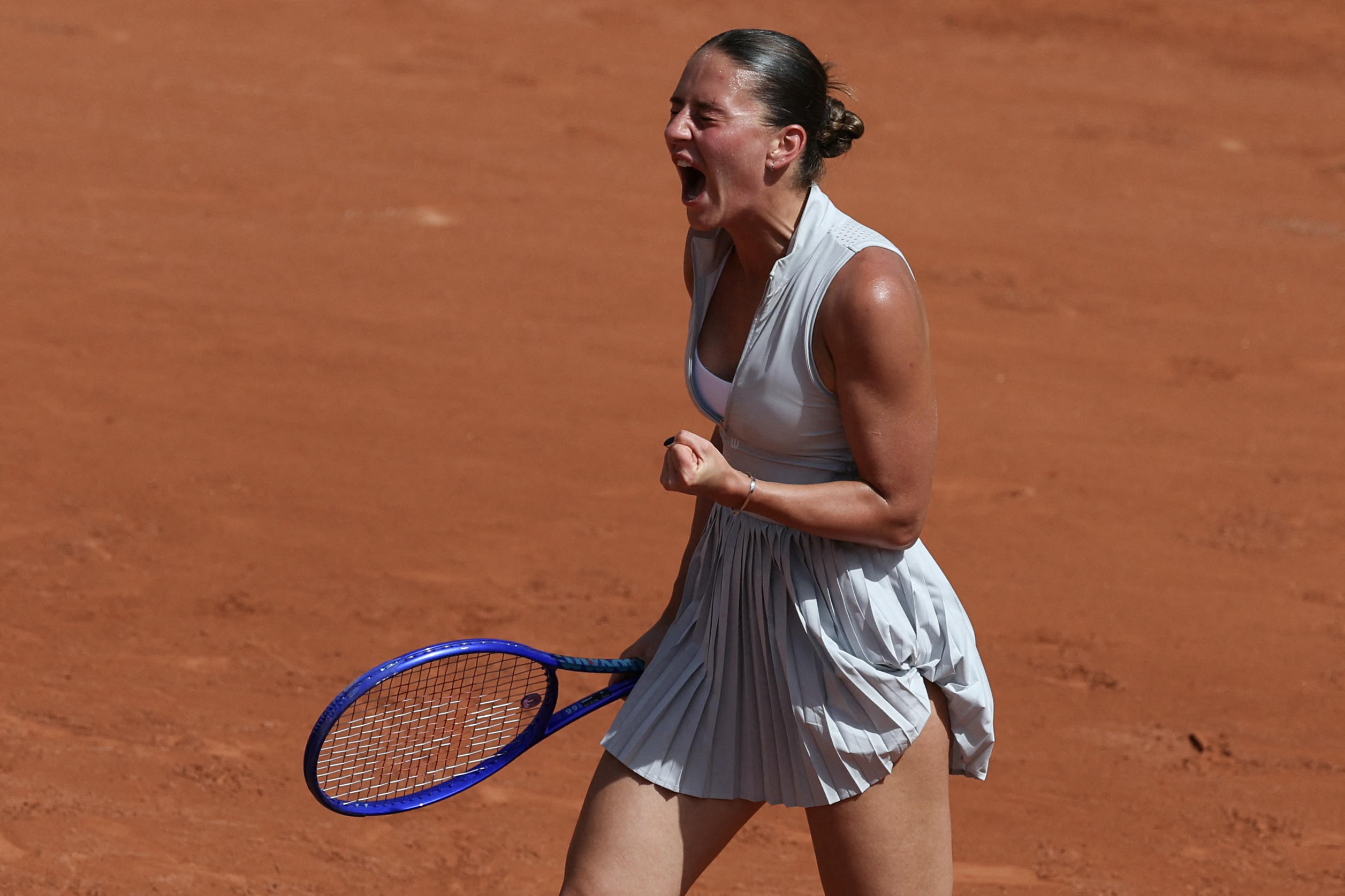
Marta Kostyuk woke on Sunday morning to news that a Russian missile had landed near her parents’ building in Kyiv. Hours later, on Court Simonne-Mathieu, the 15th-seeded Ukrainian beat Oksana Selekhmeteva 6-2, 6-3 in the first round of Roland Garros and turned her on-court interview into a tribute to her country.
“I had to live through it and deal with it and go out and play,” Kostyuk said after the match, her 12th consecutive win on clay. An image of a towering building ablaze adjacent to her family’s home in Kyiv had reached her in the hours before she stepped onto court.
Four years into the war in Ukraine, the 23-year-old has spoken often about competing while carrying the weight of news from home. Her Roland Garros opener came with that weight visibly attached. There were fist pumps and the occasional wobble on serve, but the performance itself — clean groundstrokes, sharp returning, control of the baseline rallies — looked closer to that of a player rounding into her best form than one who had spent the morning processing a missile strike.
On court. Kostyuk, the freshly-crowned WTA 1000 Madrid champion playing her first match since withdrawing from Rome with an injury, was in control from the opening exchanges. Against left-handed Selekhmeteva — the world No. 89, who recently switched her sporting nationality from Russia to Spain — the Ukrainian broke serve in the third game and never trailed. The first set lasted 36 minutes. The second was a tighter contest, with Selekhmeteva holding her serve more consistently and forcing Kostyuk to convert her break opportunities under pressure, but the 15th seed closed it out 6-3 to seal a place in the second round.
It is the seventh time Kostyuk has played Roland Garros and only the third time she has advanced past the opening round. Her best Paris result remains a fourth-round run as a 19-year-old in 2021. A first-round defeat to Sara Bejlek last year made the bar for improvement a modest one; she has now cleared it.
The clay run. Sunday’s win extended Kostyuk’s unbeaten clay-court streak to 12 matches — by some margin the longest run of her professional career. The streak began at the Open de Rouen in April, where she defeated fellow Ukrainian Veronika Podrez in the first all-Ukrainian final on the WTA Tour in the Open Era. She followed it with the WTA 1000 title in Madrid — her first at that tour level — defeating a series of higher-ranked opponents over the fortnight. A withdrawal in Rome interrupted the schedule but not the form.
She arrives in Paris at a career-high ranking and as one of the players in the women’s draw with the most consistent recent results on clay. Sabalenka’s fortnight in Madrid and Rome was bumpier than expected. Świątek and Rybakina have been intermittent. Among the seeds, only Coco Gauff and Elina Svitolina have matched Kostyuk’s clay-season trajectory.
What’s next. Kostyuk will meet the winner of the all-outsiders meeting between France’s Clara Burel and American Katie Volynets in the second round. Burel and Volynets, neither seeded, were scheduled to play later on Sunday. Whoever advances, Kostyuk will start as a clear favourite — her ranking, her recent form, and her draw section all point to a third-round meeting with a higher seed before any of the tournament’s true projected challenges.
The bigger storyline is the section of the draw she sits in: the same quarter as world No. 1 Aryna Sabalenka, with a potential fourth-round meeting if both advance that far. Sabalenka beat Kostyuk in the Brisbane International final to open the season; the rematch on clay, on the surface where Kostyuk has spent the spring building her best form, would be a substantially different test.
For Sunday, though, the result mattered less than the context around it. Kostyuk has spent four years finding ways to play tennis through the news from home. The win, dedicated openly to Ukraine in the on-court interview, was another iteration of a coping strategy she has reluctantly perfected.