

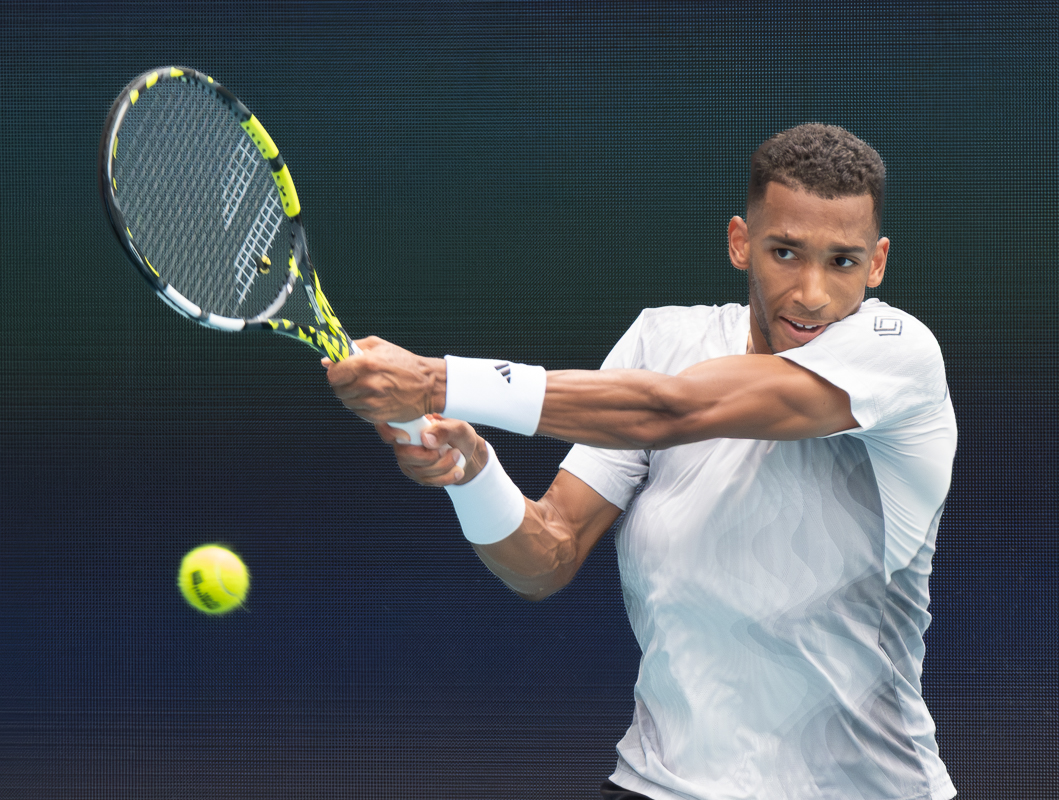
Felix Auger-Aliassime arrived at the Monte-Carlo Country Club this week as the one Masters 1000 tournament that had always slipped his grasp. He leaves Thursday’s round of 16 with the last name struck from the list, and a quarterfinal date with Jannik Sinner on Friday to show for it.
The sixth-seeded Canadian advanced when Casper Ruud retired with an apparent calf injury, the score standing 7-5, 2-2 in Auger-Aliassime’s favor. Ruud took a medical timeout at 1-1 in the second set and played through two more games before conceding, bringing a bruising opening set to an abrupt end. The retirement extends the 25-year-old Montreal native’s winning run against Ruud to four consecutive matches.
The result carries significance beyond the scoreboard. Auger-Aliassime had previously reached the quarterfinals at Indian Wells, Miami, Madrid, Rome, Canada, Cincinnati, Shanghai and Paris — eight of the nine Masters 1000 events.
Monte-Carlo was the only one that had eluded him across six previous main-draw appearances, his best result here a second-round exit. He now becomes the first Canadian player in history to have reached the last eight at every Masters 1000 tournament on the calendar. Milos Raonic, the previous standard-bearer for Canadian men’s tennis, came close but never reached the Shanghai quarterfinals.
The achievement also places Auger-Aliassime in exclusive company across generations. He is only the third player born in the 2000s to complete the career set of Masters 1000 quarterfinals, after Alcaraz — who completed his own collection at Rome last year — and Sinner, who closed his out in Paris in the same season.
The road to Friday Auger-Aliassime came into this clay swing having built considerable confidence on the indoor hard courts, winning in Montpellier and finishing runner-up in Rotterdam. His results on the red dirt have been patchier, though a Madrid final earlier in his career and consistent second-week runs at Roland Garros suggest the surface is not the obstacle it once appeared.
He spoke before the tournament about the physical demands of clay and a shift in his approach to the longer rallies the surface demands. “Sometimes rallies get long and you need to be ready to play back-to-back rallies,” he said. “Your legs can be burning, your lungs can be burning, but you have to stay ready and compete on every point.”
What awaits him next will test that resolve severely. Sinner has won each of their last four meetings, all in high-profile matches last year: the Paris Masters final, the US Open semi-finals, the Cincinnati quarter-finals and the ATP Finals round robin.
The world number two’s game briefly wobbled against Tomas Machac on Thursday — Sinner dropped a set for the first time at a Masters 1000 event since October — but he recovered to win 6-1, 6-7(3), 6-3, extending his winning streak at this level to 14 matches.
The quarter-final on Friday afternoon represents by far Auger-Aliassime’s most significant clay-court test of the season, and the biggest obstacle yet to what is already his deepest run in Monaco.