

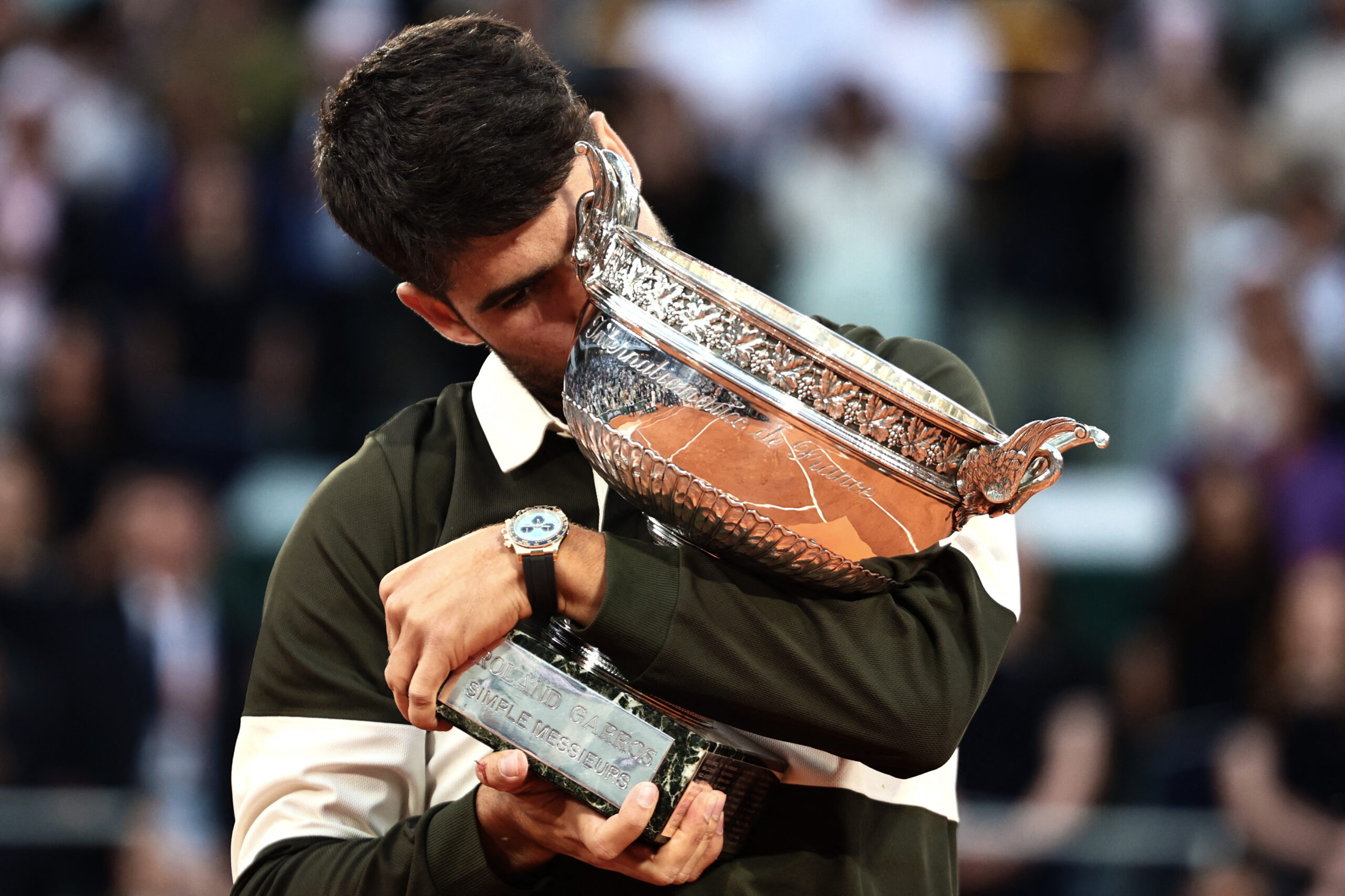
Roland Garros has been played since 1891 — making it one of the oldest and most storied tournaments in sport. Over more than 130 years of competition, the red clay of Paris has produced records of extraordinary magnitude: records of dominance that defy comparison, win streaks that ran for years, and feats of longevity and youth that have never been approached. This is a complete guide to the greatest numbers in French Open history.
The Most Untouchable Record in Tennis: Nadal’s 14 Titles
Rafael Nadal won the French Open 14 times. No player, male or female, has ever won more titles at a single Grand Slam in tennis history. No record in any Grand Slam is remotely close. The nearest men’s competitor is Björn Borg with six.
The nearest women’s competitor is Chris Evert with seven. Nadal won more than twice as many French Open titles as any other man in the Open Era.
He won his first French Open in 2005 at the age of 18 and his last in 2022 at the age of 35 — a span of 17 years between first and last title that is itself a record of consistency at a single Grand Slam.
His titles came in 2005, 2006, 2007, 2008, 2010, 2011, 2012, 2013, 2014, 2017, 2018, 2019, 2020, and 2022. The gap years — 2009, 2015, 2016 — were caused by injury rather than opponents, and in each of those three years he either didn’t compete or was not at full fitness.
He went 14-0 in French Open finals. In the entire history of the tournament, he never lost a Roland Garros final.
The Match Record: 112 Wins, 4 Losses
Titles alone do not capture the full scale of Nadal’s dominance on this court. His overall match record at Roland Garros — 112 wins against just 4 losses — is the most statistically dominant performance by any player at any Grand Slam in tennis history. He won 96.5 percent of his matches at this tournament across a 19-year career.
His four losses came against Robin Söderling in the fourth round in 2009, Novak Djokovic in the quarterfinals in 2015, Djokovic again in the quarterfinals in 2021, and Alexander Zverev in the quarterfinals in 2024.
Three of those four defeats came after he was already past his peak, and all of them required his opponent to produce some of the best clay-court tennis of their career.
For comparison, Roger Federer — widely regarded as one of the three greatest players ever — compiled 73 match wins at Roland Garros across 19 appearances, winning the title once. Novak Djokovic, who won three French Open titles, compiled the second-most match wins among active players. Neither came close to 112.
Chris Evert: Seven Titles and the 125-Match Win Streak
On the women’s side, Chris Evert’s record at Roland Garros stands as one of the most extraordinary in all of sport. She won seven French Open singles titles across nine final appearances — a final record of seven wins and two losses. Her overall clay-court win percentage across her career stands at approximately 90 percent.
But the number that most defines her relationship with the surface is the consecutive wins record. Between 1973 and 1979, Evert won 125 consecutive matches on clay — a streak that lasted six years and has never been threatened. During that run, she lost only seven sets. She was not merely dominant; she was functionally unbeatable on the surface for the better part of a decade.
Her nine French Open final appearances span from 1973 to 1986 — 13 years between first and last final. In that time, tennis changed around her, opponents came and went, the Open Era matured, and Evert remained a fixture in the deepest week in Paris. The nickname she earned — the Iron Princess — was not ironic.
Björn Borg: Six Titles, Eight Appearances, Two Losses
Before Nadal, the benchmark of clay-court supremacy was Björn Borg. Between 1974 and 1981, the Swede made eight appearances at Roland Garros, won six titles, and lost just twice.
His record of six French Open titles remained the Open Era men’s record for decades, and the efficiency of his overall Roland Garros career — a match record of 49 wins and just 2 losses — stands as one of the cleanest in Grand Slam history.
Borg won consecutive titles in 1974 and 1975, then added four straight from 1978 to 1981. He never lost a Roland Garros final. His two losses came in the quarterfinals in 1976 (to Adriano Panatta) and the fourth round in 1977 (to Guillermo Vilas, who went on to win the title that year).
In 1979 and 1980 he also won Wimbledon in the same calendar year — the last man to win both Roland Garros and Wimbledon in the same season until Roger Federer achieved the same feat in 2009.
The Youngest Champion in Open Era History: Michael Chang
In 1989, Michael Chang became the youngest man to win the French Open in the Open Era, claiming the title at 17 years, 3 months, and 20 days.
His run to the title included one of the most famous matches in Roland Garros history — his fourth-round victory over Ivan Lendl, the world number one, in which Chang served underhand during the final set and battled through severe cramps to win one of the most dramatic five-set matches the tournament had ever produced.
No man has won the French Open at a younger age in the Open Era since. Chang’s record has now stood for more than 35 years.
On the women’s side, Monica Seles holds the equivalent record. She won the French Open in 1990 at the age of 16 years and 6 months — the youngest women’s champion in the tournament’s modern history.
The Oldest Champion in Open Era History: Novak Djokovic
At the other end of the age spectrum, Novak Djokovic became the oldest French Open champion in the Open Era when he won the title in 2023 at 36 years and 20 days.
His victory over Casper Ruud in the final gave him a record 23rd Grand Slam singles title at the time — breaking the tie with Nadal — and demonstrated that the physical demands of a clay-court Grand Slam could still be conquered at an age when most players had long since retired.
The Most Match Wins in Roland Garros History
The all-time match wins leaderboard at Roland Garros in the men’s Open Era reads as a precise ranking of the greatest clay-court players in the history of the sport:
- Rafael Nadal: 112 wins
- Novak Djokovic: 80+ wins across 20+ appearances
- Roger Federer: 73 wins across 19 appearances
- Guillermo Vilas: 57 wins across 18 appearances
- Andre Agassi: 51 wins
- Ivan Lendl: 47 wins across 13 appearances (three titles, five finals)
- Björn Borg: 49 wins across 8 appearances
Borg’s efficiency relative to appearances is the most striking entry on this list: 49 wins from just 8 tournaments is a rate of more than six wins per appearance — meaning he averaged reaching the final every single time he entered.
The Record No One Talks About: The Finals Streak
Between 2005 and 2014, Rafael Nadal reached the French Open final in every year he competed at the tournament. That is ten consecutive finals over a decade — a streak of consistency that has never been approached at any Grand Slam by any player in the Open Era.
He won nine of those ten finals; the only loss came in 2006 when he was beaten by… no one. Nadal won all ten finals he reached during that run.
To place that in context: reaching a Grand Slam final in a single year is the achievement of a career for most professional tennis players. Reaching ten consecutive finals at the same Grand Slam over a decade, winning all ten, is an achievement for which no adequate comparison exists.
The Most French Open Titles in Women’s History: The Full Picture
While Chris Evert’s seven titles leads the Open Era women’s record, the full historical picture is dominated by Suzanne Lenglen, the French legend who won six titles between 1920 and 1926 and is widely regarded as the first global superstar of women’s tennis.
Lenglen went years without losing a single set at Roland Garros; her dominance of the pre-Open Era tournament was so complete that one of the venue’s show courts bears her name.
In the Open Era, behind Evert’s seven, the most decorated women’s champions include Steffi Graf (six titles), Justine Henin (seven titles — equalling Evert), Monica Seles (three consecutive titles from 1990 to 1992), and Martina Navratilova (two titles, though clay was the one surface on which Evert regularly had the better of her great rival).
Henin’s seven titles, achieved between 2003 and 2007, remain the joint-record in the Open Era alongside Evert.
The Records That Never Fell: Who Never Won at Roland Garros
Part of what makes Roland Garros records meaningful is the list of extraordinary players who could never claim one. Pete Sampras, who won 14 Grand Slams in total and was world number one for six consecutive years, never won the French Open — his serve-and-volley game found no purchase on the red clay. John McEnroe, who came agonisingly close in 1984 when he led Ivan Lendl two sets to love in the final before losing, never won in Paris.
Boris Becker, Stefan Edberg, and Jimmy Connors — collectively the dominant forces in men’s tennis for much of the 1980s — also never added a Roland Garros title to their Wimbledon and US Open victories.
Venus Williams, despite reaching the final once, never won. Maria Sharapova’s clay-court game, formidable enough to produce a Roland Garros title in 2012, never delivered the sustained dominance that other surfaces did.
The French Open has always been the Grand Slam that reveals the limits of players who are otherwise great. The red clay is indifferent to reputation.
The Bottom Line
The records at Roland Garros are, as a collection, the most extreme in Grand Slam tennis. Nadal’s 14 titles and 112-4 match record, Evert’s 125-match clay winning streak, Borg’s efficiency across eight appearances, Chang’s teenage title, Djokovic’s late-career triumph at 36 — these are not merely impressive numbers.
They are the products of a surface so demanding, so specific in what it requires, and so unforgiving to those not built for it, that the players who master it leave marks unlike anything seen elsewhere in the sport.