

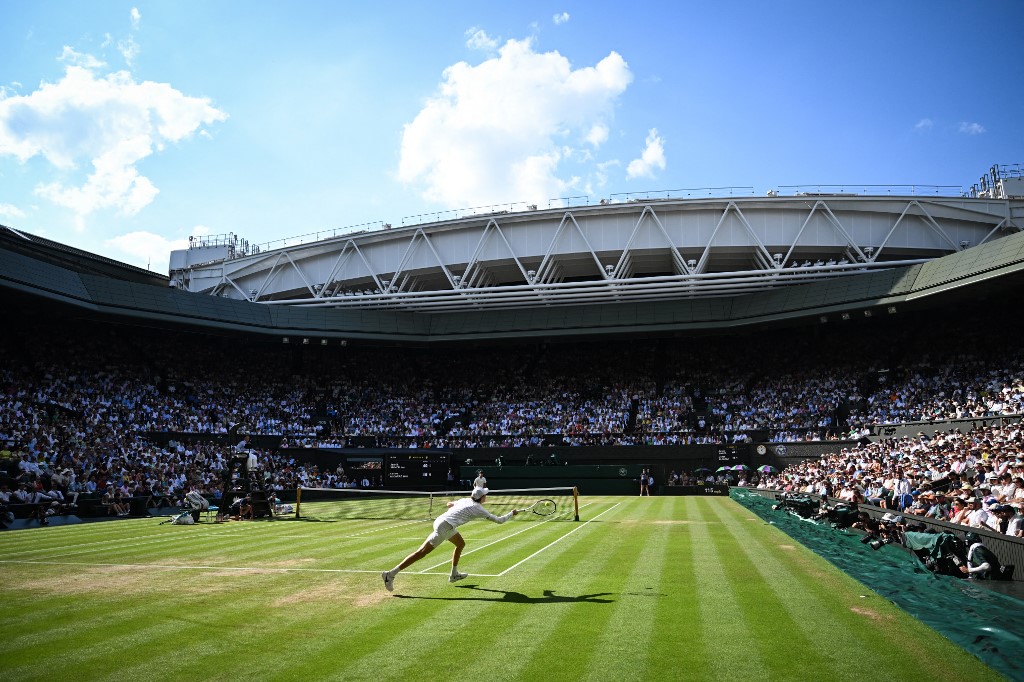
Wimbledon is the oldest and most tradition-bound tournament in professional tennis. Played each summer at the All England Club in London, it is the third Grand Slam of the calendar year after the Australian Open and the French Open and is the only major contested on grass.
First held in 1877 and part of the Open Era since 1968, Wimbledon blends historical customs with modern championship tennis. This guide explains how the tournament is structured, how the draw works, how ranking points are awarded, and what distinguishes Wimbledon from the other Grand Slams.
Where It Is Played
Venue: All England Lawn Tennis and Croquet Club
City: London, United Kingdom
Surface: Outdoor grass
Main stadium: Centre Court (capacity just under 15,000, retractable roof since 2009) Secondary show courts: No. 1 Court (roof added 2019), No. 2 Court, No. 3 Court
Wimbledon is the only Grand Slam still played on grass — the surface on which lawn tennis was invented and on which The Championships have been contested without interruption since 1877.
The courts have been 100 percent perennial ryegrass since 2001, cut to a height of exactly 8 millimetres throughout the fortnight. Qualifying matches are played at a separate site in Roehampton in the week before the main draw begins.
Tournament Format
Main Draw Size
- 128-player singles draws (Gentlemen and Ladies)
- 64-team Gentlemen’s and Ladies’ doubles draws
- 32-team mixed doubles draw
- Junior, wheelchair, and invitational competitions
Match Format
- Gentlemen’s singles: Best of five sets
- Ladies’ singles: Best of three sets
- Final-set tiebreak: First to 10 points at 6–6 in the deciding set
Wimbledon adopted the 10-point final-set tiebreak in 2022, aligning with the other Grand Slams after years of using its own no-tiebreak deciding-set format that produced the famous Isner–Mahut 70–68 in 2010.
How the Draw Works
Wimbledon features 128 players in each singles draw, including 32 seeds.
- Seeds are distributed to prevent early-round clashes
- The top two seeds cannot meet before the final
- Seeds 1–4 cannot meet before the semi-finals
- Unseeded players are placed randomly
- Qualifiers earn entry through a three-round qualifying tournament at Roehampton
- Wild cards are awarded by the All England Club, typically to British players or returning former champions
For most of the period from 2002 to 2019, Wimbledon’s gentlemen’s singles seeding used the ATP rankings as a base but adjusted positions according to grass-court performance over the previous two years — a unique formula now discontinued. Singles seeding now follows the ATP and WTA rankings directly.
Ranking Points Distribution (Singles)
As a Grand Slam, Wimbledon awards the maximum ranking points.
- Champion: 2,000 points
- Finalist: 1,300 points
- Semi-finalist: 800 points
- Quarter-finalist: 400 points
- Round of 16: 200 points
- Round of 32: 100 points
- Round of 64: 50 points
- Round of 128: 10 points
Points apply within the 52-week ATP and WTA ranking systems.
Prize Money
Wimbledon’s total prize purse is among the largest in tennis. The 2025 edition awarded £3 million to each singles champion, with equal prize money paid to men’s and women’s winners across all rounds. Wimbledon was the second Grand Slam to achieve equal prize money for men and women, doing so in 2007, the year after Roland Garros. Prize money extends down to first-round losers and qualifying competitors, with totals published by the All England Club ahead of each year’s Championships.
Scheduling Structure
- Two-week, 14-day main draw
- Late June through early July
- Play on all 14 days, including the middle Sunday (made permanent in 2022)
- Singles finals: women’s on the second Saturday, men’s on the second Sunday
- 11pm play curfew applies to all matches, including those on roofed courts
Weather interruptions are common due to London rain, but Centre Court and No. 1 Court now have retractable roofs that allow play to continue regardless of conditions. Outer courts remain exposed.
What Makes Wimbledon Unique
- Only Grand Slam played on grass, producing the lowest, fastest bounce in major tennis
- The all-white dress code — players must wear almost entirely white from the moment they step on court, the strictest dress code in professional sport
- No advertising on Centre Court — the only major venue free of courtside sponsor branding
- Royal patronage — Catherine, Princess of Wales has been Patron since 2016, presenting the singles trophies on finals weekend
- The Queue — show-court tickets sold on the day to fans who line up outside the grounds, a tradition since 1927
- Strawberries and Pimm’s — the defining food and drink of the fortnight
- A short grass-court season of just three to four weeks separates Wimbledon from Roland Garros, the shortest surface transition window in the calendar
How It Compares to Other Grand Slams
| Tournament | Surface | Conditions | Typical Pace |
|---|---|---|---|
| Australian Open (January) | Hard | Outdoor, hot | Medium |
| Roland Garros (May–June) | Clay | Outdoor | Slow |
| Wimbledon (June–July) | Grass | Outdoor | Fast |
| US Open (August–September) | Hard | Outdoor, humid | Medium-fast |
Surface and climate variation across the four majors shapes career legacies, stylistic matchups, and which players historically peak at each event.
Frequently Asked Questions
When is Wimbledon played? Late June through early July, across 14 consecutive days.
How many players are seeded? 32 in each singles draw.
How many ranking points does the champion receive? 2,000 points — the maximum at any tournament on the calendar.
What surface is used? Outdoor grass — 100 percent perennial ryegrass, mown to 8 millimetres. Wimbledon is the only Grand Slam still played on grass.
Does Wimbledon offer equal prize money for men and women? Yes. Wimbledon adopted equal prize money in 2007, one year after Roland Garros.
Is there play on the middle Sunday? Yes, since 2022. The traditional rest day was scrapped to make Wimbledon a full 14-day tournament.
What is The Queue? The line of fans who camp outside the grounds to buy show-court tickets on the day of play, allocated first-come, first-served. The tradition dates to 1927 and has its own published code of conduct.
When did Wimbledon start? The first Championships were held in 1877, making it the oldest tennis tournament in the world. It has been at its current Church Road site since 1922..