
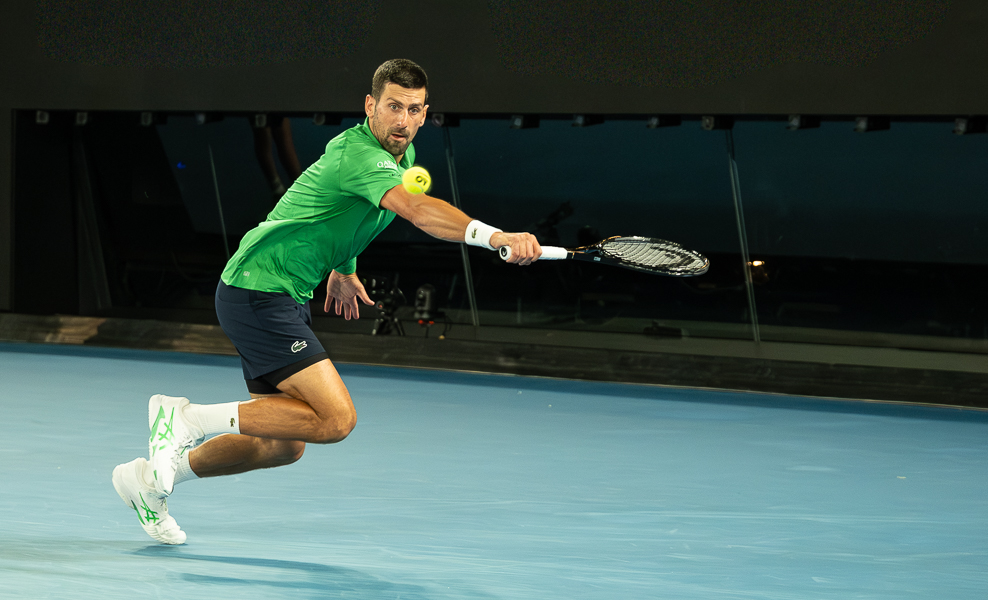
HomePlayersNovak Djokovic Profile: Career, Grand Slam Record, All-Time Records

Novak Djokovic Profile: Career, Grand Slam Record, All-Time Records

Novak Djokovic is the most decorated player in the history of men’s tennis. His 24 Grand Slam singles titles, 428 weeks at world No. 1, and Career Golden Slam — all four majors plus Olympic gold — sit on top of a career that has rewritten the sport’s all-time record book.

His combination of return-game brilliance, defensive elasticity, and mental durability built one of the longest peaks tennis has ever seen, and the late chapters of his career have been defined by the pursuit of records that may never be matched.

Quick facts

  • Full name: Novak Djokovic
  • Born: May 22, 1987, in Belgrade, Serbia
  • Nationality: Serbian
  • Residence: Monte Carlo, Monaco
  • Height: 6 ft 2 in (1.88 m)
  • Plays: Right-handed, two-handed backhand
  • Turned pro: 2003
  • Coach: Viktor Troicki

Season snapshot

Updated: May 2026

  • Current ATP ranking: World No. 4
  • Career-high ranking: World No. 1
  • Weeks at No. 1: 428 (all-time record)
  • Year-end No. 1 finishes: 8 (all-time record)
  • Career ATP singles titles: 101
  • Career Grand Slam titles: 24 (all-time men’s record)
  • Career Masters 1000 titles: 40 (all-time record)
  • Career prize money: Over US $192 million (all-time record across both tours)

This section is refreshed periodically. For week-by-week results, see ATP Tour rankings and our latest news coverage.

Background and path to the tour

Djokovic was born in Belgrade in 1987 and grew up in a Serbia shaped by war and economic collapse — circumstances he has cited throughout his career as central to his competitive identity. He was first spotted by coach Jelena Genčić at age six, who recognized an unusual seriousness in the young player and trained him for years before he moved to Niki Pilić’s academy in Munich as a teenager.

He turned professional in 2003 at 16, won his first ATP titles in 2006 at Amersfoort and Metz, and broke into the top ranks in 2007 with a maiden Masters 1000 title in Miami. His 2008 Australian Open victory over Jo-Wilfried Tsonga marked his first Grand Slam title and the arrival of a third force alongside Federer and Nadal — the partnership that would later be known as the Big Three.

Playing style and strengths

The return of serve

Djokovic’s return is the defining shot of his game and widely considered the greatest in the history of men’s tennis. He stands close to the baseline, reads serves early, and neutralizes the biggest deliveries on tour. The return is the foundation of his pressure game — it turns opponents’ service holds into work and converts break opportunities at a rate few players have ever matched.

Two-handed backhand

The backhand is his cleanest groundstroke — flat, accurate, and capable of producing winners cross-court and down the line from any position on the court. It is the shot that breaks rally patterns and the one that allows him to attack short balls without leaving openings.

Movement and elasticity

Djokovic’s defensive movement is among the most distinctive in tennis history. His flexibility lets him slide on any surface, recover from positions other players cannot, and turn defense into offense within a single shot. The sliding game on hard courts in particular — long thought impossible — was largely his innovation.

Mental and physical durability

The single thread that ties his career together. Djokovic plays the long match better than anyone of his era, manages pressure points with composure, and has won repeatedly from match-point down at the biggest stages. His longevity — competing at the top of the sport into his late 30s — is the practical expression of that durability.

Serve and tactical adaptation

The serve, once a relative weakness, was rebuilt in the early 2010s into a dependable hold-protector with strong placement and variety. Across his career, he has continually adapted his game — adding drop shots, more net play, and surface-specific tactical adjustments — which is part of how his peak extended far past the typical career arc.

Career milestones

  • 2008: Won maiden Grand Slam at the Australian Open; won Olympic bronze in Beijing
  • 2010: Led Serbia to its first Davis Cup title
  • 2011: Won three Slams (Australian Open, Wimbledon, US Open); reached world No. 1 for the first time; finished as year-end No. 1
  • 2015: Won three Slams (Australian Open, Wimbledon, US Open); reached 15 consecutive finals; set a season ranking-points record
  • 2016: Won Roland Garros to complete the non-calendar-year Grand Slam (holding all four majors simultaneously) — the first man since Rod Laver in 1969
  • 2018: Returned from elbow surgery to win Wimbledon and the US Open
  • 2021: Won the first three Slams of the year, falling one match short of the calendar-year Grand Slam in the US Open final
  • 2023: Won the Australian Open, Roland Garros, and US Open — moved to 24 majors, surpassing the men’s record outright
  • 2024: Won Olympic gold in Paris (defeating Carlos Alcaraz), completing the Career Golden Slam — all four majors plus Olympic gold
  • 2025: Won his 100th career ATP title at Geneva; became the first player to win a title in 20 consecutive seasons

Grand Slam record

Best results at each major:

  • Australian Open: Champion 10 times (2008, 2011, 2012, 2013, 2015, 2016, 2019, 2020, 2021, 2023) — all-time record
  • Roland Garros: Champion 3 times (2016, 2021, 2023)
  • Wimbledon: Champion 7 times (2011, 2014, 2015, 2018, 2019, 2021, 2022)
  • US Open: Champion 4 times (2011, 2015, 2018, 2023)

The Australian Open is the cornerstone of his record — 10 titles, three back-to-back-to-back runs (2011–2013 and 2019–2021), and an unmatched dominance on the Melbourne hard court. He is the first player, man or woman, to reach 100 match wins at three different Grand Slams (Australian Open, Roland Garros, and Wimbledon).

His overall Grand Slam record includes the most finals, semifinals, and quarterfinals in the history of men’s tennis, and he is the only man to have won every major at least three times.

Surface breakdown

Hard courts are the surface most associated with his peak — the Australian Open dynasty, US Open titles, and a dominant indoor record on which most of his ATP Finals success was built.

Grass has produced seven Wimbledon titles, including a five-final run between 2018 and 2022. His ability to adapt his sliding baseline game to grass remains one of the defining technical achievements of the era.

Clay is the surface that took longest to conquer. Roland Garros required navigating prime Rafael Nadal at Roland Garros — a head-to-head Djokovic ultimately won at the major (defeating Nadal in 2015 and 2021) — and his three Roland Garros titles include wins over Andy Murray (2016) and Casper Ruud (2023). His 2024 Olympic gold on the Roland Garros clay over Alcaraz remains one of the most significant clay-court victories of his career.

All-time records

The depth of Djokovic’s record book is unlike anything in the sport’s history. Among the records he holds outright:

  • 24 Grand Slam singles titles (men’s all-time)
  • 428 weeks at world No. 1
  • 8 year-end No. 1 finishes
  • 40 ATP Masters 1000 titles
  • 2 completed Career Golden Masters (winning each of the nine Masters 1000 events at least twice)
  • 7 ATP Finals titles
  • Career Super Slam (all four majors, Olympic gold, ATP Finals, plus the Career Golden Masters)
  • First player to reach 100 match wins at three different Slams
  • Most match wins, finals, semifinals, and quarterfinals at the Grand Slam level

The list will continue to grow as long as he plays.

Coaching history

Djokovic’s coaching history is one of the longer and more notable in the sport. His foundational partnership with Marian Vajda stretched across nearly his entire prime and produced the bulk of his Grand Slam record. Boris Becker joined the team between 2013 and 2016 during his sharpest stretch on grass and indoor hard courts.

After Vajda’s departure, Goran Ivanisevic coached him through several more Grand Slam titles and the Career Golden Slam in 2024. Andy Murray joined in late 2024 in one of the most-discussed appointments in modern tennis — pairing two long-time rivals — but the partnership ended after roughly six months without a title. Viktor Troicki, his long-time friend and Davis Cup teammate who had also been part of the team during the 2024 Olympic gold run, was named head coach in May 2026.

The path forward

The defining question of the final chapter of Djokovic’s career is whether he can win a 25th Grand Slam — a number that would set the all-time record clear of all other contenders and finalize his case as the most decorated player in tennis history.

The second question is the rivalry with Carlos Alcaraz and Jannik Sinner. The two younger players have now beaten him at the latest stages of multiple Slams, and the era of him being the betting favorite at every major has ended. He remains capable of late-major runs, but the path through both Alcaraz and Sinner to a title is the steepest of any era of his career.

The third question is physical durability. He continues to manage the demands of a calendar that has worn down every other player of his generation, and how long his body holds is now part of every conversation about the records still in front of him.

Off the court

Djokovic founded the Novak Djokovic Foundation to support early-childhood education in Serbia and has served as a UNICEF Goodwill Ambassador. He is married to Jelena Đoković, with whom he has two children, and lives primarily in Monte Carlo. In 2020 he co-founded the Professional Tennis Players Association (PTPA) with Vasek Pospisil, an athlete-led group focused on player representation in tour governance — a continuing source of debate in the sport’s structural conversations.

Related reading

RELATED ARTICLES
- Advertisment -spot_img

Most Popular

Latest Tennis News