

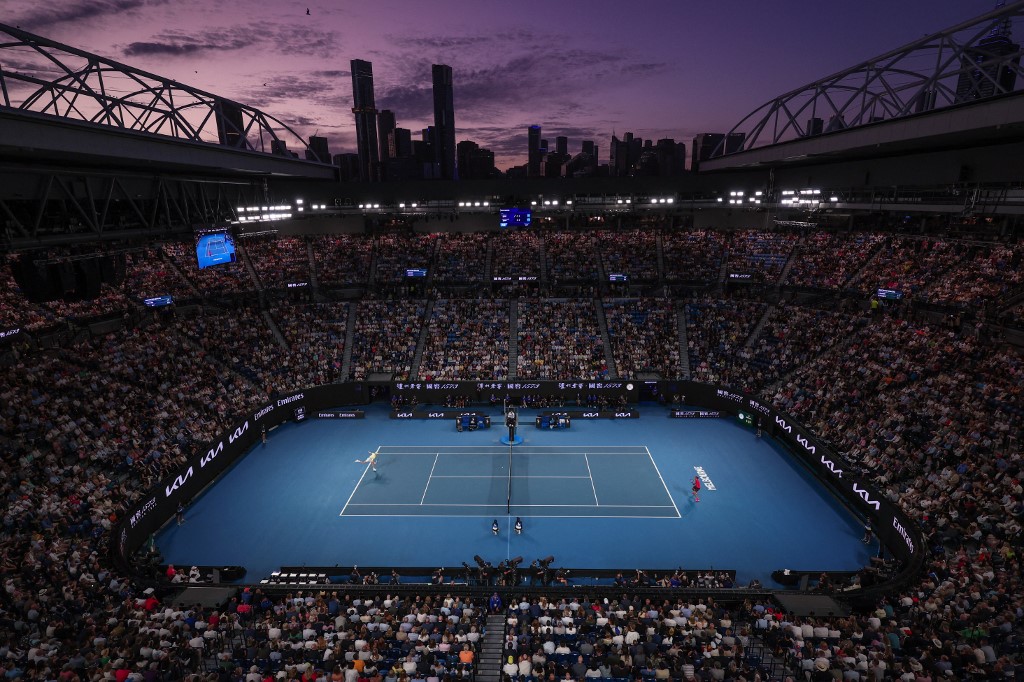
The four Grand Slam venues are among the most recognisable sporting arenas in the world, but they are far more different from one another than they might appear on a television screen.
Melbourne Park — home of the Australian Open — stands apart from Wimbledon, Roland Garros, and Flushing Meadows in ways that go well beyond geography. Here’s what makes it genuinely unique.
It Was the First Venue in the World With a Retractable Roof on a Tennis Stadium
When Rod Laver Arena opened in 1988, it featured something no tennis venue — and no major sporting venue anywhere in the world — had ever had before: a fully retractable roof. The 700-tonne structure could open or close in around 20 minutes, allowing play to continue in rain or to be protected from Melbourne’s extreme summer heat.
Wimbledon, often regarded as the spiritual home of tennis, didn’t add a retractable roof to Centre Court until 2009 — more than two decades later. Roland Garros followed with a roof on Court Philippe-Chatrier in 2020. The US Open’s Arthur Ashe Stadium received its retractable roof in 2016.
Melbourne Park went further still. It is the only Grand Slam venue in the world with retractable roofs on three courts — Rod Laver Arena, Margaret Court Arena, and John Cain Arena — giving tournament directors far more flexibility to manage weather and heat disruptions than any of its rivals can match.
It Sits in the Middle of the City
Melbourne Park’s location is one of its most distinctive qualities. The precinct sits on the edge of Melbourne’s central business district, just minutes from Flinders Street Station and the city centre, bordered by the Yarra River and the Melbourne Cricket Ground. It is as urban a Grand Slam setting as exists in world tennis.
Compare this to the other venues. The All England Club at Wimbledon is set in a quiet residential suburb in southwest London, accessed by a long queue and a short walk from the nearest tube station.
Roland Garros is tucked into the 16th arrondissement of Paris, hemmed in on all sides by residential streets and the Bois de Boulogne, with almost no room to grow. The USTA Billie Jean King National Tennis Center at Flushing Meadows sits in a large park in the New York borough of Queens — accessible but far from central.
Melbourne Park’s city-edge position means it integrates naturally into Melbourne’s broader sporting and entertainment precinct, sitting alongside the MCG, Marvel Stadium, and AAMI Park. The Tanderrum Bridge, which opened in 2017, physically connects the venue to Melbourne’s CBD, making it walkable from the city in a way that no other Grand Slam venue can claim.
It Is the Largest Tennis Precinct in the World by Total Capacity
Arthur Ashe Stadium in New York holds over 23,700 spectators — the largest individual tennis stadium on the planet. But in terms of total precinct capacity, Melbourne Park holds its own. The site can accommodate over 40,000 fans across its 35 outdoor courts and three main arenas, making the overall venue footprint among the most expansive in the sport.
The grounds-pass culture at Melbourne Park is a significant part of what this capacity enables. Unlike Wimbledon, where the queue for grounds access is a ritual unto itself, or Roland Garros, where the compact site limits how many fans can comfortably wander, Melbourne Park’s open precinct design invites fans to roam freely between courts, food outlets, fan activations, and live viewing areas.
The Australian Open has consistently broken Grand Slam attendance records in recent years, drawing over 1.2 million visitors across the 2025 tournament.
It Is a True Multi-Purpose Venue, Year-Round
Wimbledon’s grass courts are famously closed for most of the year to recover and be prepared for the following season. Roland Garros uses its clay courts for other events but is fundamentally a tennis-only complex. Melbourne Park, by contrast, functions as a major live entertainment and multi-sport venue throughout the year.
Rod Laver Arena and Margaret Court Arena host some of Australia’s biggest concert tours. John Cain Arena is a regular home for Melbourne United basketball (NBL) and two Super Netball teams — the Melbourne Vixens and the Collingwood Magpies.
The precinct has hosted ice skating, track cycling, beach volleyball, and international swimming events. Just two weeks after the 1988 Australian Open final, AC/DC played the first of five consecutive nights at what was then Centre Court. Pink Floyd followed shortly after.
This multi-purpose model was built into Melbourne Park’s DNA from the start — the venue was conceived by the Victorian Government as a public asset designed to deliver broad economic and social benefits to the state, not simply to host a tennis tournament once a year.
It Has Three Courts Named After Australian Legends
The naming of Melbourne Park’s three main courts tells a story about Australian tennis history that no other Grand Slam venue replicates.
Rod Laver Arena — the main show court — honors the Queenslander who won 11 Grand Slam singles titles and remains the only player in the Open Era to complete the calendar Grand Slam twice.
Margaret Court Arena recognizes the holder of the all-time record of 24 Grand Slam singles titles.
John Cain Arena — renamed in 2021 from Melbourne Arena — is named after a former Premier of Victoria rather than a tennis figure, but the court’s identity has evolved alongside the precinct’s history.
By contrast, Wimbledon’s courts are simply called Centre Court and Court 1. The US Open’s main arena bears the name of Arthur Ashe, the great American champion. Roland Garros names its courts after French tennis figures — Philippe Chatrier, Suzanne Lenglen, and Simonne Mathieu — but the stadium itself is named after a World War I aviator who played no tennis at all.
Only Melbourne Park has its two most prominent courts named after Australian Open champions.
It Has Changed Its Surface Three Times
No other Grand Slam has altered its playing surface as significantly or as often as the Australian Open at Melbourne Park. The tournament arrived at Flinders Park in 1988 on Rebound Ace, having left the grass courts of Kooyong behind.
After 20 years, concerns about the surface’s heat retention properties led to a switch in 2008 to Plexicushion Prestige — the blue surface that would become visually synonymous with the Australian Open for a decade. In 2020, the tournament switched again to GreenSet, the medium-fast acrylic surface in use today.
Wimbledon has played on grass since 1877. Roland Garros has played on clay since its inception. The US Open’s switch from grass to clay to hard court happened in the 1970s, before the modern era of the venue.
The Australian Open’s willingness to keep evolving its surface reflects a broader philosophy at Melbourne Park: this is a venue that prioritizes performance and innovation over tradition.
It Pioneered Technology in the Sport
Melbourne Park has a consistent track record of being first. The retractable roof was the most dramatic example, but the Australian Open has also been an early adopter of electronic line-calling technology.
The tournament was among the first Grand Slams to deploy Hawk-Eye electronic line judges across all courts, eventually moving to a fully automated system that eliminated human line judges entirely on the main show courts — a change that has since been adopted, with debate, at other majors.
The tournament has also embraced fan technology, data visualisation, and in-venue digital infrastructure earlier and more ambitiously than most of its counterparts. It was the first Grand Slam to launch a comprehensive tournament app and has consistently invested in the spectator experience as a competitive differentiator.
The “Happy Slam” Reputation Is Venue-Driven
The Australian Open’s reputation as the “Happy Slam” — relaxed, fan-friendly, and welcoming — is not simply a matter of Australian culture. It is substantially a product of the venue itself.
Melbourne Park’s open grounds, warm January evenings, city-center location, and festival atmosphere create conditions for a tournament that feels different from the formality of Wimbledon, the grit and intensity of Roland Garros in the cold Paris spring, or the frenetic energy of New York’s late summer.
Players consistently rank Melbourne Park among the best venues they compete at. The off-court facilities, the player amenities, and the overall standard of the precinct were noted as world-class from opening day in 1988 — and decades of continued investment have kept that standard high.
It is no coincidence that many of the sport’s biggest names have produced some of their most memorable performances here.
The Bottom Line
Melbourne Park is not simply a Grand Slam venue that happens to be in Australia. It is a purpose-built, multi-use, city-integrated precinct that pioneered features the rest of world tennis eventually followed.
Three retractable roofs. A central city location. Year-round activation. A surface that has evolved with the sport. The first venue in the world to think about what a major tennis complex could be, rather than simply inheriting what one had always been. That combination of ambition, innovation, and scale is what sets it apart.