

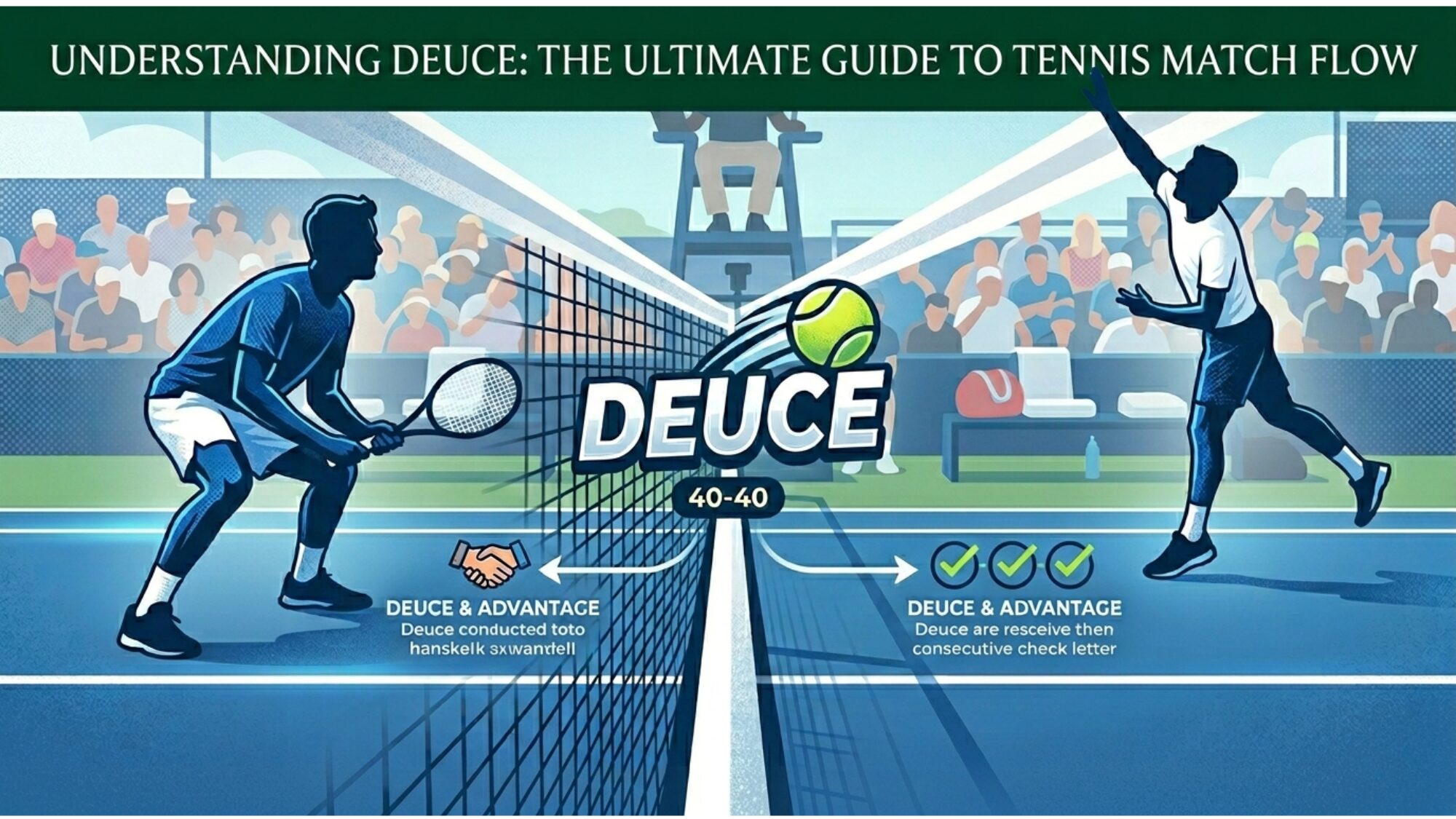
There is a moment in tennis that every fan learns to recognize — not from the scoreboard, but from the atmosphere. The crowd leans in. The players slow down between points. The chair umpire’s voice carries a particular weight when they announce it. That moment is deuce.
It’s a single word that means both players have fought to a 40–40 tie within a game, and now neither can win with just one more point. From here, someone must win two in a row. That requirement — the “win by two” rule — sounds simple on paper.
In practice, it is one of the most psychologically demanding conditions in sport. Understanding it changes how you watch every single game in a tennis match.
What Deuce Actually Means
Deuce occurs when both players reach 40–40 within a single game. In the standard tennis point sequence — love, 15, 30, 40, game — both players have won exactly three points each. Neither has the two-point margin required to claim the game, so the score resets to a neutral starting point: deuce.
From deuce, the rules are straightforward. Win the next point and you have advantage — one step away from the game. Win the point after that and you win the game. But if your opponent wins the advantage point, the score returns to deuce.
There is no limit to how many times this can happen. A single game can cycle through deuce and advantage a dozen times or more before someone finally claims it.
That open-ended quality is what makes deuce so different from the tiebreak or the set — there is no tiebreak equivalent to bail you out at 40–40. You simply have to win two consecutive points. Full stop.
Why “Win by Two” Exists
The win-by-two rule is not unique to tennis. It appears in volleyball, table tennis, and racquetball, among others. The logic is the same in each case: when a competition is perfectly tied at a critical threshold, a single point should not decide the outcome.
One lucky net cord, one line call that goes your way — these shouldn’t be enough to close out a game. The win-by-two requirement ensures that the winner of a game earns it with a small but meaningful margin of superiority.
In tennis specifically, the rule dates back centuries and has survived every modernization of the sport because it works. It creates natural drama, extends close games in a way that rewards the better performer in that stretch, and prevents fluky single-point outcomes in tight situations.
The Psychological Weight of Deuce
Here is where deuce becomes more than a scoring rule — it becomes a mental battlefield. Consider what deuce requires of both players. The server, who statistically has the advantage in any given game, now faces the possibility of losing the game entirely despite winning three points already.
The returner, who has fought back from a deficit to reach 40–40, sees an opportunity to take something that wasn’t supposed to be theirs. Both players feel the pressure differently. The server fears the break. The returner smells blood.
Now multiply that by repetition. If deuce cycles back three or four times in a single game, both players are being asked to perform under pressure again and again, with no release. Each time advantage changes hands and reverts, the tension resets — but the fatigue, both physical and mental, accumulates.
A player who is brilliant at saving deuce situations — who can lock in and win two in a row when it matters — has a skill that doesn’t show up cleanly in any single statistic but defines careers.
Rafael Nadal is perhaps the greatest modern example. His ability to win games from deuce, particularly on clay, was almost preternatural. He treated each point as its own complete event, never carrying the weight of the previous one into the next. That psychological reset — the ability to play each deuce point as if it were the first point of the match — is one of the hardest skills to develop in tennis.
Advantage: The Most Tense Single Point in Tennis
Once a player wins the first point after deuce, the score moves to advantage — commonly called “ad.” There are two versions:
- Ad-in — the server has advantage. One more point wins the game.
- Ad-out — the returner has advantage. One more point wins the game and breaks serve.
The advantage point is the single most pressure-loaded point in any deuce game. For the player with advantage, it’s a chance to close. For the player facing advantage, it’s a chance to claw back to neutral. Neither outcome ends the game — only the advantage player winning does. That asymmetry makes the point feel enormous in both directions.
Watch professional players during advantage points and you’ll notice a shift in body language. Servers often go to their biggest, most reliable serve — the one they trust most under pressure. Returners crouch a little lower, concentrate a little harder. Coaches in the stands go quiet. These are the points that reveal character.
How Deuce Changes Set Strategy
Deuce doesn’t just affect individual games — it ripples outward and changes how an entire set unfolds.
A single deuce game that extends to five or six cycles can take five minutes or more to complete. In a match where both players are holding serve comfortably, a long deuce game represents a significant energy expenditure for both players — but it matters more for whoever eventually loses it. Losing a long deuce game as the server is doubly damaging: you expend the energy, you lose the game, and you hand your opponent a psychological lift heading into the next game, which they serve with momentum.
This is why commentators pay so much attention to the length of deuce games. A server who escapes a four-deuce game by the skin of their teeth may have technically held, but they’ve spent resources — physical and mental — that their opponent hasn’t. Over the course of a long set or match, that imbalance compounds.
Conversely, winning a long deuce game as the returner — converting a break point after three or four deuces — is one of the most energizing moments in tennis. The crowd reacts, the returner pumps a fist, and the server trudges to the opposite baseline knowing they’ve just given away something they could have held.
Break Points: Deuce’s High-Stakes Cousin
Closely related to deuce is the break point — a point where the returner is one point away from winning the service game. Break points can occur without deuce (if the returner wins three consecutive points from the start of a game, reaching 0–40, those are break points too). But many of the most important break points in a match arrive via deuce.
An ad-out situation is, by definition, a break point. The returner has advantage, the server is facing the possibility of losing their service game. Convert it and you’ve broken. Lose it and you’re back to deuce.
Statistics on break point conversion are among the most revealing numbers in tennis analysis. Top players typically convert somewhere between 35% and 50% of break point opportunities — meaning they fail more often than they succeed, even at the highest level.
What separates elite servers is not just winning break points against them, but the rate at which they save them. A player who saves 70% of break points faced is extraordinarily difficult to break, even if the returner creates plenty of opportunities.
The most extreme version of a break point situation is triple break point — 0–40. The returner needs one of the next three points. The server needs to win all three just to reach deuce. Saving a triple break point and going on to hold the game is one of the most momentum-shifting sequences in tennis, often turning a match around entirely.
No-Ad Scoring: When the Win-by-Two Rule Gets Removed
Not everyone plays with the traditional deuce rule. An alternative format called no-ad scoring — sometimes written as “no advantage” — is used in some recreational leagues, college tennis, and certain professional doubles formats.
Under no-ad rules, if a game reaches 40–40, a single deciding point is played immediately. The returner gets to choose which side the serve comes from — deuce side or ad side. Whoever wins that one point wins the game. No cycling through deuce and advantage. No extended drama.
No-ad scoring exists primarily to speed up play and is common in team formats like college dual matches or mixed doubles events where time management matters. It fundamentally changes the texture of the game — deuce games become sharp, decisive moments rather than drawn-out battles.
Some players prefer it because it rewards boldness on that single deciding point. Others dislike it because it removes the sustained pressure that makes traditional deuce so revealing of character.
At the four Grand Slams and most major professional events, traditional deuce scoring is used. The win-by-two rule remains the standard at the sport’s highest level.
Famous Deuce Games in Tennis History
Some of the most memorable moments in tennis history have been shaped by extended deuce games at critical junctures.
The 2008 Wimbledon final between Roger Federer and Rafael Nadal — widely considered the greatest match ever played — featured multiple extended deuce games in the fifth set, each one a microcosm of the entire match’s tension. Neither player could pull decisively away, and the win-by-two rule meant that advantage changed hands repeatedly before the set’s conclusion.
In the 2019 US Open men’s final, Rafael Nadal and Daniil Medvedev traded extended deuce games throughout a grueling five-set match that lasted nearly five hours. Several games cycled through four or five deuces, each one draining both players physically and mentally before the decisive points were finally played.
These matches illustrate the deeper truth about deuce: it doesn’t just decide individual games. In long matches, the cumulative toll of repeated deuce games — the energy spent, the pressure absorbed, the mental resilience required — shapes who has enough left in the deciding moments.
Reading Deuce in Real Time
Now that you understand deuce, here’s how to watch for it in live matches:
Watch the body language between points. When a game reaches deuce, the pace of play often slows slightly. Servers take longer bouncing the ball at the baseline. Returners settle more deliberately into their stance. These are not stalling tactics — they are genuine moments of psychological preparation.
Listen for the crowd. Tennis crowds are expert at recognizing high-leverage moments. A deuce call is often met with a low murmur of anticipation, particularly if the game has been going for a while. Ad-out — a break point — will produce audible crowd engagement, especially if it’s been a long game.
Count the deuces. A game that goes to deuce once is common. Two deuces is notable. Three or more and you’re watching something significant unfold. Keep a mental note of who eventually wins those games and how it affects their energy going into the next one.
Track the break point scoreline. Most broadcast graphics display break points created and converted for each player. By the end of a set, this number tells a story — not just of how many opportunities were created, but of how well each player performed under the specific pressure of the win-by-two requirement.
Key Terms at a Glance
- Deuce — The score when both players reach 40–40 in a game. Two consecutive points must be won to claim the game from this position.
- Advantage (Ad) — The score after one player wins the first point from deuce. One more point wins the game.
- Ad-in — The server holds advantage.
- Ad-out — The returner holds advantage; this is simultaneously a break point.
- Break point — Any point where the returner is one point from winning the service game.
- Triple break point (0–40) — The returner leads 0–40; they have three consecutive chances to break.
- No-ad scoring — An alternative format where a single deciding point is played at 40–40 instead of traditional deuce.
- Hold — Winning the game as the server, including from deuce situations.
- Break — Winning the game as the returner, often after surviving or creating multiple deuce cycles.
Why Deuce Makes Tennis What It Is
Strip deuce out of tennis and you have a faster game, certainly. You also have a fundamentally shallower one. The win-by-two rule is the mechanism by which tennis tests not just ability but nerve. It creates a space where the better player on that particular day — in that particular game, at that particular moment — tends to emerge. Not always. But more often than chance would allow.
When you understand deuce, you stop watching individual points in isolation and start seeing games as complete psychological arcs. You notice who wants the deuce point more. You see who flinches at ad-out and who locks in.
You begin to understand why winning a long deuce game as the server feels like a small exhale of relief, and why winning one as the returner feels like stealing something precious.
That’s the gift of understanding deuce. Tennis was always dramatic. Now you know exactly why.
Part of the Tennis 101 series. Previous: How Serving Works. Next: Understanding the Tiebreak — When Sets Go to 6–6.