

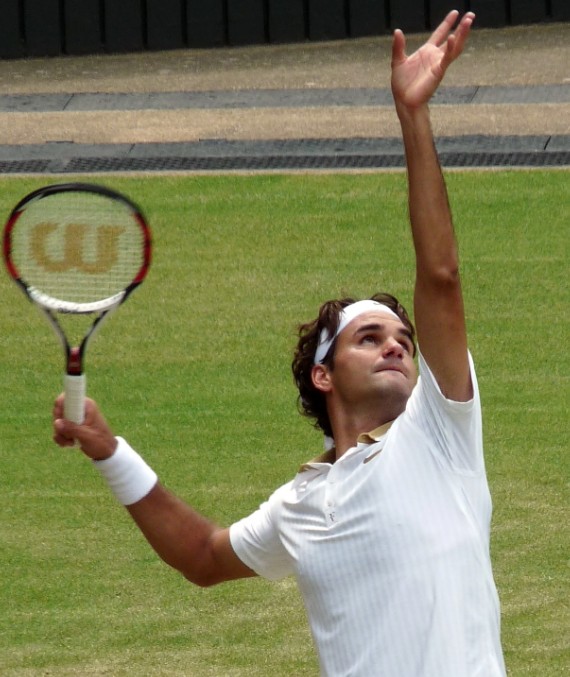
Roger Federer won Wimbledon eight times between 2003 and 2017. No man in the Open Era has won the All England Club’s championship more often. His eight titles — accumulated across fifteen years of competitive history on Centre Court — represent the most extreme concentration of excellence at any Grand Slam tournament by any player in the men’s game.
This is the story of how a Swiss player who once described Wimbledon as the tournament that meant most to him personally turned the All England Club into his defining achievement — and what his record means for the modern history of the sport.
The Eight Titles
Federer’s eight Wimbledon titles came across a fifteen-year span between 2003 and 2017. The complete list:
- 2003 — defeated Mark Philippoussis 7–6(5), 6–2, 7–6(3)
- 2004 — defeated Andy Roddick 4–6, 7–5, 7–6(3), 6–4
- 2005 — defeated Andy Roddick 6–2, 7–6(2), 6–4
- 2006 — defeated Rafael Nadal 6–0, 7–6(5), 6–7(2), 6–3
- 2007 — defeated Rafael Nadal 7–6(7), 4–6, 7–6(3), 2–6, 6–2
- 2009 — defeated Andy Roddick 5–7, 7–6(6), 7–6(5), 3–6, 16–14
- 2012 — defeated Andy Murray 4–6, 7–5, 6–3, 6–4
- 2017 — defeated Marin Cilic 6–3, 6–1, 6–4
Each title was won on Centre Court. Each was achieved across seven consecutive matches over the Wimbledon fortnight. Each established its own narrative in the modern history of the All England Club — but the cumulative weight of all eight is what transformed Wimbledon’s competitive identity across the period from 2003 to 2017.
The Sampras Connection: 2001
What is sometimes forgotten about Federer’s relationship with Wimbledon is the moment that began it — a fourth-round match in 2001 between a nineteen-year-old Federer and a seven-time Wimbledon champion Pete Sampras. Sampras had won seven of the previous eight Wimbledons. He was the defending champion. He was widely regarded as the greatest grass-court player in the history of the sport.
Federer beat him 7–6(7), 5–7, 6–4, 6–7(2), 7–5 in a five-set match that lasted three hours and forty-one minutes. The win produced one of the most symbolic competitive moments in modern tennis history — the passing of the grass-court torch from one generation to the next, with a Swiss teenager defeating the player whose Wimbledon dominance had defined the previous decade.
The 2001 Wimbledon ended for Federer in the next round — a quarterfinal loss to Tim Henman. But the Sampras match had established something more important than a tournament result. It had announced that the player who would define the next era of Wimbledon tennis had arrived. The two-year gap between 2001 and Federer’s first Wimbledon title in 2003 was the period in which that announcement became a reality.
The 8-from-12 Finals Record
Federer appeared in twelve Wimbledon finals across his career. He won eight. His four losses came in 2008 (to Nadal), 2014 (to Djokovic), 2015 (to Djokovic), and 2019 (to Djokovic). Three of his four losses came against Novak Djokovic in the latter stages of his career, and one came against Rafael Nadal at the absolute peak of the Federer-Nadal rivalry.
For context: Pete Sampras made seven Wimbledon finals across his career, winning all seven. Björn Borg made six consecutive Wimbledon finals between 1976 and 1981, winning five. Andy Murray made three Wimbledon finals, winning two (2013 and 2016). Novak Djokovic has made eight Wimbledon finals through the present, winning seven.
What distinguishes Federer’s record is not simply the number of finals he reached but the quality of opposition he faced at the deciding stage. Roddick, Nadal, Murray, Djokovic, Cilic — the list of his Wimbledon finals opponents reads as a roll call of the best players of his era. The seven-Slam champion Roddick, in particular, lost three Wimbledon finals to Federer (2004, 2005, 2009) — a record of three-time runner-up status that defined Roddick’s competitive relationship with the All England Club.
The 2008 Final: The Greatest Match Ever Played
The 2008 Wimbledon men’s singles final between Federer and Rafael Nadal is widely regarded as the greatest tennis match ever played. The contemporary consensus on this point — across players, analysts, broadcasters, and journalists — has held up remarkably well in the years since.
Nadal won the match 6–4, 6–4, 6–7(5), 6–7(8), 9–7 in four hours and forty-eight minutes of competitive tennis, played across nearly seven total hours when rain delays were included. The match was Nadal’s first Wimbledon title and the moment that established him as a legitimate challenger to Federer’s grass-court dominance.
The match’s competitive quality was extraordinary across every dimension. Both players were operating at the peaks of their abilities. Federer had won five consecutive Wimbledon titles entering the match — matching Björn Borg’s modern Open Era record. Nadal was the world number two and the four-time French Open champion, with the previous year’s Wimbledon final loss to Federer as the immediate competitive context.
The final set produced one of the most dramatic competitive sequences in modern Grand Slam history. The two players exchanged service holds across the entire set, with the match eventually decided by Nadal’s break of Federer’s serve at 8–7 in the deciding set — the match concluding in near-darkness with the All England Club’s lighting unable to fully illuminate the court as the result was sealed.
The 2008 final’s significance went beyond the trophy itself. It demonstrated that grass-court tennis could be played at a level of physical and tactical intensity that the older serve-and-volley grass-court tradition had not anticipated. It established Nadal as a legitimate competitor to Federer at the surface where Federer’s dominance had appeared most secure. And it produced the kind of competitive narrative that made the Federer-Nadal rivalry one of the defining storylines in tennis history.
It also made the case for the Centre Court retractable roof more powerfully than any administrative argument could. The roof — installed in 2009 — was substantially designed in response to the rain delays that had nearly forced the 2008 final to be suspended overnight. For more on how the 2008 final shaped Centre Court’s modern infrastructure, see The History and Meaning of Centre Court at Wimbledon.
The 2009 Final: 16–14 in the Fifth
The 2009 Wimbledon men’s singles final between Federer and Andy Roddick was decided in the longest fifth set in the history of Grand Slam finals — a 16–14 deciding set that Federer eventually won to claim his sixth Wimbledon title and his fifteenth Grand Slam championship overall, surpassing Pete Sampras’s previous Open Era record.
Roddick was Federer’s third Wimbledon final opponent (after 2004 and 2005, both Federer wins). The 2009 match represented Roddick’s final realistic opportunity to win a Wimbledon title — he was twenty-six years old and competing in a period when Federer’s dominance and the emerging Big Three were combining to make Slam championships increasingly difficult for non-elite players to claim.
The final’s fifth set produced one of the most extraordinary competitive sequences in Wimbledon history. Both players exchanged service holds across thirty consecutive games — a level of service-game dominance that was possible because the deciding set at Wimbledon at the time had no tiebreak. The set continued until Federer eventually broke Roddick at 15–14 to win 16–14 in the deciding set.
The match’s specific length — five hours and twelve minutes overall — and its specific historical significance (Federer’s record-breaking 15th Slam, surpassing Sampras) gave it a competitive weight that few Wimbledon finals have matched. Roddick’s emotional response to losing his third Wimbledon final to Federer — the visible tears at the trophy ceremony, the visible disappointment in the post-match comments — produced one of the most poignant moments in modern Wimbledon history.
The 2009 final has been cited subsequently as one of the matches that justified the eventual introduction of the deciding-set tiebreak at all four Grand Slams. Wimbledon adopted the 10-point final-set tiebreak in 2022 — a structural change that means the specific 16–14 fifth set will never be repeated at the All England Club.
The 2012 Final: The Return to No. 1
The 2012 Wimbledon men’s singles final between Federer and Andy Murray produced one of the most emotionally significant moments of Federer’s career and a defining moment for the home British crowd at Centre Court.
Murray was the first British man to reach a Wimbledon singles final since Bunny Austin in 1938 — a 74-year drought that had become one of the most prominent ongoing narratives in British tennis. The Centre Court crowd’s investment in Murray’s potential breakthrough was extraordinary. The atmosphere on the day of the final was reportedly among the most charged in modern Wimbledon history.
Federer won the match 4–6, 7–5, 6–3, 6–4 in three hours and twenty-four minutes — recovering from a first-set loss to control the remaining three sets through tactical adjustments and his characteristic clinical execution at decisive moments. The win was Federer’s seventh Wimbledon title — tying Pete Sampras’s then-Open Era record for the tournament.
The match’s broader significance went beyond the title itself. The win returned Federer to the world number one ranking for the first time in over two years — a position he subsequently held for an additional 17 weeks across late 2012. The combination of the seventh Wimbledon title and the return to the top of the rankings produced one of the most successful late-career resurgences of Federer’s competitive period.
For Murray, the 2012 loss was one of his most painful career defeats. He subsequently described his speech at the trophy ceremony — when he attempted to thank the British crowd and broke down in tears — as one of the most emotional moments of his career. The 2012 loss was a defining moment in his Wimbledon journey, but it would not be the final chapter. Murray returned the following year to win the 2013 Wimbledon title, ending the seven-decade British drought.
The 2017 Final: The Record-Setting Eighth
The 2017 Wimbledon men’s singles final between Federer and Marin Cilic was Federer’s eighth Wimbledon title — setting the all-time men’s record at the tournament and exceeding Pete Sampras’s previous Open Era record of seven. He was thirty-five years and 342 days old, the oldest Wimbledon men’s singles champion since Arthur Ashe in 1975.
Federer’s path to the 2017 final was remarkable in its own right — he won the tournament without losing a single set across seven matches. The straight-sets dominance at age 35 represented one of the most efficient title runs in modern Grand Slam history and reflected the strategic adjustments Federer had made to his game following his 2016 second-half-of-season break.
The final itself was a straight-sets win — 6–3, 6–1, 6–4 in one hour and forty-one minutes. Cilic, the 2014 US Open champion and a legitimate Slam-level player, struggled with a blistered foot that limited his movement across the match. The competitive result was largely settled by the second set, with Federer controlling the tactical patterns and Cilic visibly compromised by his physical condition.
But the broader significance of the 2017 title was less about the specific match and more about what it meant for Federer’s career narrative. After his five-year drought between Grand Slam titles from 2012 to 2017 — including the 2017 Australian Open comeback win that immediately preceded this Wimbledon — Federer had produced one of the most extraordinary late-career resurgences in tennis history. The 2017 Wimbledon title cemented this resurgence as one of the defining narratives of his competitive era.
The trophy ceremony produced one of the most emotional moments of Federer’s career. His acknowledgment of his family, his support team, and his audience — combined with the visible reflection of what the record-setting title meant to him personally — established the 2017 win as one of the defining moments not only of Wimbledon’s modern history but of Federer’s entire career.
The 2019 Final: Two Championship Points
The 2019 Wimbledon men’s singles final between Federer and Novak Djokovic produced one of the most heartbreaking defeats in Federer’s career. The match lasted four hours and fifty-seven minutes — the longest Wimbledon final in tennis history — and ended with Djokovic winning 7–6(5), 1–6, 7–6(4), 4–6, 13–12(3) in the first Wimbledon final to use the new 12-12 final-set tiebreak that the tournament had adopted that year.
Federer led the match in multiple ways across nearly five hours of play. He had two championship points on his own serve at 8–7 in the deciding set, leading 40–15. Djokovic saved both championship points with aggressive return play, broke Federer’s serve, and eventually won the tournament through the deciding tiebreak at 13–12.
The match’s competitive quality was extraordinary. Federer played at a level that contemporary observers described as exceptional for any age, let alone the thirty-seven he was at the time of the match. His ability to compete against Djokovic across nearly five hours, to construct match points on his own serve in the deciding set, and to come within two points of an unprecedented ninth Wimbledon title represented one of the most distinctive competitive performances of his career.
The 2019 final remains one of the most painful losses in Federer’s career — not because the result was unjust, but because the championship points on his own serve in the deciding set represented one of the most extreme near-miss moments any tennis player has experienced. He never returned to the Wimbledon final after 2019, making the championship points he could not convert that day his closest brush with a ninth title.
Career Statistical Profile
Federer’s Wimbledon career statistics produce a profile that has no equal in the men’s game at any single Grand Slam in the Open Era:
- Eight singles titles (Open Era record at Wimbledon)
- Twelve singles finals (most Wimbledon finals by any man in the Open Era)
- 105 career match wins at Wimbledon against 14 losses
- Career winning percentage at Wimbledon of approximately 88 percent
- Five consecutive titles (2003-2007) — matching Björn Borg’s modern Open Era record
- An additional 18 quarterfinal appearances beyond the 12 finals
- A 15-year span between his first and last Wimbledon titles — among the longest title-to-title intervals at a single Grand Slam in Open Era history
The combination of these numbers establishes Federer as the most successful Wimbledon player of the Open Era — a status that the cumulative weight of the record cannot easily be challenged.
Why Centre Court Suited Federer’s Game
The specific qualities that made Federer the defining champion of Wimbledon’s modern era reflect a fit between his game and the grass-court conditions that no other tournament could replicate as precisely.
Federer’s signature qualities — exceptional first serve placement, the most effective slice backhand in the men’s game, court positioning that allowed him to take serves early, and tactical patience that prevented him from playing in panic mode at decisive moments — found their most complete expression on the low-bouncing, fast grass at the All England Club.
The Wimbledon surface’s specific properties — the way grass rewards aggressive returners, the way it punishes errors of timing, the way it favours players who can construct points quickly rather than build them gradually — gave Federer structural advantages that he leveraged across his fifteen years of competitive Wimbledon history.
His ability to construct points from neutral baseline positions with shorter rallies than other surfaces required gave him tactical advantages that few opponents could match. His low slice backhand was particularly effective on grass — the way the grass court’s low bounce amplified the difficulty of returning low slices made his return-game weapon especially destructive at Wimbledon.
The Centre Court atmosphere itself — particularly the specific culture of the All England Club, the courteous British crowd, the awareness of the tournament’s history that pervades every match played there — produced a competitive setting that experienced players consistently rank among the most distinctive in the sport. Federer’s specific temperament and personality were a strong fit with that culture — his elegant playing style and his characteristically gracious public presentation found their most natural expression at Wimbledon, where these qualities were valued as competitive virtues rather than incidental personality traits.
The Modern Era’s Defining Wimbledon Champion
What does it mean to be the defining champion of a Grand Slam tournament’s modern era? It means the player whose competitive performance most completely shaped the tournament’s identity across a specific historical period — the player whose game and whose results changed how the tournament is understood by players, fans, and the broader sporting culture.
For Wimbledon, that role belongs unambiguously to Roger Federer. His eight titles between 2003 and 2017 — combined with the 2008 final loss that is widely considered the greatest match ever played, the 2009 final 16–14 fifth set that surpassed Sampras’s Open Era record, the 2012 final win that returned him to world number one, the 2017 final win that set the all-time men’s record, and the 2019 final loss with championship points on his serve — combine to make Federer the player whose competitive performance most completely shaped what the modern Wimbledon is understood to mean.
Future champions will accumulate their own Wimbledon titles. Novak Djokovic has already won seven, with a realistic possibility of equalling or surpassing Federer’s record. The next generation will produce its own narratives across the coming decades. But for the period from 2003 to 2017 — and likely for the foreseeable future — Federer’s relationship with Wimbledon will remain the single most distinctive concentration of excellence at a Grand Slam tournament in the Open Era of men’s tennis.
The modern Wimbledon is Roger Federer’s tournament. The records bear it out. The history confirms it. The cultural fit between his game and the All England Club’s institutional identity — the elegant playing style, the gracious public conduct, the natural respect for the tournament’s traditions — completes the narrative. The player who lifted the championship trophy eight times on Centre Court remains the figure against whom every subsequent claim of Wimbledon dominance will be measured.
Part of the Wimbledon series. Related: The History and Meaning of Centre Court at Wimbledon · Wimbledon Guide — Format, Grass Courts, Draws, and Prize Money · Novak Djokovic at the Australian Open — The Defining Champion