

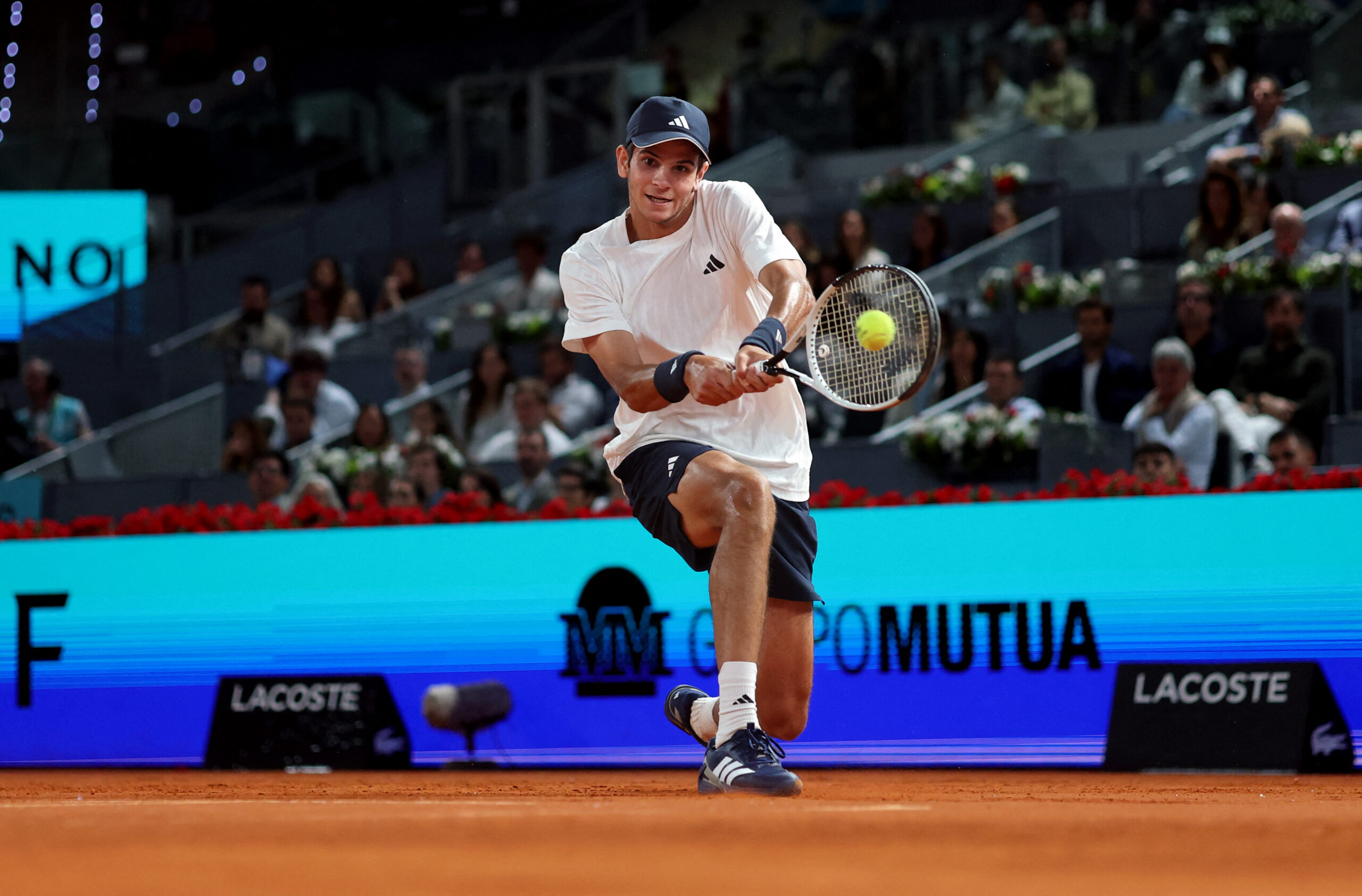
Spanish tennis has spent the past 12 months waiting to see who would step into the spotlight behind Carlos Alcaraz. As of this week, the answer has a name, a forehand, and a hometown crowd that has turned the Caja Mágica into the loudest building on the ATP Tour.
Rafael Jódar, 19 years old and barely a year removed from a ranking of No. 911, has reached the round of 16 of the Mutua Madrid Open, beaten a top-10 player in straight sets, knocked out Joao Fonseca in front of a capacity crowd at Manolo Santana Stadium, and is now one win away from a Masters 1000 quarter-final on home soil.
Jódar mania has officially arrived.
The Breakthrough Week
Jódar entered Madrid as a wild card with a career-high ranking of No. 42, achieved on 20 April after a semi-final run at the Barcelona Open Banc Sabadell as a wild-card entrant. In the first round he saved the match before recovering to defeat Jesper de Jong 2-6, 7-5, 6-4.
He followed that with the most striking result of his young career so far, a 6-3, 6-1 demolition of fifth seed Alex de Minaur for his first top-10 win. World No. 1 Jannik Sinner watched from the stands.
Two days later, in a meeting between the two most hyped 19-year-olds in men’s tennis, Jódar outlasted Joao Fonseca 7-6(4), 4-6, 6-1 in a match that finished close to one in the morning. Jódar struck 46 winners, won 81 percent of his first-serve points, and converted three of four break points.
With the win he climbed to a live ranking of No. 34 and locked in his first Roland Garros main-draw appearance, very likely as a seed.
The Numbers
Jódar’s 17 wins from his first 25 tour-level matches now lead all active players when measured against their first 25 on tour, ahead of Rafael Nadal and Joao Fonseca on 15 each, and Carlos Alcaraz on 14.
He began 2025 ranked No. 895 and ended the year as a Next Gen ATP Finals qualifier after winning three Challenger titles between August and October, joining Nicolas Almagro and Alcaraz as the only Spanish teenagers to capture three Challenger crowns.
He turned professional on 31 December 2025, qualified for the Australian Open in his first attempt, reached the third round of his first Masters 1000 in Miami, and won his maiden ATP title in his first tour-level clay event in Marrakech, defeating Marco Trungelliti 6-3, 6-2 in the final without dropping serve in the second set.
His tour-level record on clay this season stands at 11 wins against three losses.
Home Court, Hometown
Jódar was born on 17 September 2006 in Madrid and grew up in Leganés. Contrary to wide assumption, he was not named after Rafael Nadal. His father, grandfather and great-grandfather are all Rafaels, a family lineage that predates Nadal’s first Roland Garros title.
Nadal was nonetheless his idol from childhood, and one of the formative experiences of Jódar’s career was serving as a hitting partner for the Spanish Davis Cup team at the 2024 Final 8 in Málaga, the tournament that marked Nadal’s last professional appearance.
The symbolism of a teenage Madrileño named Rafa, sparring with the original Rafa in his final week, has not been lost on Spanish observers, and it has fed the narrative engine driving this week’s hysteria.
The Caja Mágica crowd has responded accordingly, with Manolo Santana Stadium reaching capacity for both his De Minaur and Fonseca matches, and the atmosphere drawing comparisons to Alcaraz’s first deep run in the Spanish capital in 2022.
The Game
What separates Jódar from many of his Next Gen contemporaries is the willingness to construct points rather than blast through them. The forehand is the heaviest shot in his arsenal, an inside-out weapon he used to close out match point against both De Minaur and Fonseca with the identical pattern, and he serves with above-tour-average first-serve efficiency for his ranking bracket.
Against Fonseca he won 73 percent of his first-serve points across the tournament, struck 12 aces in three matches, and broke serve 14 times at a 50 percent conversion rate. Stefanos Tsitsipas, asked this week to compare Jódar with Alcaraz, identified Jódar as the more conventional baseliner of the two, with cleaner mechanics and a less acrobatic but more repeatable point-construction model.
Daniil Medvedev called the speed of his evolution “record time.” Sinner, after watching him beat De Minaur, described his class of 2006, which also includes Fonseca, Jódar, Norway’s Nicolai Budkov Kjær and Japan’s Rei Sakamoto, as “a very strong year.”
What he faces next
Jódar plays Czech veteran Vit Kopriva, ranked No. 66, in the round of 16 on Tuesday afternoon at Manolo Santana Stadium, with the match scheduled not before 16:00 local time.
The two have never met. Kopriva reached the fourth round after the retirement of Arthur Rinderknech in their previous match. Jódar enters as the heavy favourite at -526 on the moneyline.
The winner faces Sinner in the quarter-finals, assuming Sinner advances past his bracket, setting up the possibility of the most-watched men’s match of the Spanish clay season.
The Bigger Picture
With Alcaraz ruled out of Roland Garros with a wrist injury and Novak Djokovic’s participation in Paris uncertain due to a shoulder problem, the men’s clay swing has been searching for a new central storyline. Jódar has provided one.
A Roland Garros seeding now appears not just possible but probable, his coaching team remains his father, and his post-match interviews have been notable for their composure. “I’m keeping my life simple,” Jódar told Tennis Channel this week.
“I’m the same person as I was one year ago, two years ago, and I will always be the same person, no matter the results.” Whether that holds through what is coming next, on a court he grew up watching, against the world No. 1 he idolises, is the question Spanish tennis has been waiting almost a decade to ask of someone other than Carlos Alcaraz.