

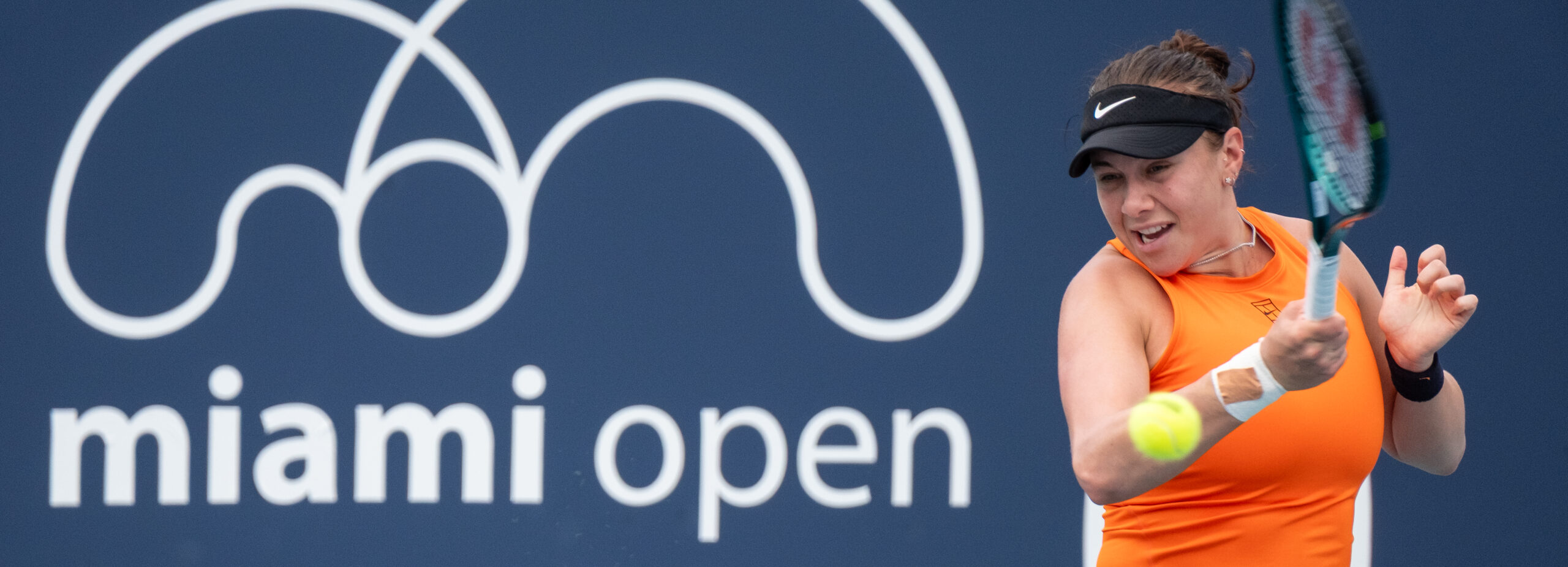
The Miami Open returns to Hard Rock Stadium in Miami Gardens, Florida in March 2026, bringing a combined ATP Masters 1000 and WTA 1000 field to outdoor hard courts.
The basics
Location: Miami Gardens, Florida Venue: Hard Rock Stadium Surface: Outdoor hard Level: ATP Masters 1000; WTA 1000 Dates: March 15–29, 2026 (event); March 17–29, 2026 (WTA main-draw window) Draw size: Singles 96, Doubles 32
Top seeds
Official seedings are finalized closer to the start of the tournament. For now, here are the projected top seeds based on the likely field.
On the ATP side, the projected top line includes Novak Djokovic, Jannik Sinner, Carlos Alcaraz, Alexander Zverev and Taylor Fritz.
On the WTA side, the projected top line includes Aryna Sabalenka, Iga Swiatek, Coco Gauff, Elena Rybakina and Jessica Pegula.
Five storylines to watch
1) The Sunshine Double pressure
Miami is the second half of the Indian Wells–Miami swing. Players who go deep at Indian Wells arrive in Florida with form, but also fatigue and less practice time.
2) A 96-player draw means early danger matches
With a 96-player singles draw, seeded players typically receive byes, but the first match can still be a trap: qualifiers have rhythm, and unseeded main-draw players can be top-30 quality.
3) Hard-court margins and serve patterns
On outdoor hard courts, short stretches decide sets: one loose service game, one strong return game, one tiebreak. Miami often rewards players who serve cleanly and take the first forehand.
4) WTA depth and matchups that bite early
The women’s field is deep enough that a “second-week” player can be forced into a tight match on Day 3. The byes help, but they don’t protect against awkward styles.
5) Late changes that reshape the draw
As the calendar compresses, withdrawals happen. Miami is a tournament where wild cards, qualifiers, alternates, and lucky losers can matter.
How Wild Cards Work in Tennis | How Tennis Qualifying Works | What Is a Lucky Loser in Tennis
Draw notes
The live draw details will be updated once the bracket is released.
Potential quarterfinal collisions
The ATP top half carries real volatility. Djokovic arrives as the defending finalist — he reached the 2025 final before falling to Jakub Menšík in straight sets, a match in which Menšík went 7-0 in tiebreaks throughout the tournament. That result means Djokovic is back defending finalist points, and any early exit would be a significant rankings blow.
If Sinner and Alcaraz land in the same half, an earlier-than-expected collision is possible given how deep this field runs. On the WTA side, a Sabalenka-Gauff quarterfinal is the most anticipated potential matchup — Gauff has a strong recent record against Sabalenka, and a home crowd in Florida only amplifies the stakes.
Floaters who can upset seeds early
Menšík — the defending ATP champion — arrived last year ranked 54th in the world and went on to win the title, a reminder that the Miami draw can produce genuine chaos regardless of seeding. He now arrives as a top-seed-level player with points to defend, which makes his section of the draw one to watch for first-round danger.
On the WTA side, Sabalenka won the 2025 women’s title without dropping a set, but the field around her is deeper this year, and players like Mirra Andreeva and Diana Shnaider — who have both broken through at the 1000 level — are capable of making noise early.
Wild cards and qualifiers to watch
Update once the entry list is confirmed. Miami historically uses its wild card spots for American players and high-profile returnees, and with the tournament taking place during spring break in South Florida, home-nation recipients always draw crowd support. Watch the qualifier section closely — last year the draw demonstrated that qualifiers with momentum can be as dangerous as seeded players in the opening rounds.
The section of the draw that looks “open”
Identify this once the bracket is published. In a 96-player field, the quarter that lacks a clear top-10 favorite tends to produce the most surprising results. Last year’s men’s draw showed that an unseeded Czech teenager could win the whole thing, so no quarter should be written off until the bracket is set.
Conditions and how the court plays
Miami is outdoor hard-court tennis in South Florida. Day sessions can feel very different from night sessions, and wind can become a real factor. In a draw this large, players who adjust quickly to conditions tend to separate.
Players most likely to win
Novak Djokovic
Arrives with history on his side and something to prove. He reached the 2025 Miami final, where Menšík denied him what would have been his 100th career title – a milestone he will have circled on his calendar. His experience, return depth, and ability to manage big-match moments over a two-week draw make him one of the most dangerous players in the field even when he isn’t at his physical peak.
Jannik Sinner
Enters Miami with clean first-strike patterns and baseline control that translate well in hard-court 1000-level weeks. Having missed Miami entirely last year due to suspension, he carries no points to defend here, making any deep run a straight gain in the rankings race.
Carlos Alcaraz
Brings explosive athletic offense with enough defensive range to survive tough early matches in a draw this deep. He won Miami in 2022 as an 18-year-old and has been in elite form to start 2026, making him a genuine title contender from the first round.
Alexander Zverev
Enters Miami with serve platform and backhand stability that can carry him through fast hard-court stretches. His five-set Australian Open semifinal against Alcaraz showed he still has the capacity to compete at the highest level when fully locked in.
Taylor Fritz
Is the local favorite and a genuine threat on home hard courts. His serve-plus-one efficiency plays up in Miami conditions where breaks are scarce and tiebreaks are frequent.
Aryna Sabalenka
is the defending WTA champion and one of the most dangerous players in the field. She won the 2025 title without dropping a set, defeating three top-10 players in the same tournament ATP Tour — a level of dominance that makes her the clear favourite again this year. Her first-strike power and serve can shorten matches and punish weaker service games before opponents settle.
Iga Swiatek
Returns pressure and baseline consistency travel even when conditions vary from day to night. She won Miami in 2022 and her game translates well to hard courts when her return is clicking from the start of the week.
Coco Gauff
Is playing her home event and carries real momentum into Miami. Her elite athletic defense and improving first-strike patterns make her a threat to go deep, and a home crowd at Hard Rock Stadium gives her a meaningful edge in tight matches.
Elena Rybakina
Enters Miami as a Grand Slam champion fresh off her 2026 Australian Open title. Her serve is one of the most damaging weapons in the women’s game on hard courts, and her flat baseline game rewards the faster conditions Miami typically provides.
Jessica Pegula
Is a proven Miami performer whose early-ball timing and steady decision-making are well-suited to this draw. She reached the 2025 final before falling to Sabalenka, and she’ll be looking to go one better on familiar hard courts.
One To Watch
Iva Jovic has arrived too fast to call a true sleeper — she entered 2026 ranked inside the top 20 after a 14-5 start to the season with an Australian Open quarterfinal and a WTA title already on her résumé. But she remains underrated in terms of how much damage she can do in a big draw.
Playing in South Florida, close to her California home and in front of a crowd that will be squarely behind an American teenager, Jovic has the complete game and competitive temperament to upset a seed or two and make a genuine run. She’s no longer a wildcard — she’s a threat.
What it means for rankings
Miami is a Masters 1000 and WTA 1000 week, so the points leverage is large. A deep run can swing seeding and momentum heading into the next phase of the season, while a poor week can create immediate pressure because of how the rolling 52-week system drops points from the same window a year earlier.
Related reading
Tennis Rankings Explained | Masters 1000 Guide | WTA 1000 Guide | How Tennis Seeding Works | How Wild Cards Work in Tennis | How Tennis Qualifying Works | What Is a Lucky Loser in Tennis