

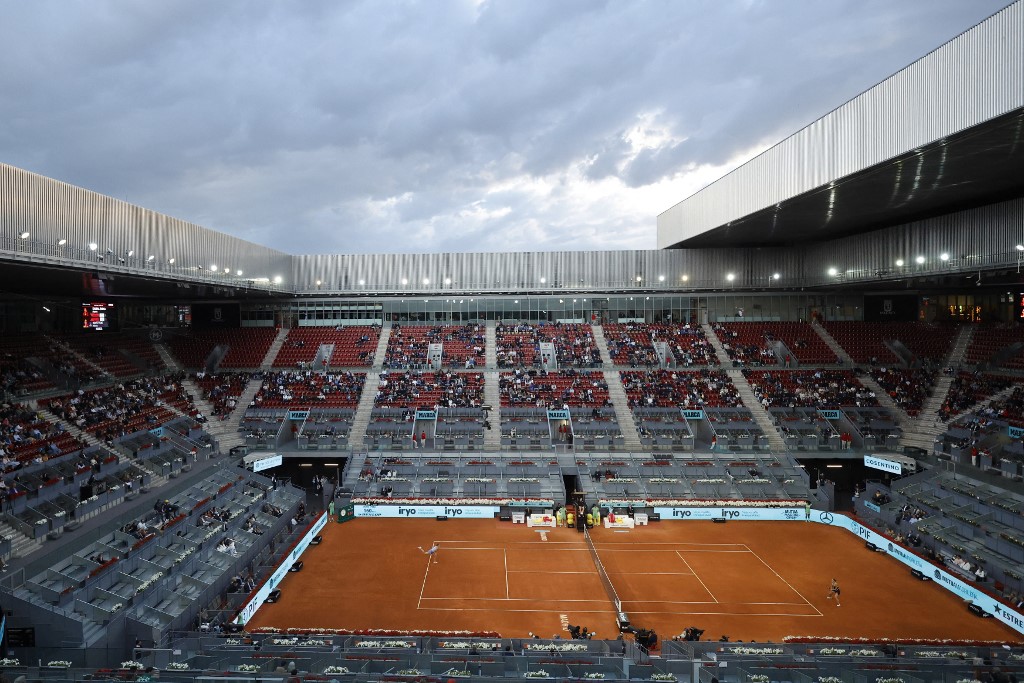
The Mutua Madrid Open runs April 22 to May 3, 2026 at the Caja Mágica in Madrid, a combined ATP Masters 1000 and WTA 1000 event on outdoor clay courts that anchors the early European clay swing.
The basics
Location: Madrid, Spain
Venue: Caja Mágica
Surface: Outdoor clay
Level: ATP Masters 1000; WTA 1000
Dates: April 22–May 3, 2026
Top seeds
Official seedings are finalized closer to the start. For now, list projected contenders and update once the official seed list posts.
Projected ATP top line: Carlos Alcaraz, Jannik Sinner, Novak Djokovic, Alexander Zverev, Daniil Medvedev
Projected WTA top line: Aryna Sabalenka, Iga Swiatek, Coco Gauff, Elena Rybakina, Jessica Pegula
Five storylines to watch
1) The clay swing’s first major stress test
Madrid is where clay season stops being theory and becomes a points-heavy reality. One strong week here can reshape seeding heading into Rome and Roland Garros.
2) Clay tennis with a different feel
Madrid is clay, but it often plays differently from slower European clay weeks. Players who serve well and strike cleanly can carry that advantage deeper than they might at heavier, slower venues.
3) The transition problem
Some players arrive with hard-court habits and need time to adjust: movement patterns, rally tolerance, and the way points reset on clay. Early rounds often expose who adapted fastest.
4) WTA depth on clay
Clay demands patience, but the women’s field has enough pace that matches can still turn quickly. Return games and second-serve pressure are often the real battleground.
5) The entry pipeline and draw chaos
Late withdrawals, wild cards, qualifiers and lucky losers can matter, especially in a 1000-level week with a packed calendar.
How Wild Cards Work in Tennis | How Tennis Qualifying Works | What Is a Lucky Loser in Tennis
Draw notes
The live draw details will be updated once the bracket is released around April 19.
Potential quarterfinal collisions
The matchup to circle before the draw even drops is Alcaraz vs. Sinner. Alcaraz arrives in Madrid defending a massive points haul from last year’s clay swing, having won Monte-Carlo, Rome, and Roland Garros.
Sinner, by contrast, missed nearly all of last year’s clay season and has virtually nothing to defend until Rome — meaning every match he wins in Madrid is pure gain.
If they land in opposite halves, a final is the most likely meeting point, but a quarterfinal or semifinal collision in the same half is the scenario that scrambles the whole narrative. Zverev and Medvedev meeting in the quarters is another credible heavy-half scenario, as both are capable of winning on clay without being natural clay specialists.
Floaters who can upset seeds early
Casper Ruud — the 2025 defending champion — arrives with points to protect and the surface confidence to go deep again, but that also makes him a dangerous floater if he lands outside the top seeds’ projected paths.
Lorenzo Musetti is another name worth tracking after his run to the 2025 semifinals; he’s now a genuine top-10 clay threat. Jack Draper showed last year that his game translates to Madrid-pace clay, reaching the final before losing to Ruud.
Wild cards and qualifiers to watch
Update once the entry list is confirmed. Madrid’s wild card spots historically go to Spanish players and high-profile returnees. Given the home crowd factor, any Spanish recipient — particularly a young clay-courter — will have built-in support and should be noted.
The section of the draw that looks “open”
Identify this once the bracket is published. In a draw this size, the quarter where the highest seeds face the most awkward early-round matchups tends to produce the real upsets. On the WTA side, unseeded Moyuka Uchijima reached the quarterfinals last year as a reminder that the bottom half of big draws can open up fast.
On the ATP side, lucky loser Gabriel Diallo reached the quarterfinals before falling to Musetti — a signal that the “open” quarter can emerge quickly once a seed or two falls early.
Conditions and how the court plays
Madrid is outdoor clay at a major venue. Treat this as a style tournament: movement and point construction matter, but players who can serve effectively and take control early often gain extra value here compared with slower clay weeks.
Players most likely to win
Carlos Alcaraz
Arrives in Madrid as the clear favorite and the man everyone else has to beat. He enters the clay swing with a 13-0 record in 2026, having already won the Australian Open and the Qatar Open, and he is the defending Madrid champion.
His clay athleticism — the ability to construct points, change direction mid-rally, and end matches with a range of offensive options — makes him uniquely dangerous on this surface at this venue.
Jannik Sinner
Enters the clay swing with a significant opportunity. He missed nearly all of last year’s clay season while serving a suspension, which means he has virtually no points to defend from Monte-Carlo through Rome.
Every match he wins in Madrid is pure gain. His baseline control and improving first-strike patterns on clay make him a genuine title threat, and a deep run here could quickly close the gap at the top of the rankings.
Novak Djokovic
Is coming off a remarkable Australian Open campaign, eliminating two-time defending champion Sinner in the semifinals — saving 16 break points — before falling to Alcaraz in the final. That run confirmed he still has the return discipline and high-leverage clutch tennis to compete at the highest level. On clay, his experience and tactical intelligence give him a ceiling that few players can match.
Alexander Zverev
Enters Madrid having demonstrated his ability to push Alcaraz to the limit. Their Australian Open semifinal lasted 5 hours and 27 minutes, the longest in the tournament’s history. His serve platform and backhand stability hold up on clay, and if he can find consistent rhythm from the baseline, he’s a serious threat to reach the final.
Daniil Medvedev
Remains a credible contender in any Masters 1000 week when his movement and patience click early. He has fewer natural advantages on clay than the others in this group, but his ability to neutralize pace and grind out tight sets makes him dangerous in a long draw.
Aryna Sabalenka
Is the defending Madrid champion and arrives with serious points to protect. Her power game is well-suited to Madrid’s conditions, where a big serve and clean, decisive striking can end sets quickly before opponents settle.
Iga Swiatek’s
Clay-court patterns translate most directly to this surface. She won her sixth Grand Slam at Wimbledon in 2025 and finished the year ranked No. 2, and her return pressure and heavy baseline patterns make her a consistent threat from the first round in any WTA clay event.
Elena Rybakina
Enters the clay swing as a Grand Slam champion, having won the 2026 Australian Open by defeating Sabalenka in the final. Her serve and clean ball-striking are particularly effective when Madrid’s conditions reward first-strike tennis, and she showed at the Australian Open that she can grind through a full field when her game is locked in.
Coco Gauff
Has steadily built her clay credentials into a genuine major-level threat. A strong clay swing in 2025 culminated in the Roland Garros title, and her combination of athletic defense and improving point construction gives her a clear pathway through any draw.
Jessica Pegula
Is playing some of the best tennis of her career heading into the clay season. She won the Dubai title in 2026, defeating four top-20 players, and her early-contact game and consistency make her a real threat to grind through awkward matchups in a 96-player draw.
One sleeper pick
Francisco Cerúndolo is a strong sleeper candidate in Madrid because his clay-court patterns translate immediately: heavy forehand pressure, comfort in longer exchanges, and the ability to win points without needing low-percentage shots.
If the draw gives him a manageable early path, he’s the type of player who can turn a couple of tight wins into a genuine run, especially against seeds who are still calibrating movement and patience on clay.
What it means for rankings
As an ATP Masters 1000 and WTA 1000, Madrid offers major points and influences seeding for Roland Garros. A deep run can swing a player’s clay-season narrative in a single week.
Related reading
Tennis Rankings Explained | Masters 1000 Guide | WTA 1000 Guide | How Tennis Seeding Works | How Wild Cards Work in Tennis | How Tennis Qualifying Works | What Is a Lucky Loser in Tennis