

Grass is the surface on which tennis was invented, and Wimbledon is the only Grand Slam still played on it. But what exactly does grass do to the game?
The answer goes deeper than “the ball bounces low” — it reaches into physics, physiology, tactics, and a deliberately engineered change to the surface itself that transformed the kind of tennis Wimbledon produces. Here is a complete guide to what grass does to tennis, and why Wimbledon rewards the players it does.
The Physics of Grass
Every surface in tennis is defined by two fundamental properties: how fast the ball travels through the air after bouncing, and how high it bounces. Grass sits at one extreme of both scales simultaneously — it is both the fastest surface and the one that produces the lowest bounce of any Grand Slam.
The reason is friction. Grass courts have lower friction and absorb more energy during the bounce. As a result, the ball bounces low due to loss of vertical speed, but bounces fast due to lower friction and smaller loss of horizontal speed.
In practical terms: when a ball lands on grass, the blades and the soil beneath absorb some of the energy that would otherwise push the ball upward, while simultaneously offering very little horizontal resistance.
The ball stays low and keeps moving fast — the opposite of what happens on clay, where high friction grips the ball and redirects energy upward into a high, slow bounce.
The coefficient of restitution — the measure of how much vertical energy the ball retains after bouncing — is lower on grass than on any other Grand Slam surface. Grass has a naturally low coefficient of restitution because the soft soil absorbs much of the impact’s energy. The ball skids rather than bounces.
A player who grew up on clay or hard courts, arriving at Wimbledon for the first time, often describes the ball as feeling like it barely comes up at all — like trying to return a shot that has already gone past before you’ve had time to set up.
The Serve Becomes a Weapon Unlike Anywhere Else
No surface amplifies the serve more powerfully than grass, and no tournament demonstrates this more clearly than Wimbledon. The combination of the fast, low surface and the traditional grass-court ball — which is slightly softer and lighter than hard court balls — means that a powerful serve skids through the court at an angle and height that gives the receiver almost no time to react.
On clay, a 220 km/h serve bounces high and slow enough for even a world-class receiver to set up and drive a return. On grass, the same serve barely clears knee height off the bounce and arrives at the receiver in a fraction of the time.
The effective difficulty of returning a serve on grass is categorically different from returning the same serve on any other surface — which is why aces and unreturned serves constitute a substantially higher proportion of points at Wimbledon than at Roland Garros or even the hard court Slams.
Flat serves down the T and wide slice serves that curve off the court are particularly punishing on grass. The ball skids, retains much of its speed, and bounces low. Players must adapt quickly to unpredictable bounces.
A slice serve hit wide in the deuce court can skid off the surface at an angle that pulls the receiver entirely off the court, leaving the entire court open for a first-volley winner. This shot, barely threatening on clay, can be a point-ender on grass on virtually every occasion it is executed well.
Why Serve-and-Volley Was Born on Grass
Traditionally, serve-and-volley tennis has been the route to success, with returners having less time to react to the serve and good volleyers able to dominate the forecourt. The logic is straightforward.
If your serve forces a weak, defensive return, and the surface keeps the ball low and fast, the optimal strategy is to follow your serve to the net and put the weak return away with a volley before the rally can develop.
On clay, the same strategy fails because the return sits up high enough to be driven aggressively past you. On grass, it works because everything happens faster and lower.
The great Wimbledon champions of the pre-2002 era were almost exclusively serve-and-volley players. John McEnroe, Boris Becker, Stefan Edberg, and Pete Sampras — four of the most decorated grass-court champions in history — all built their Wimbledon games around the serve-and-volley, each in their own technical variation.
In the 2001 Wimbledon final, Goran Ivanisevic and Pat Rafter served and volleyed on every first and second serve. Not most serves. Every serve. The tactical choice was total and the surface fully supported it.
The worn path that developed along the middle of the service box toward the net at Wimbledon — visible in photographs from the McEnroe and Sampras eras — was literally the footprint of the serve-and-volley game inscribed into the turf.
Players made that run so many times across a fortnight that the grass was stripped bare and the soil exposed. The court was recording the dominant tactical choice of the era in its own surface.
The 2002 Surface Change That Transformed the Tournament
One of the least-discussed but most consequential decisions in modern tennis history occurred at Wimbledon in 2002. Stung by criticism that the game had become too boring because of the domination of big servers, Wimbledon changed its grass. Until then, the grass was a 70/30 combination of rye grass and creeping red fescue grass; it became 100 percent perennial grass.
The change was agronomic on the surface — perennial ryegrass is more durable and wears more consistently across a two-week tournament — but its tactical consequences were profound. A harder, more compact soil significantly increases the coefficient of restitution, generating a higher bounce.
The most lethal change for the classic attacking game was not the modest reduction in horizontal speed, but the drastic increase in the height of the bounce. A higher bounce is the antithesis of an effective approach volley.
The numbers tell the story. In the 2002 final, the only time Lleyton Hewitt and David Nalbandian went to the net was when they shook hands at the end of the match. The 2001 final had been a serve-and-volley exhibition. The 2002 final was a baseline battle, played on the same surface in the same stadium. The grass had been changed, and the game had changed with it.
Modern Wimbledon grass is faster than hard courts but significantly slower than the pre-2002 surface. It still rewards serving and net play. But it no longer makes baseline tennis impossible, as it functionally did throughout the 1980s and 1990s. The modern Wimbledon is a contested territory between serve-first and baseline-first players, rather than a surface where only one approach is viable.
Topspin: Why It Works Less Well on Grass
The dominant weapon of clay-court tennis — heavy topspin — loses a significant portion of its effectiveness on grass, and the physics explain why. On clay, topspin interacts with the high-friction surface to produce a bounce that kicks upward above shoulder height.
On grass, the low friction means the surface cannot amplify the topspin rotation the same way. The ball still carries its topspin forward, but it stays lower than on any other surface, diminishing the high-bouncing kick effect that makes topspin so useful on clay.
The low bounce makes it challenging for opponents to generate heavy topspin or effectively use defensive lobs. Players must be incredibly agile and possess excellent balance to handle the quick movements and the skidding ball.
This is why players who rely almost exclusively on heavy topspin groundstrokes — a style the clay-court season actively rewards and reinforces — often find Wimbledon the most technically disorienting adjustment of the year. Their primary weapon has been partially disarmed.
The practical response is to flatten shots out. Flat, penetrating shots that stay low are far more effective at rushing your opponent. This requires a different swing path and a different contact point than heavy topspin, and players who have not practiced flat driving groundstrokes regularly throughout the year must recalibrate quickly in the few weeks between Roland Garros and Wimbledon.
Movement: No Sliding, More Stability
Clay court movement and grass court movement are almost opposites. On clay, sliding into groundstrokes is not just permitted but necessary — the loose surface encourages and enables it. On grass, sliding is dangerous.
Players wear special grass-court shoes, with protection on the outside of the shoes. At Wimbledon, players must wear shoes with a completely flat sole, to avoid damaging the grass.
The footwork adjustment required for grass is one of the most physically demanding aspects of the transition from the clay season. Moving on grass is about balance and precision, not sliding.
Players need to use small, controlled steps to stay stable on the often-slippery surface and get their body low to handle those skidding shots. The surface is unforgiving of mistimed steps — slips and falls are more common at Wimbledon than at any other Grand Slam, particularly in the first week when the turf is still lush and most slippery.
The requirement to stay low — bending the knees deeply to get down to the level of a skidding ball — is physically taxing in a different way from clay. On clay, the muscular challenge is endurance across long rallies.
On grass, it is the constant low-posture demand of reaching balls that barely rise off the surface, combined with the need to change direction quickly on a surface that offers less traction than clay or hard courts.
How the Courts Change Through the Tournament
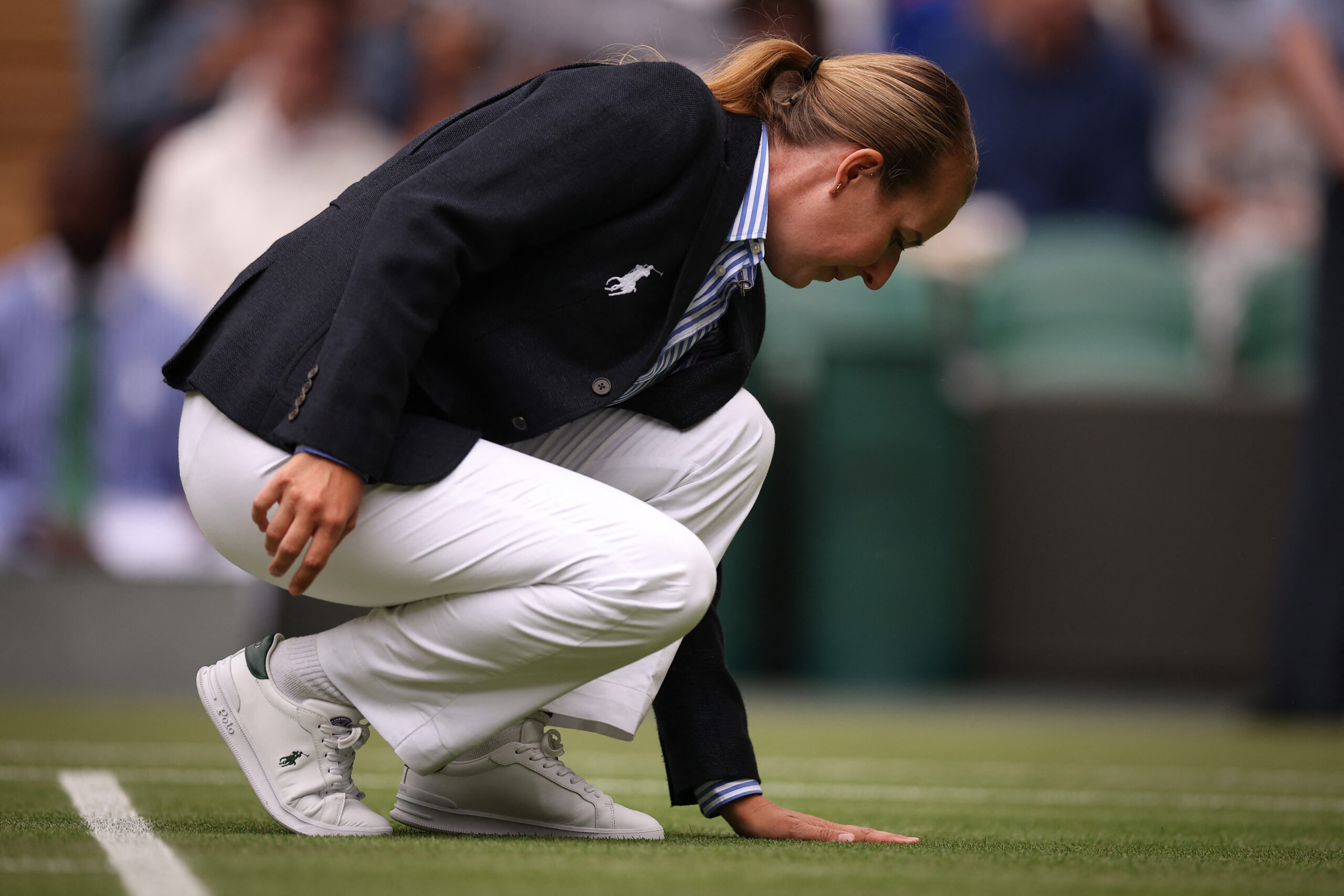
Wimbledon’s grass is not the same surface in the first round as it is in the final. As the tournament progresses and the turf is worn down, the courts become less treacherous, but potentially more unpredictable on the bounce as players have to navigate areas of the court — usually near the baseline — where the grass is worn bare.
After a week or so of competition, the courts tend to develop a large, uneven patch of dirt that can generate awkward bounces.
This is a unique feature of grass that has no parallel at the other Grand Slams. A clay court at Roland Garros plays more slowly as the tournament progresses, because the surface compacts and moisture builds up, but it remains essentially consistent in its bounce behavior.
Wimbledon’s Centre Court in the second week, with a bare dirt patch near both baselines, is a materially different playing environment from Centre Court in the first round. Players who survive to the second week must adjust to a surface that has been partially transformed by the matches played on it before them.
The Players Grass Creates
The list of Wimbledon’s greatest champions reflects the specific technical demands the surface imposes. Martina Navratilova has been the most successful player in singles at Wimbledon, winning nine titles, while Roger Federer won eight on the men’s side.
Both were defined by the qualities grass rewards most: Navratilova by her serve-and-volley game and aggressive net presence that was simply unstoppable on this surface across a decade; Federer by a combination of a flat, penetrating serve, exceptional volleying instincts, and a footwork efficiency on the slick surface that no other player in the modern era has matched.
Federer’s eight Wimbledon titles came in an era when the surface had already been slowed — meaning he dominated on a grass that was harder to dominate than the grass McEnroe, Becker, Edberg, and Sampras had conquered before him.
His ability to combine baseline fluency with serve-and-volley instincts on the post-2002 Wimbledon surface is the clearest demonstration of what modern grass-court excellence looks like: a player who is as comfortable trading groundstrokes from the baseline as he is coming to the net, but who uses the surface’s still-considerable serve reward to dictate terms from the first ball.
The Bottom Line
Wimbledon’s grass is not simply a surface. It is a set of physical conditions that systematically favors certain players, rewards certain technical choices, and punishes others — and it changed significantly in 2002 in ways that reshaped the entire tactical landscape of the tournament without most spectators ever knowing.
The ball bounces low and fast. The serve dominates. Topspin is partially disarmed. Movement requires caution and balance rather than the sliding abandon of clay. The courts deteriorate through the fortnight. And all of it combines to produce a two-week tournament that plays unlike anything else in tennis — as it has, in one form or another, since 1877.