

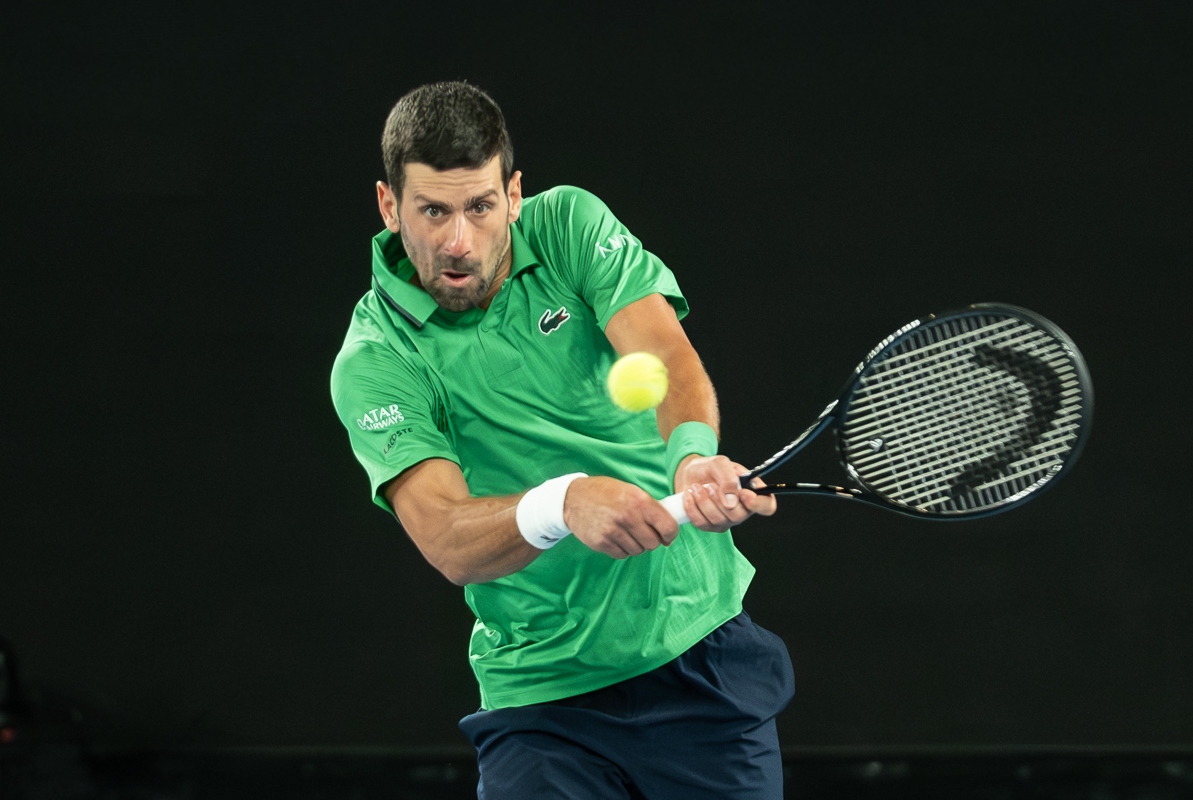
Novak Djokovic turned 39 in Paris on Friday and admitted, with the kind of candour that has crept into his press conferences in the second half of his career, that he had not been sure he would be at Roland Garros at all. “Not kind of how I imagined my birthday to go,” the Serbian said of the day, spent fielding questions about a body that has only fitfully allowed him to play tennis in 2026.
The numbers behind that admission are stark. Since losing the Australian Open final to Carlos Alcaraz in January, Djokovic has contested two tournaments. Indian Wells in March, where Jack Draper beat him in the fourth round. Rome two weeks ago, where the 20-year-old qualifier Dino Prizmic beat him in his opening match. Between them, nine weeks of rehabilitation, withdrawals from Miami, Monte Carlo, Madrid and Geneva, and a body Djokovic said simply would not allow him to compete.
“I wanted to play more, but my body was not allowing me,” he said. “I was going through rehabilitation process for my injury. So after Indian Wells, it was just not possible for me to compete for several months.”
Rome as a probation. Djokovic was open about why he travelled to the Foro Italico at all. It was not a competitive entry. He arrived with visible taping on his right shoulder and lost in three sets after winning the first 6-2. The point, he said, was to have one match under his belt before Paris. “I really wanted to go to Rome to give it a shot and try and see how I feel. I was far from being ready to compete, but still, I needed at least that one match just to have the score called by chair umpire and have experience of the nerves before I eventually come to Roland Garros, which at that point I didn’t know if I was going to be able to play or not.”
The last ten days, practising in Athens and then in Paris, have been encouraging enough that the three-time Roland Garros champion is willing to commit to starting the tournament. He is less willing to commit to anything beyond that. “Lots of hours spent on the court and trying to perfect the game and the body and enable myself physically and game-wise to be ready for best-of-five. Let’s see. I don’t know whether that’s going to be the case for the entire tournament, however long that tournament will be for me.”
The draw he has been handed. Djokovic, the third seed in the absence of the injured Alcaraz, opens on Sunday against the home favourite Giovanni Mpetshi Perricard. A second-round meeting with either Valentin Royer or a qualifier is projected, with the Brazilian Joao Fonseca looming in the third round and the Rome finalist Casper Ruud in the fourth. Sinner and Djokovic, by the geometry of the bracket, cannot meet before the final.
Asked whether the absence of Alcaraz, who has beaten him in their last two Slam meetings, altered his outlook, Djokovic declined to take the bait. “He’s a two-time defending champion of Roland Garros. Of course it’s a big blow for the tournament not to have him.” His own circumstances, he said, had occupied his thinking for the past six to eight months in a way that left little room for hypotheticals about other players.
The argument for hope. What Djokovic returns to, again and again, is freshness. The career that has produced 24 Grand Slam titles and a record 40 Masters 1000 trophies has lately been organised around the idea that if his body holds, his tennis can still meet the moment. Melbourne in January, where he beat Sinner in the semi-final before Alcaraz overcame him in four sets, is the evidence he cites. “If I’m healthy and I’m able to maintain that level of freshness throughout the tournament — that obviously will not be the same at the beginning like it is towards the end of the tournament, but if I’m able to somehow maintain that level of freshness and progress, then I feel like I have always a very good chance. I have proven that in Australia this year where I was close to win another slam.”
It is, on its face, a thinner argument than the one he was making at this stage a year ago. The schedule he has played is the lightest of his career on the eve of a major. But Djokovic, who plays his 22nd Roland Garros this fortnight in pursuit of a 25th Grand Slam title, has built a career on the assumption that the maths only has to work for two weeks at a time.
On Sunday, on Philippe Chatrier, against Mpetshi Perricard, the maths starts again.